

Normal Computing
A specialized platform for high-stakes enterprise AI that uses probabilistic logic to quantify uncertainty—essential for mission-critical engineering and finance, but overkill for standard generative tasks.
Excellent for reliability-first engineering and financial modeling, weaker for general-purpose chatbot deployment.
Analysis based on product data, pricing structure, traffic signals, and public user sentiment.
Who Should Use Normal Computing?
Typical users
R&D engineers, quantitative researchers, and systems architects in semiconductors, aerospace, or finance who require verifiable AI outputs.
Maturity fit
advanced
Choose this if…
- Your priority is quantifying model uncertainty over raw creative output
- You operate in a regulated industry where 'hallucinations' carry significant financial or safety risks
- You need to integrate LLMs with complex physical simulations or symbolic reasoning
Skip this if…
- You need a simple plug-and-play wrapper for basic customer support bots
- Your team lacks the mathematical background to interpret probabilistic graphical models
- You require a low-cost, self-service SaaS tool with transparent monthly pricing
About Normal Computing
Normal Computing develops a full-stack platform for probabilistic AI, targeting industries where standard LLMs are too unreliable for production. Founded by former Google Brain and Palantir engineers, the company focuses on 'Thermodynamic AI' to make complex reasoning both scalable and verifiable.
Official profiles
What it actually does
The platform provides tools to build AI systems that can explain their reasoning and quantify how confident they are in a specific answer. It combines large language models with probabilistic programming and specialized hardware acceleration to handle high-stakes decision-making in engineering and finance.
What makes it different
Unlike standard AI platforms that focus on prompt engineering, Normal Computing focuses on the underlying architecture of uncertainty. They are uniquely developing 'Thermodynamic' hardware and software designed to process probabilistic workloads more efficiently than traditional GPUs.
Key Features
Normal SDK
Provides the programmatic interface for building and deploying probabilistic workflows.
Uncertainty Quantification
Assigns a confidence score to every model output to flag potential hallucinations.
Thermodynamic AI
Specialized algorithms designed to solve optimization problems by mimicking physical processes.
Enterprise Reasoning Chains
Structures LLM outputs into logical steps that can be audited by human experts.
Simulation Integration
Connects AI agents directly to high-fidelity engineering simulators for iterative design.
Risk Management Frameworks
Built-in tools for setting safety bounds on autonomous AI actions.
Pricing
Enterprise
- Full access to Normal SDK
- Custom probabilistic model development
- Hardware-accelerated compute options
- Dedicated engineering support
- On-premise or private cloud deployment
Pricing checked 5 months ago
Pricing guidance
- Moving from research to production in a regulated environment
- Requiring hardware acceleration for large-scale probabilistic simulations
- Needing custom integration with proprietary enterprise data silos
- Hardware availability for thermodynamic computing is currently limited to select partners
- Implementation requires significant consulting hours from the vendor
Premium enterprise positioning targeting high-value R&D budgets.
Pros & Cons
Strengths
-
Solves the 'Black Box' problem
By quantifying uncertainty, it allows engineers to see exactly where a model is guessing, which is critical for safety-critical applications.
-
High-fidelity reasoning
Better suited for complex math and logic-heavy tasks than standard GPT-4 implementations due to its probabilistic grounding.
-
Deep domain expertise
The platform is built specifically for technical sectors like semiconductor manufacturing and quantitative finance, not general consumer use.
Weaknesses
-
High barrier to entry
Requires significant technical expertise in machine learning and probability to implement effectively.
Affects: Small teams without dedicated AI researchers
-
Opaque pricing and access
No self-service signup; requires enterprise sales engagement which slows down the evaluation process.
Affects: Early-stage startups or solo developers
-
Niche ecosystem
Fewer community resources and third-party integrations compared to mainstream frameworks like LangChain or PyTorch.
Affects: Developers looking for quick community support
Real User Sentiment
Generally positive among technical experts who view it as a necessary evolution for AI in 'real-world' engineering, though it is seen as highly academic.
Users tend to like
- Focus on uncertainty quantification
- Technical depth of the founding team
- Potential for thermodynamic hardware to reduce energy costs
Users commonly complain about
- Lack of public documentation
- High complexity for non-PhD users
- Long lead times for enterprise deployment
Recurring tradeoffs
- Users trade ease-of-use and rapid deployment for extreme reliability and auditability.
Happiest users
Research leads at Fortune 500 engineering firms who have been burned by LLM hallucinations.
Often frustrated
Product managers looking for a quick AI feature to add to a consumer app.
Use Cases
Semiconductor Design
Using probabilistic AI to optimize chip layouts while accounting for manufacturing variances.
Quantitative Finance
Building risk models that can quantify the probability of 'tail-risk' events in volatile markets.
Supply Chain Optimization
Managing complex logistics where uncertainty in lead times and demand must be modeled explicitly.
Aerospace Engineering
Integrating AI agents into flight simulation workflows where safety verification is mandatory.
Autonomous Systems
Developing decision-making logic for robots that must pause and ask for help when uncertainty exceeds a threshold.
Frequently Asked Questions
How much does Normal Computing cost?
Pricing is not public. It is an enterprise-only tool that requires a consultation with their sales team. Expect pricing to be in the high five-to-six-figure range annually, depending on compute needs and support.
Is Normal Computing better than OpenAI for enterprise?
It is not 'better' in a general sense, but it is more specialized. While OpenAI's GPT-4 is superior for creative writing and general tasks, Normal Computing is better for tasks requiring mathematical reliability and uncertainty quantification.
What is Thermodynamic AI?
It is a new computing paradigm Normal Computing is developing that uses the physics of thermodynamics to perform probabilistic calculations. It aims to be much faster and more energy-efficient than GPUs for specific types of AI reasoning.
Does it integrate with existing tools?
The platform is designed to integrate with standard enterprise stacks and engineering simulators, but it requires custom implementation via the Normal SDK rather than one-click connectors.
Can I use it to stop LLM hallucinations?
Yes, that is its primary purpose. It uses probabilistic logic to identify when a model is likely to be hallucinating and provides a confidence score so you can filter out unreliable answers.
Is there a trial version available?
No, there is currently no self-service trial. Interested organizations must contact Normal Computing for a demo and potential pilot program.
Why trust this page?
This evaluation combines product positioning, pricing analysis, traffic and market signals, and public user sentiment into a single decision-support page. Content is generated editorially — not copied from the vendor's website.
Funding & Company
Founded
2022
Stage
Series b
Total Raised
$85M
Latest Round
Series B (Mar 2026)
Notable Investors
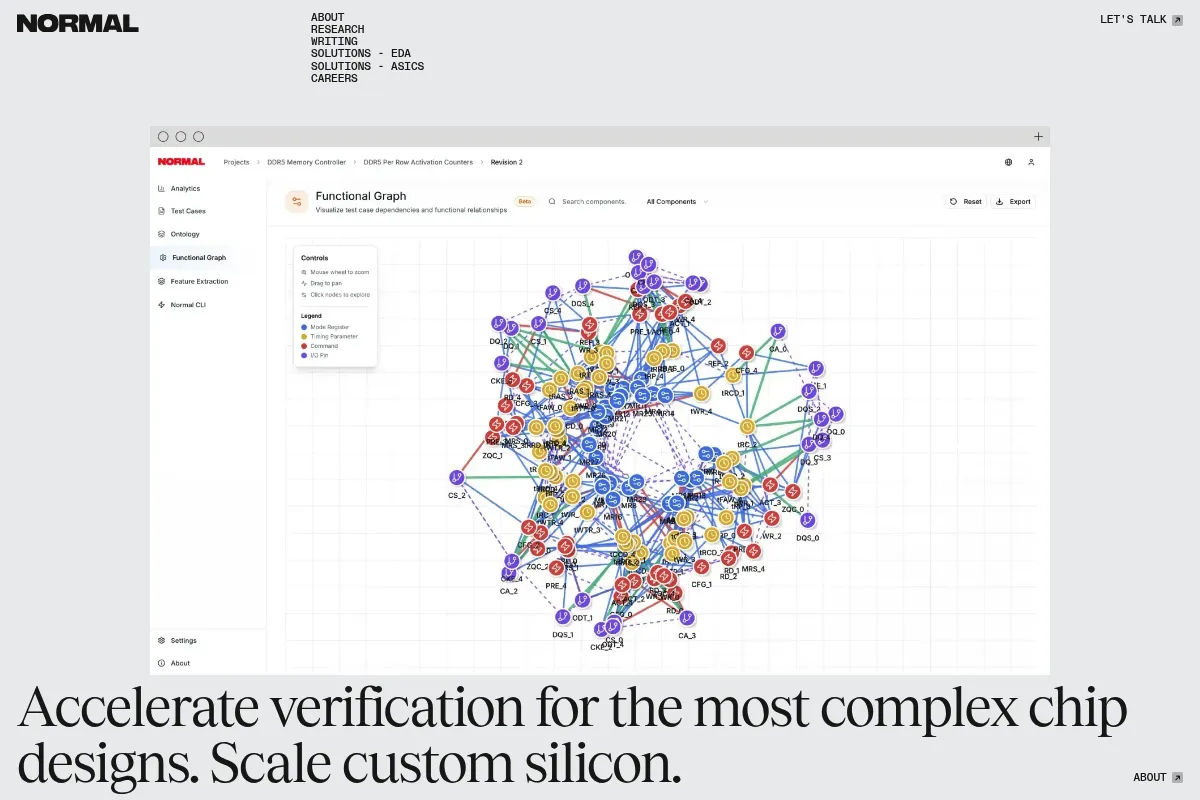
Normal Computing has raised a total of $85 million across two significant rounds, including a $50 million Series B in March 2026 led by Samsung's venture arm. This substantial backing from strategic and financial investors indicates strong confidence in its dual approach of building AI-powered chip design software and developing novel, energy-efficient processors.
Market Signals & Traffic
Estimated visits, global rank, geography, traffic sources, monthly visit trends, and organic search keywords (Similarweb)—on a dedicated page built for depth and search.
- Estimated visits
- 0
- Global rank
- —
- Snapshot
- Apr 2026
- Traffic trend
- —
Estimated monthly visits
Alternatives to Normal Computing
View all alternativesAmazon CodeWhisperer
Developer Tools

AI-powered coding companion that generates code recommendations.
Extropic
Developer Tools, Research

Thermodynamic computing platform for high-performance and energy-efficient generative models.
Similar Tools
Comet
Developer Tools, Research, Automation & Agents

MLOps platform for experiment tracking and model evaluation
Sierra AI
AI Assistant, Automation

AI platform for building autonomous customer support agents.
Reflection
AI Assistant, Developer Tools, Research

Open-source language model that corrects its own reasoning errors.
Cognition
Developer Tools, Automation & Agents

Autonomous software engineer that plans and executes complex coding tasks.
AI21 Labs
Developer Tools, AI Assistant, Content Creation

Foundation models and developer tools for building language-based applications.
CVector
Automation & Agents, Developer Tools, Workflow

Build and deploy autonomous agents with advanced tool-use capabilities.