

Avantos
An AI-native workflow engine that uses autonomous agents to execute multi-step business processes across disconnected SaaS tools, best suited for operations teams moving beyond simple trigger-action automation.
Excellent for automating complex, logic-heavy back-office operations, but overkill for simple task-syncing between apps.
Analysis based on product data, pricing structure, traffic signals, and public user sentiment.
Who Should Use Avantos?
Typical users
Operations managers, HR leaders, and finance teams at mid-market to enterprise companies who manage high-volume, manual administrative workflows.
Maturity fit
scaling to advanced
Choose this if…
- Your workflows require reasoning and decision-making, not just data mapping
- You need agents that can navigate UI elements in legacy software without APIs
- You want to consolidate fragmented manual tasks into a single autonomous 'digital worker'
Skip this if…
- You only need to sync data between two modern apps with native integrations
- Your budget is tight and you prefer a self-serve, low-cost tool like Zapier
- You lack the internal process documentation required to train an agent effectively
About Avantos
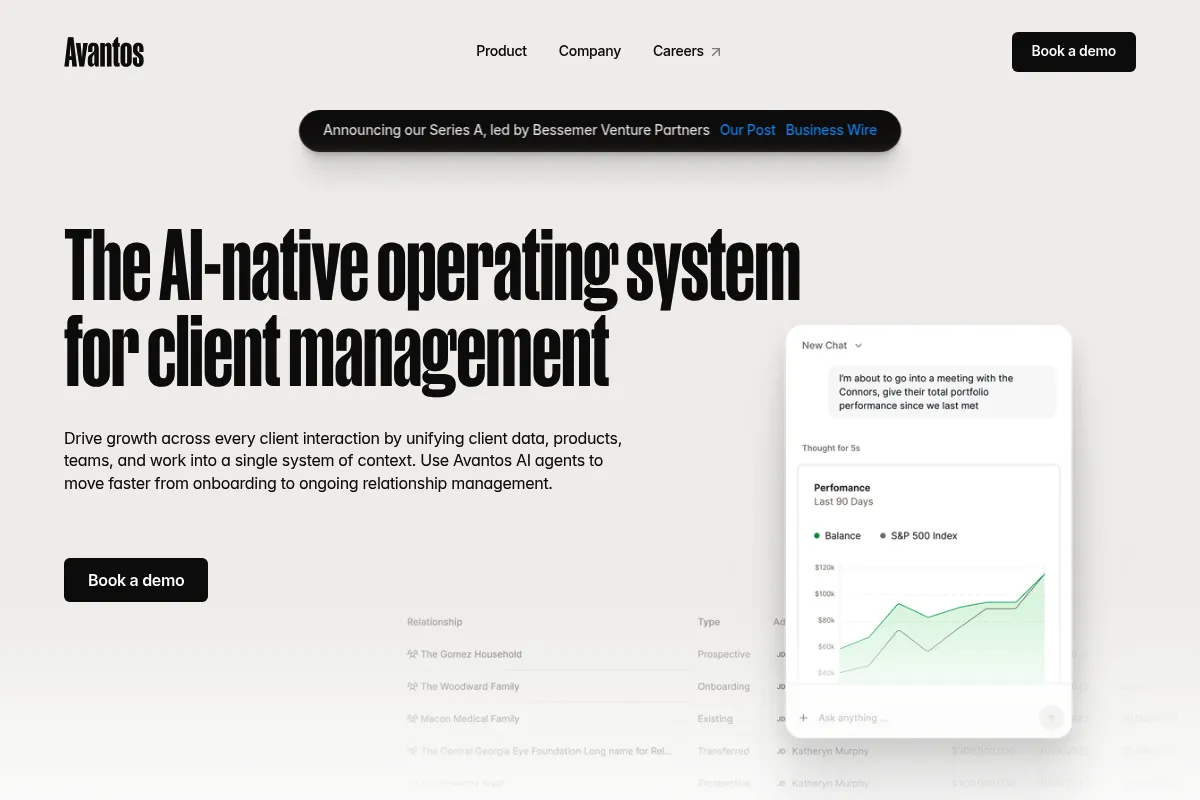
Avantos is an AI-native operating system designed to replace manual business processes with autonomous agents. It targets the 'messy middle' of operations where human intervention is usually required to bridge gaps between different software platforms.
Official profiles
What it actually does
The platform deploys agents that can read, reason, and act across various software interfaces. It handles end-to-end workflows like employee onboarding, invoice reconciliation, or lead enrichment by mimicking human decision-making and navigation.
What makes it different
Unlike traditional RPA which relies on rigid scripts, Avantos uses LLM-based reasoning to handle variability in data and UI. It focuses on 'agentic' workflows that can self-correct and ask for human input only when a high-confidence threshold isn't met.
Key Features
Autonomous Agents
Executes tasks by navigating software interfaces like a human user.
Human-in-the-Loop (HITL)
Pauses workflows for human approval or clarification on edge cases.
Dynamic Reasoning
Adapts to changes in UI or data formats without breaking the automation.
Process Discovery
Helps identify and map manual steps into automated sequences.
Enterprise Security
Includes SOC2 compliance and data encryption for sensitive operations.
Multi-App Orchestration
Coordinates actions across HRIS, CRM, and Finance stacks simultaneously.
Pricing
Enterprise
- Custom agent deployment
- Unlimited workflow steps
- Dedicated account management
- SOC2 compliance
- Custom integrations
Pricing checked 4 months ago
Pricing guidance
- When manual back-office tasks exceed 20+ hours per week
- When existing RPA or Zapier workflows become too brittle to maintain
- When scaling headcount specifically for data entry or administrative roles
- Implementation time can take weeks depending on process complexity
- Agent 'runs' or tokens may be capped based on the custom agreement
Premium enterprise positioning aimed at replacing high-cost manual labor with digital workers.
Pros & Cons
Strengths
-
Handles non-API workflows
Because the agents can interact with UIs, you can automate legacy systems or niche tools that don't have Zapier or Make connectors.
-
Reduces 'babysitting' time
The reasoning engine handles minor errors or data inconsistencies that would typically cause traditional automation tools to fail.
-
Centralized operations hub
Provides a single pane of glass to monitor various autonomous workers across different departments.
Weaknesses
-
High barrier to entry
Setting up autonomous agents requires a deep understanding of your own internal processes and clear documentation.
Affects: Small teams without dedicated Ops roles
-
Opaque pricing
Lack of public pricing makes it difficult for smaller companies to evaluate ROI without a lengthy sales cycle.
Affects: Startups and SMBs
-
Potential for 'hallucination' errors
While the reasoning is a strength, LLM-based agents can occasionally misinterpret complex instructions if not strictly constrained.
Affects: Finance and Compliance teams
Real User Sentiment
Generally positive among early enterprise adopters who are looking to move beyond the limitations of traditional RPA.
Users tend to like
- Ability to handle complex logic
- Reduction in manual data entry
- Professional implementation support
Users commonly complain about
- Steep learning curve for configuration
- Lack of self-serve onboarding
- High cost compared to simple automation tools
Recurring tradeoffs
- Users trade the simplicity of 'if-this-then-that' for the power of autonomous reasoning, which requires more trust in the AI.
Happiest users
Operations leaders at 200+ person companies with standardized but manual back-office processes.
Often frustrated
Solo founders or very small teams looking for a quick, cheap 'plug-and-play' automation fix.
Use Cases
Employee Onboarding
Automatically provisioning accounts, sending documents, and updating HRIS systems.
Invoice Processing
Extracting data from varied invoice formats and entering it into ERP software.
Lead Enrichment
Researching new signups across LinkedIn and company websites to update CRM records.
Customer Support Triage
Categorizing complex tickets and drafting responses based on internal documentation.
Compliance Auditing
Periodically checking user permissions across multiple SaaS tools against a master list.
Frequently Asked Questions
How much does Avantos cost?
Avantos does not publish fixed pricing. It is an enterprise-grade tool where pricing is determined by the complexity of the workflows and the number of agents deployed. You must book a demo to get a quote.
How does Avantos compare to Zapier?
Zapier is best for simple, linear triggers (e.g., 'When I get an email, save the attachment'). Avantos is for complex, multi-step processes that require reasoning (e.g., 'Review this invoice, check it against our budget in Excel, and if it matches, enter it into our legacy accounting software').
Is Avantos an RPA tool?
It is often called 'AI-native RPA.' Traditional RPA (like UiPath) uses rigid scripts that break when a button moves 5 pixels. Avantos uses AI to understand the page, making it much more resilient to UI changes.
Does it require coding knowledge?
While it is designed to be low-code/no-code for the end user, setting up complex autonomous agents often requires a technical mindset to define the logic and 'guardrails' correctly.
What integrations does Avantos support?
It supports standard API integrations for modern SaaS (Salesforce, Slack, etc.) but its standout feature is the ability to interact with any web-based application through browser-based agents, even if no API exists.
Is my data safe with Avantos?
Avantos is built for the enterprise and emphasizes security, including SOC2 compliance. They offer features to ensure sensitive data is handled according to corporate governance standards.
Why trust this page?
This evaluation combines product positioning, pricing analysis, traffic and market signals, and public user sentiment into a single decision-support page. Content is generated editorially — not copied from the vendor's website.
Funding & Company
Founded
2024
Stage
Series a
Total Raised
$35M
Latest Round
Series A (Feb 2026)
Notable Investors
Avantos has raised a total of $35 million across two rounds, including a $25 million Series A in February 2026 led by Bessemer Venture Partners. [1, 3, 4] This recent and substantial funding from a top-tier VC firm, along with strategic investment from clients like Vanguard and SEI, signals strong market validation and provides significant operational runway.
Market Signals & Traffic
Estimated visits, global rank, geography, traffic sources, monthly visit trends, and organic search keywords (Similarweb)—on a dedicated page built for depth and search.
- Estimated visits
- 25,506
- Global rank
- #997,345
- Snapshot
- Apr 2026
- Traffic trend
- Surging
Estimated monthly visits
Alternatives to Avantos
View all alternatives

Similar Tools
FurtherAI
Automation & Agents, Workflow, Productivity

Workflow automation platform for the commercial insurance industry
Mammouth AI
Automation & Agents, Workflow, Productivity

Build and deploy autonomous agents for complex workflow automation
Flowhunt
Automation & Agents, Workflow, Productivity

Visual platform for building custom automation workflows and agents
Imbue
Automation & Agents, Developer Tools, AI Assistant

Developing AI agents capable of reasoning and coding.
AWeber
Email Marketing, Marketing Automation, Automation

Email marketing and automation platform for small businesses and creators
Alpha Drive AI
Developer Tools, Research, Automation

Cloud-based testing and validation platform for autonomous driving algorithms.