

Boundary
A domain-specific language that treats prompts as compiled code, offering a superior developer experience for structured LLM extraction compared to standard Python libraries.
Best for teams building complex extraction pipelines who want type safety and a dedicated IDE experience, weaker for those who prefer pure Python or TypeScript without a new syntax.
Analysis based on product data, pricing structure, traffic signals, and public user sentiment.
Who Should Use Boundary?
Typical users
Backend and AI engineers building production-grade LLM applications that require high-reliability structured data.
Maturity fit
scaling to advanced
Choose this if…
- You want to separate prompt logic from application code
- Your priority is a fast feedback loop between prompt changes and schema validation
- You need type-safe LLM outputs in Python, TypeScript, or Ruby
Skip this if…
- You are unwilling to add a new domain-specific language (DSL) to your stack
- Your extraction needs are simple enough for basic Pydantic or JSON mode
- Your team is strictly limited to pure-Python or pure-JS environments without custom compilers
About Boundary
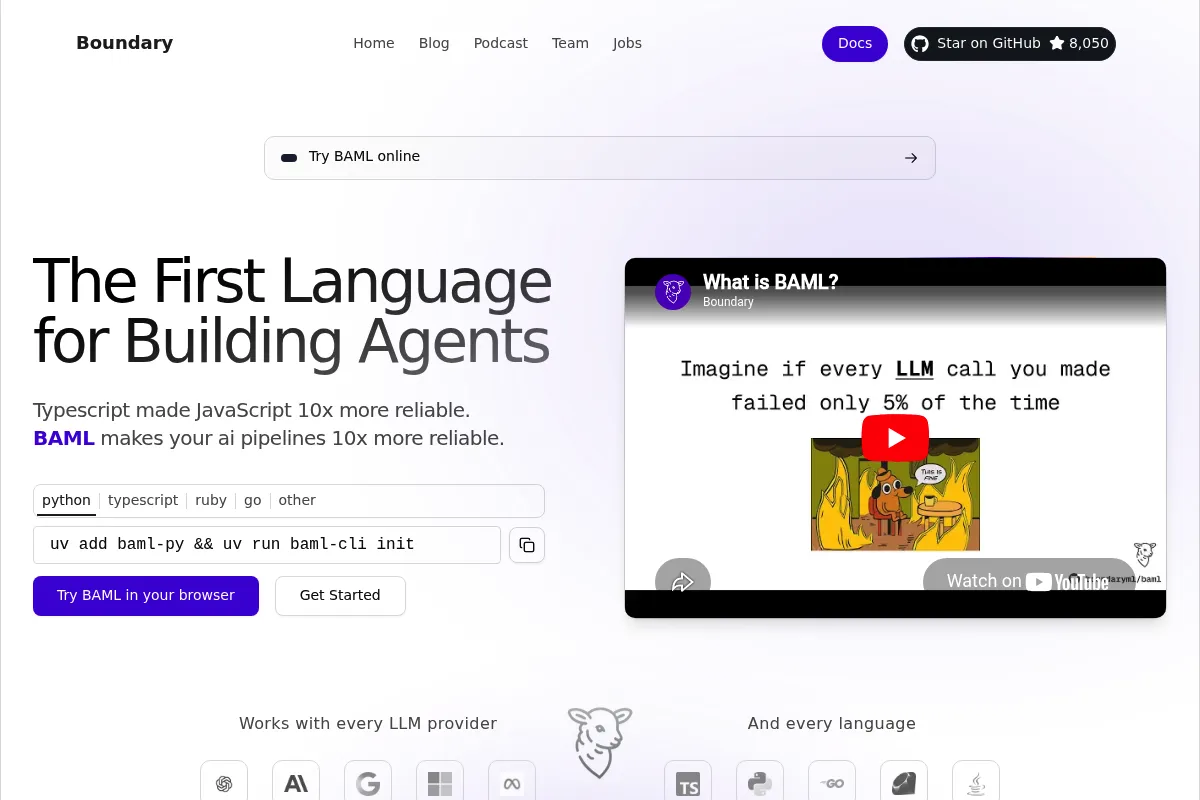
Boundary is the company behind BAML, a programming language designed specifically for prompting LLMs. It moves prompt engineering out of raw strings and into a structured, compiled environment that generates type-safe clients for your primary application code.
Official profiles
What it actually does
It allows developers to define LLM functions, schemas, and prompts in .baml files. These files are compiled into native Python or TypeScript code, providing full IDE support, autocompletion, and real-time testing for LLM outputs.
What makes it different
Unlike libraries like Instructor or Marvin that work within existing languages, BAML is a standalone DSL. This allows for a VS Code extension that provides a live preview of prompts and instant testing against real LLM providers without leaving the editor.
Key Features
VS Code Extension
Provides a playground-like experience directly in your IDE with real-time output previews.
BAML Compiler
Turns your prompt definitions into native, type-safe functions in your target language.
Schema-First Design
Ensures the LLM output strictly matches your defined data structures before it reaches your app logic.
Boundary Cloud
A hosted dashboard for monitoring, versioning, and analyzing LLM traces in production.
Jinja-like Templating
Allows for logic-heavy prompts using a familiar syntax for loops and conditionals.
Native Testing
Define test cases in BAML to verify prompt performance across different models instantly.
Pricing
BAML (Open Source)
- BAML Language and Compiler
- VS Code Extension
- Python, TS, and Ruby clients
- Local testing framework
Boundary Cloud (Free)
- Up to 1,000 traces per month
- 7-day data retention
- Basic observability dashboard
- Community support
Boundary Cloud (Pro)
- Unlimited traces
- 30-day data retention
- Team collaboration tools
- Advanced analytics
- Priority support
Enterprise
- Self-hosting options
- Unlimited retention
- SSO/SAML
- Custom SLAs
Pricing checked 6 months ago
Pricing guidance
- When you need to share LLM traces across a team
- When you exceed 1,000 monthly traces in production
- When you require longer retention for debugging production issues
- Cloud features are separate from the core compiler
- Retention on the free cloud tier is very short (7 days)
- Pro pricing is per-seat, which can scale quickly for large engineering teams
Generous open-source core with a premium seat-based model for enterprise-grade observability.
Pros & Cons
Strengths
-
Superior developer loop
The VS Code extension eliminates the need to jump between a web-based playground and your code editor, significantly speeding up prompt iteration.
-
Strict type safety
By generating code from a DSL, it catches schema mismatches at compile time rather than runtime, reducing production errors.
-
Clean code separation
Keeps long, messy prompt strings out of your main application logic, making the codebase easier to read and maintain.
Weaknesses
-
New language overhead
Teams must learn BAML syntax and manage a new file type (.baml), which adds friction to the onboarding process.
Affects: New developers and small teams
-
Tooling dependency
The best parts of the experience are tied to the VS Code extension; developers using other editors will have a significantly degraded experience.
Affects: Vim, JetBrains, or Emacs users
-
Build step complexity
Integrating the BAML compiler into CI/CD pipelines adds another layer of complexity to the deployment process.
Affects: DevOps and Platform Engineers
Real User Sentiment
Highly positive among developers who prioritize DX and type safety, with some hesitation regarding the introduction of a new DSL.
Users tend to like
- The VS Code extension's live preview
- Speed of iteration compared to LangChain
- Clean separation of prompts and code
- High-quality TypeScript support
Users commonly complain about
- Initial friction of learning BAML syntax
- Lack of support for non-VS Code editors
- Documentation can be sparse for edge cases
Recurring tradeoffs
- You gain incredible DX and safety but lose the ability to write 'pure' code in your host language.
Happiest users
TypeScript and Python developers building complex data extraction pipelines who are tired of 'string soup' prompts.
Often frustrated
Developers who want a library they can just 'pip install' and use without a separate compilation step or IDE extension.
Use Cases
Document Parsing
Extracting specific fields from resumes, invoices, or medical records into a database-ready format.
Chatbot Tool Calling
Defining strict schemas for LLMs to use when interacting with external APIs.
Content Categorization
Tagging large volumes of text with predefined enums and nested categories.
Data Cleaning
Transforming messy, unstructured user input into clean, validated JSON.
Synthetic Data Generation
Creating structured datasets that follow a specific schema for testing or training.
Frequently Asked Questions
Is BAML free to use?
Yes, the BAML language, compiler, and VS Code extension are open-source and free. Boundary makes money through its Cloud platform, which provides observability and management tools for production environments starting at $50/user/month.
How does BAML compare to Instructor?
Instructor is a Python/TS library that uses Pydantic/Zod to force LLMs into JSON mode. BAML is a separate language that compiles to Python/TS. BAML offers a better developer experience with its VS Code extension and live previews, whereas Instructor is easier to add to an existing project without new file types.
Do I have to use Boundary Cloud to use BAML?
No. BAML is fully functional as a local tool. You only need Boundary Cloud if you want hosted observability, tracing, and team-based prompt management.
What languages does BAML support?
BAML currently generates type-safe clients for Python, TypeScript, and Ruby. Support for other languages like Go or Java is often requested but not yet standard.
Can I use BAML with any LLM?
Yes, BAML supports major providers like OpenAI, Anthropic, and Azure, as well as any OpenAI-compatible API (like Ollama or vLLM) for local models.
Does BAML work with editors other than VS Code?
While the BAML compiler works via CLI, the 'live preview' and playground features are currently exclusive to the VS Code extension. Users of Vim or JetBrains will miss out on the core DX benefits.
Why trust this page?
This evaluation combines product positioning, pricing analysis, traffic and market signals, and public user sentiment into a single decision-support page. Content is generated editorially — not copied from the vendor's website.
Funding & Company
Founded
2023
Stage
Seed
Total Raised
$1.5M
Latest Round
Seed (May 2023)
Notable Investors
Boundary secured a $1.5M Seed round in May 2023 following its participation in Y Combinator's Winter 2023 batch. This initial funding provides the company with the necessary capital to develop its core product, the BAML programming language, and establish a foothold in the competitive AI developer tool market.
Market Signals & Traffic
Estimated visits, global rank, geography, traffic sources, monthly visit trends, and organic search keywords (Similarweb)—on a dedicated page built for depth and search.
- Estimated visits
- 28,309
- Global rank
- #999,201
- Snapshot
- Apr 2026
- Traffic trend
- Falling
Estimated monthly visits
Similar Tools
Instructor
Developer Tools, Data Extraction

Extract structured data from large language models using Pydantic.
Cosine
Developer Tools, Documentation

Semantic code search and codebase understanding for developers
Taipy
Developer Tools, Workflow, Automation

Python library for building production-ready data and AI applications.
Pyramid Flow
Video Creation, Developer Tools, Content Creation

Generate high-resolution videos from text and image prompts efficiently.
Milvus
Developer Tools, Search

Open-source vector database for high-performance similarity search and RAG.
Arthur
Developer Tools, Privacy & Compliance

Observability and governance platform for machine learning models.