

Brickanta
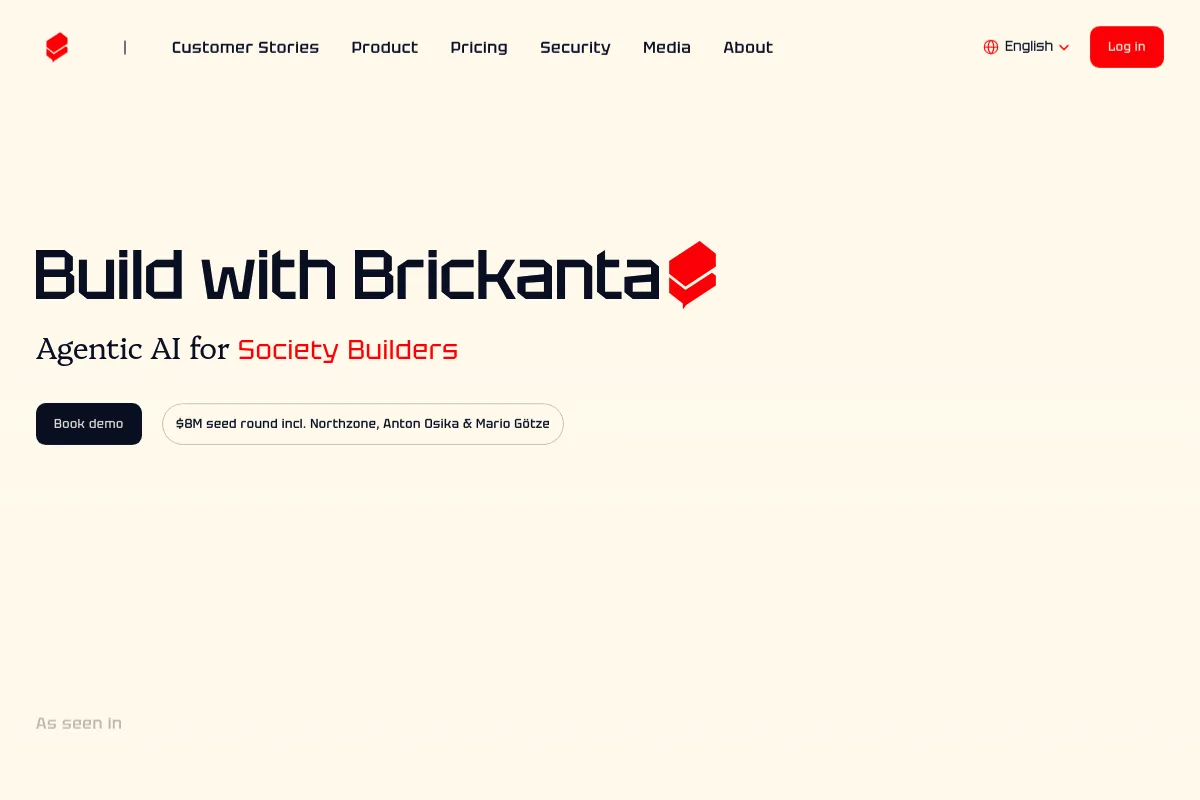
An agentic AI platform that automates the manual drudgery of pre-construction—specifically quantity takeoffs, risk identification, and bid leveling—to help contractors bid faster and more accurately.
Excellent for mid-to-large contractors needing to scale their bidding volume, weaker for firms looking for an all-in-one on-site project management suite.
Analysis based on product data, pricing structure, traffic signals, and public user sentiment.
Who Should Use Brickanta?
Typical users
Estimators, pre-construction managers, and quantity surveyors at mid-sized to large general contracting or subcontracting firms.
Maturity fit
scaling
Choose this if…
- Your team is bottlenecked by manual quantity takeoffs and document review.
- You want to identify discrepancies between blueprints and specifications before they become costly change orders.
- Your priority is increasing the volume of bids you submit without increasing headcount.
Skip this if…
- You handle small-scale residential projects where manual estimation is fast enough.
- You need a tool primarily for field execution, daily logs, or safety management.
- Your workflow requires a low-cost, self-service tool with transparent public pricing.
About Brickanta
Brickanta is an AI-native platform built to automate the pre-construction lifecycle. It uses specialized agents to parse complex construction documents, extract data, and manage the procurement process. It exists to solve the high-error, high-effort nature of manual construction estimation.
What it actually does
The platform analyzes project drawings and specifications to automatically generate quantity takeoffs and identify project risks. It also streamlines the tendering process by automating subcontractor outreach and comparing incoming bids side-by-side.
What makes it different
Unlike traditional takeoff software that acts as a digital ruler, Brickanta uses agentic AI to interpret the context of documents. It specifically looks for 'gaps'—conflicts between what is drawn and what is written—which are the primary sources of risk in construction bidding.
Key Features
Agentic Document Processing
Interprets messy PDFs and blueprints to extract structured data without manual tagging.
Automated Takeoffs
Calculates material quantities directly from drawings to reduce the time spent on manual measurements.
Risk Detection
Flags missing information or conflicting requirements between different project documents.
Bid Leveling
Normalizes subcontractor quotes to allow for an apples-to-apples comparison of costs and scopes.
Historical Benchmarking
Compares current estimates against past project performance to ensure pricing accuracy.
Tender Automation
Generates and distributes bid packages to subcontractors based on project requirements.
Pricing
Contact Sales
- AI-powered quantity takeoffs
- Document risk analysis
- Bid leveling and procurement
- Historical data integration
- Dedicated support
Pricing checked 4 months ago
Pricing guidance
- When moving from a single-project pilot to firm-wide adoption
- When project volume exceeds initial contract limits
- When requiring deeper integration with existing ERP systems
- Project volume caps may apply
- Storage limits for large-scale historical document archives
- Seat-based licensing for larger estimation teams
Premium enterprise positioning aimed at professional construction firms with significant project pipelines.
Pros & Cons
Strengths
-
Significant reduction in manual takeoff time
By automating the measurement and counting process, estimators can focus on strategy and pricing rather than clicking on drawings.
-
Early risk identification
The AI's ability to cross-reference specs and drawings helps catch errors that lead to budget overruns during construction.
-
Improved bid accuracy
Using historical data and automated extraction reduces the human error inherent in manual data entry and spreadsheet calculations.
Weaknesses
-
Opaque pricing model
The lack of public pricing requires a sales engagement, which slows down the evaluation process for smaller firms.
Affects: Small subcontractors and independent estimators
-
Verification overhead
While the AI is fast, high-stakes bids still require a human-in-the-loop to verify the AI's interpretations of complex drawings.
Affects: Estimators on high-liability projects
-
Narrow functional scope
It is a specialized pre-construction tool; it does not handle project scheduling, field reporting, or financial accounting.
Affects: Firms looking for a single platform to manage the entire project lifecycle
Real User Sentiment
Users generally view Brickanta as a high-efficiency tool for the bidding phase, though it is still seen as a specialized addition to a tech stack rather than a replacement for core ERPs.
Users tend to like
- Speed of generating initial takeoffs
- Ability to find 'hidden' requirements in long spec documents
- Clean interface for comparing subcontractor bids
Users commonly complain about
- Learning curve for the AI's specific document interpretation logic
- Need for manual verification on non-standard architectural symbols
- Lack of public pricing transparency
Recurring tradeoffs
- Users trade the control of manual clicking for the speed of AI, requiring a shift in the estimator's role to 'auditor'.
Happiest users
Mid-sized general contractors who bid on 50+ projects a year and need to filter through thousands of pages of documentation.
Often frustrated
Small residential builders who find the setup and cost of an enterprise AI tool overkill for simple projects.
Use Cases
General Contractor
Automating the creation of a bid package for a $20M commercial office build.
Subcontractor
Quickly extracting linear footage and counts for electrical or plumbing bids across multiple projects.
Pre-construction Manager
Auditing a set of 500+ blueprints to find conflicting specifications before finalizing a GMP.
Quantity Surveyor
Using historical project data to benchmark a new estimate against similar past builds.
Procurement Officer
Leveling five different subcontractor bids to identify the most complete and cost-effective quote.
Frequently Asked Questions
How much does Brickanta cost?
Brickanta does not publish its pricing. It follows an enterprise sales model where pricing is customized based on your firm's size, project volume, and specific feature needs. You must book a demo to receive a quote.
How does Brickanta compare to Procore?
Procore is a broad project management platform that handles everything from field logs to financials. Brickanta is a specialized agentic AI tool focused specifically on the pre-construction phase. Many firms use Brickanta to feed data into Procore rather than choosing one over the other.
Can Brickanta read handwritten notes on blueprints?
While the AI is highly capable with standard digital text and symbols, its accuracy with handwritten notes varies. It is best used with digital-first PDFs and CAD-exported drawings for maximum reliability.
Does it support international construction standards?
Yes, the AI agents can be configured to recognize different measurement units (metric/imperial) and regional specification formats commonly used in North America, Europe, and Australia.
What file formats does Brickanta support?
It primarily supports PDF, which is the industry standard for blueprints and specs, but it can also process common image formats and structured data from Excel for historical cost analysis.
Is there a free trial available?
There is no self-service free trial. Brickanta typically offers guided pilots for qualified firms to test the platform on a real project before committing to a full annual license.
Why trust this page?
This evaluation combines product positioning, pricing analysis, traffic and market signals, and public user sentiment into a single decision-support page. Content is generated editorially — not copied from the vendor's website.
Funding & Company
Founded
2025
Stage
Seed
Total Raised
$8.5M
Latest Round
Seed (Jan 2026)
Notable Investors
Brickanta has raised a total of $8.5M, including a significant $8M Seed round in January 2026 led by top-tier VC firm Northzone. This follows its participation in the Y Combinator accelerator, providing a strong financial runway to develop its AI platform for the construction industry.
Market Signals & Traffic
Estimated visits, global rank, geography, traffic sources, monthly visit trends, and organic search keywords (Similarweb)—on a dedicated page built for depth and search.
- Estimated visits
- 5,765
- Global rank
- #3,152,477
- Snapshot
- Apr 2026
- Traffic trend
- Falling
Estimated monthly visits
Alternatives to Brickanta
View all alternatives
Similar Tools
Adept
Automation & Agents, Productivity, Workflow

Automate complex workflows across any software tool or website
Mercor
Automation & Agents, Productivity, Workflow

Automated platform for vetting and hiring global software engineers.
Simplai
Automation & Agents, Productivity, Workflow

Automate business workflows and manage communications with intelligent agents.
Bretton
Automation & Agents, Productivity, Workflow

Currency risk management platform for international businesses.
Braintrust
Automation & Agents, Productivity, Workflow

Decentralized talent network and autonomous recruitment platform for hiring.
Arahi AI
Privacy & Compliance, Workflow

Governance and risk management platform for enterprise deployments.