

A data orchestration layer that replaces manual prospecting by chaining 75+ enrichment sources and AI research into a programmable spreadsheet.
Excellent for high-growth outbound teams needing deep lead personalization, weaker for teams looking for a simple, all-in-one CRM or email sequencer.
Analysis based on product data, pricing structure, traffic signals, and public user sentiment.
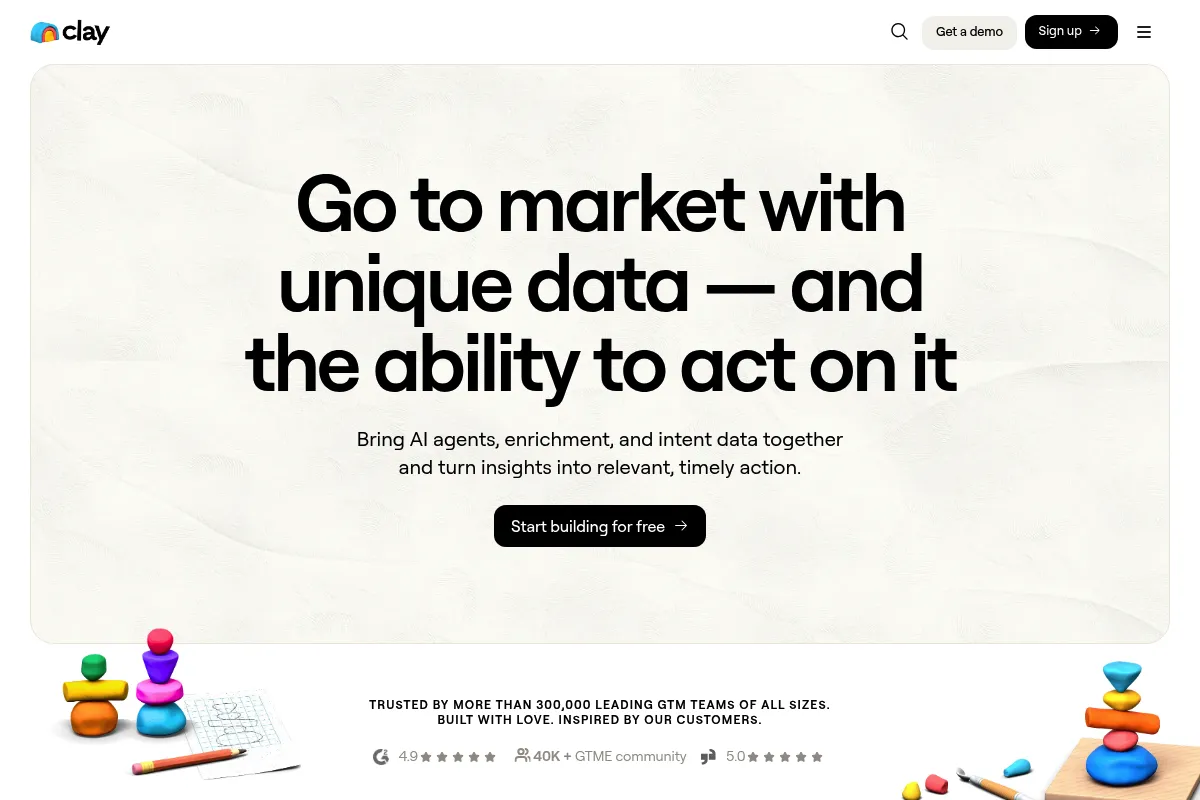
Who Should Use Clay?
Typical users
Growth engineers, SDR managers, and founders at B2B startups who have outgrown basic database filters.
Maturity fit
scaling to advanced
Choose this if…
- You need to combine data from multiple providers (e.g., Apollo, Hunter, and LinkedIn) without manual CSV merging.
- Your outbound strategy relies on niche triggers that require AI web scraping or deep research.
- You want to automate the 'Virtual Assistant' layer of your prospecting workflow.
Skip this if…
- You need a built-in email sending tool; Clay prepares data but doesn't execute sequences.
- You have a low volume of leads and can't justify a $149/month starting price.
- You prefer a simple, guided UI over a flexible but complex spreadsheet-style interface.
About Clay
Clay is a sales automation and data enrichment platform that functions as a logic engine for GTM teams. It aggregates dozens of third-party data providers and uses AI agents to perform web research that previously required human intervention. It exists to solve the problem of 'generic outbound' by making deep personalization technically scalable.
Official profiles
What it actually does
Clay connects to over 75 data sources to find emails, phone numbers, and company details. It uses a spreadsheet interface where each row is a lead and each column can be an automated action, such as scraping a website or using AI to summarize a LinkedIn profile.
What makes it different
Unlike static databases like ZoomInfo, Clay is an orchestration layer. Its 'waterfall' logic allows users to automatically try multiple data providers in sequence until a valid email is found, maximizing hit rates while minimizing costs. The inclusion of 'Claygent,' an autonomous AI web researcher, separates it from traditional enrichment tools.
Ratings across the web

Ratings aggregated from independent review platforms.
Key Features
Waterfall Enrichment
Automatically checks multiple databases for contact info to ensure the highest possible find rate.
Claygent
An AI agent that can browse the web to answer specific questions like 'Does this company mention SOC2 on their site?'
75+ Native Integrations
Connects directly to tools like Apollo, Lusha, and PredictLeads without needing Zapier.
AI Writing Assistant
Uses specific lead data points to draft personalized opening lines for outbound emails.
Import from LinkedIn
Scrapes search results or individual profiles directly into a workspace.
Source Agnostic
Users can bring their own API keys for various services or use Clay's built-in credits.
Webhooks and API
Allows developers to push data into Clay from external apps or trigger workflows programmatically.
Pricing
Free
- 100 credits per month
- Access to all 75+ providers
- Unlimited users
- Basic support
Starter
- 2,000 credits per month
- Unlimited users
- All data providers
- Standard support
Explorer
- 10,000 credits per month
- Advanced AI capabilities
- Priority support
- Early access to new features
Pro
- 50,000 credits per month
- Dedicated account manager
- Custom onboarding
- Advanced security features
Pricing checked 6 months ago
Pricing guidance
- When you need to run more than 2,000 enrichments per month.
- When you start using Claygent for web scraping (which is credit-intensive).
- When you need to sync data to premium CRM integrations.
- Some premium data providers cost multiple credits per successful hit.
- Claygent usage is billed based on the complexity of the AI task, not just a flat rate per row.
Premium positioning justified by the massive time savings and the replacement of multiple other software subscriptions.
Pros & Cons
Strengths
-
Consolidated Data Stack
Eliminates the need for separate subscriptions to multiple enrichment tools by providing a single interface for 75+ sources.
-
Superior Data Accuracy
The waterfalling technique significantly increases the likelihood of finding valid work emails compared to using a single provider.
-
Deep Research Automation
Claygent can find information that isn't in any database, such as specific keywords in a job description or recent news mentions.
Weaknesses
-
Steep Learning Curve
The interface is powerful but complex; users often need several hours of training or a consultant to build advanced workflows.
Affects: New users and non-technical sales reps
-
Credit Cost Complexity
Different actions (enrichment vs. AI research) consume credits at different rates, making monthly spend difficult to predict.
Affects: Budget-conscious small teams
-
Performance Lag
Large tables with thousands of rows and multiple AI columns can become slow or unresponsive during processing.
Affects: High-volume growth teams
Real User Sentiment
Users are generally obsessed with the tool's power but frustrated by the complexity of the credit system and the learning curve.
Users tend to like
- The 'waterfall' enrichment logic
- Claygent's ability to scrape specific website data
- The active and helpful Slack community
- The speed of feature releases
Users commonly complain about
- High price point for small teams
- Confusing credit consumption rules
- Occasional UI bugs when handling large datasets
Recurring tradeoffs
- You trade simplicity for power; it is much harder to set up than Apollo but yields better data.
Happiest users
Growth leads at Series A+ startups who have a clear outbound strategy and need to scale it.
Often frustrated
Solo founders looking for a 'quick and easy' way to find a few emails without learning a new platform.
Use Cases
Personalizing at scale
Finding a specific podcast appearance or blog post by a lead to mention in an email.
Hiring-based triggers
Identifying companies that just posted a job for a 'Head of Sales' and enriching the hiring manager's info.
Tech stack targeting
Finding companies that use a specific competitor's software and have a certain headcount.
Local business enrichment
Scraping Google Maps results to find local businesses and then finding the owner's personal email.
CRM Cleanup
Running an existing HubSpot database through Clay to update job titles and verify emails.
Frequently Asked Questions
How does Clay compare to Apollo.io?
Apollo is primarily a database and a sequencer; it's an all-in-one tool that is cheaper but more rigid. Clay is an orchestration layer that can actually pull data *from* Apollo, combine it with other sources, and use AI to research the leads. Most advanced teams use Apollo for their base list and Clay for the enrichment and personalization logic.
Does Clay send emails?
No, Clay is not an Email Service Provider (ESP). It is designed to find and clean data. Once your list is ready in Clay, you export it to a sending tool like Instantly, Smartlead, or your CRM (HubSpot/Salesforce) to actually send the emails.
What are Clay credits and how do they work?
Credits are the currency of the platform. Simple actions like finding an email might cost 1 credit, while using 'Claygent' for AI web research might cost significantly more depending on the task complexity. You can also use your own API keys for services like OpenAI or Hunter to save Clay credits.
Is there a free version of Clay?
Clay offers a free tier with 100 credits per month. This is intended for exploring the features and setting up your first table, but it is not enough for any real-world outbound campaign.
Can Clay scrape LinkedIn?
Yes, Clay has a Chrome extension that allows you to scrape LinkedIn search results, individual profiles, and 'People Also Viewed' sections directly into a Clay table for enrichment.
Does Clay integrate with HubSpot?
Yes, Clay has a native integration with HubSpot. You can set it up to automatically push new leads into HubSpot or pull existing contacts from HubSpot into Clay for enrichment and then sync the updated data back.
Why trust this page?
This evaluation combines product positioning, pricing analysis, traffic and market signals, and public user sentiment into a single decision-support page. Content is generated editorially — not copied from the vendor's website.
Funding & Company
Founded
2017
Stage
Series c
Total Raised
$202M
Latest Round
Series C (Aug 2025)
Notable Investors
Clay has raised a total of $202 million, culminating in a $100 million Series C round in August 2025 led by Alphabet's growth fund, CapitalG. This significant and recent funding from top-tier investors like Sequoia Capital and Meritech Capital provides substantial operational runway. The capital ensures long-term product development and stability for users committing to the platform.
Market Signals & Traffic
Estimated visits, global rank, geography, traffic sources, monthly visit trends, and organic search keywords (Similarweb)—on a dedicated page built for depth and search.
- Estimated visits
- 0
- Global rank
- —
- Snapshot
- May 2026
- Traffic trend
- Steady
Estimated monthly visits
Alternatives to Clay
View all alternatives
Similar Tools
Spider
Data Extraction, Developer Tools, Search

High-performance web crawler for data extraction and LLM training.
StackOne
Developer Tools, Automation, Marketing Automation

Unified API for HRIS, ATS, CRM, and marketing integrations.
Attentive
Email Marketing, Marketing Automation, Communication

SMS and email marketing platform for personalized customer engagement
Airbyte
Data Extraction, Developer Tools, Automation

Open-source data integration platform for building automated ELT pipelines.
Bland AI
AI Assistant, Automation

AI platform for automating inbound and outbound phone calls.
Cursor
AI Assistant
An AI-powered code editor designed to help developers build software faster.