

Coactive
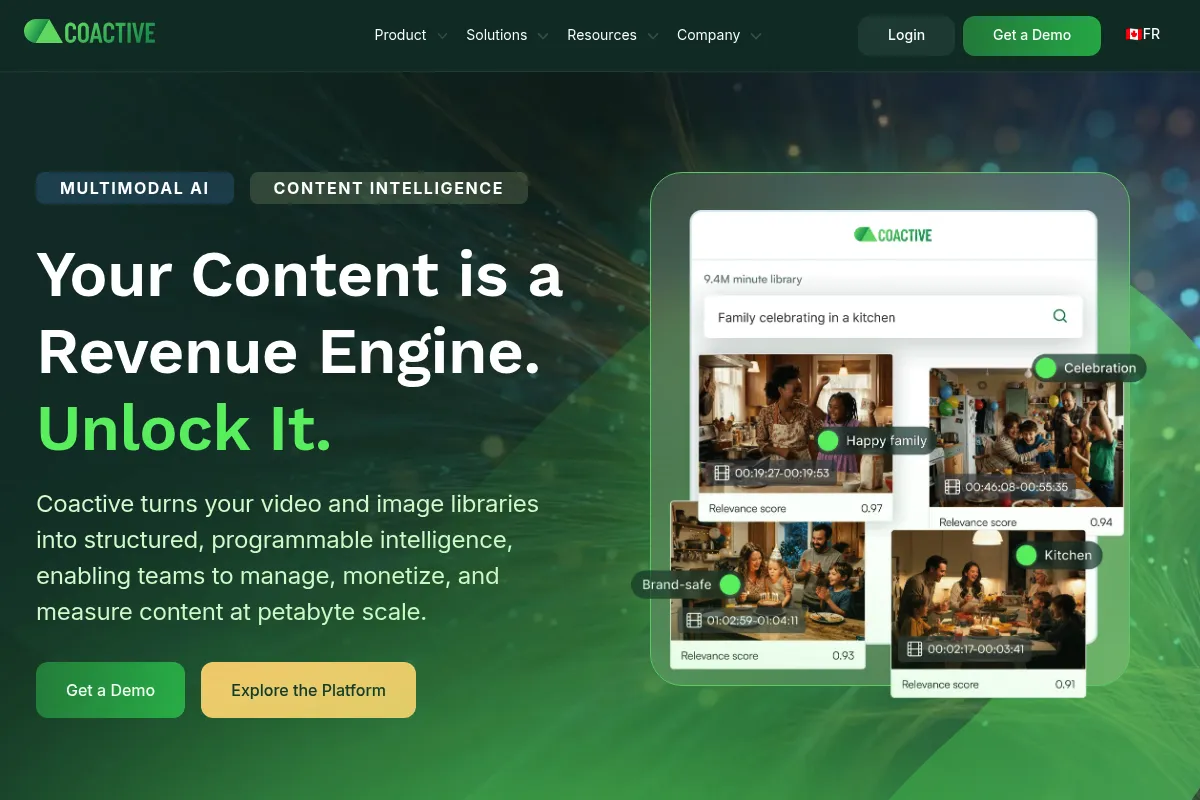
Coactive is a visual data infrastructure layer that indexes unstructured image and video content into a structured format searchable via standard SQL and natural language.
Best for data teams managing petabyte-scale visual datasets who want to query media using SQL, weaker for small teams needing a simple plug-and-play media gallery.
Analysis based on product data, pricing structure, traffic signals, and public user sentiment.
Who Should Use Coactive?
Typical users
Data engineers, ML practitioners, and content moderation teams at mid-to-large enterprises handling massive volumes of unstructured visual data.
Maturity fit
scaling to advanced
Choose this if…
- Your visual data is currently a 'black box' that requires manual labeling to be searchable
- You want to use SQL to join visual metadata with existing relational business data
- You need to curate specific subsets of image/video data for training machine learning models
- Your priority is reducing the time spent on manual data labeling and curation
Skip this if…
- You have a small volume of images that can be managed with basic tags or folders
- You require a consumer-facing front-end for media management rather than a developer-first API
- Your workflow is entirely dependent on pre-built, low-code SaaS integrations
About Coactive
Coactive provides the infrastructure to make visual data as accessible as text-based data. It uses multimodal foundation models to automatically extract metadata from images and videos, allowing users to query unstructured content without manual tagging.
Official profiles
What it actually does
The tool converts visual content into a structured index that resides alongside your existing data stack. Users can perform complex searches using natural language or SQL to find specific objects, actions, or attributes within millions of files in seconds.
What makes it different
Unlike traditional computer vision tools that require training specific models for every new concept, Coactive uses a 'zero-shot' approach via foundation models. Its primary differentiator is the SQL-native interface, which allows data teams to treat images and videos like rows in a database rather than isolated files.
Key Features
SQL Interface
Allows data analysts to query visual data using familiar syntax without learning new languages.
Foundation Model Indexing
Eliminates the need for manual labeling by automatically understanding content context.
Data Warehouse Integration
Connects directly to S3, Snowflake, or Databricks to keep data in place.
Zero-Shot Learning
Enables searching for new concepts or objects immediately without retraining models.
Scalable Vector Search
Handles petabytes of data with low-latency retrieval times.
Metadata Export
Allows users to push extracted visual insights into downstream analytics tools.
Content Moderation API
Identifies and filters sensitive or non-compliant content automatically.
Pricing
Enterprise
- Full SQL and Natural Language search
- Unlimited metadata extraction
- Direct data warehouse integrations
- Dedicated support and implementation
- Custom foundation model fine-tuning
Pricing checked 4 months ago
Pricing guidance
- When manual labeling costs exceed the cost of automation
- When search latency in existing systems becomes a blocker
- When you need to integrate visual data into a centralized SQL-based analytics workflow
- Pricing is likely tied to data volume (GB/TB) or number of objects processed
- Integration complexity may vary depending on the specific cloud storage configuration
Premium enterprise positioning justified by the massive reduction in manual labor and specialized engineering time.
Pros & Cons
Strengths
-
Eliminates manual labeling bottlenecks
By using foundation models to index data, teams can skip months of manual tagging and start querying their data immediately.
-
Bridges the gap between CV and Data Engineering
The SQL support allows standard data teams to work with visual data without needing deep expertise in computer vision or vector embeddings.
-
High scalability
Designed for enterprise-scale workloads where data is measured in petabytes, making it suitable for high-volume platforms like social media or retail.
Weaknesses
-
High barrier to entry for small projects
The infrastructure-first approach and enterprise focus make it overkill for users with small datasets or limited technical resources.
Affects: Startups and solo developers
-
Opaque pricing
Lack of public pricing tiers makes it difficult for teams to evaluate cost-effectiveness without going through a sales cycle.
Affects: Budget-conscious procurement teams
-
Requires existing data infrastructure
To get the most value, you need an established data lake or warehouse, as Coactive acts as a layer on top of existing storage.
Affects: Teams with fragmented or immature data stacks
Real User Sentiment
Users and industry analysts view Coactive as a sophisticated solution for the 'unstructured data problem,' specifically praising its ability to make images searchable via SQL.
Users tend to like
- The ability to query images like a database
- Speed of indexing large datasets
- Reduction in reliance on third-party labeling services
- Seamless integration with Snowflake
Users commonly complain about
- Lack of self-serve onboarding
- High technical requirement for initial setup
- Limited documentation for non-enterprise users
Recurring tradeoffs
- Users trade off the simplicity of a UI-based asset manager for the power and flexibility of a developer-centric API and SQL interface.
Happiest users
Data engineers at large-scale retail or media companies who are tired of managing custom computer vision pipelines.
Often frustrated
Product managers looking for a simple, low-cost tool to organize a few thousand marketing assets.
Use Cases
E-commerce
Searching through millions of product images to find specific styles or attributes without manual tags.
Content Moderation
Automatically identifying and flagging non-compliant video content at scale using natural language rules.
Autonomous Vehicles
Curation of specific driving scenarios (e.g., 'rainy night with pedestrians') from massive video logs for model training.
Media & Entertainment
Finding specific scenes or objects within vast video archives for post-production or licensing.
Social Media
Analyzing user-generated content trends by querying visual themes across the platform.
Frequently Asked Questions
How much does Coactive cost?
Coactive does not publish its pricing. It is an enterprise-grade tool where costs are typically determined by the volume of data processed and the specific integration requirements. You must contact their sales team for a quote.
How does Coactive compare to Pinecone or other vector databases?
Pinecone is a general-purpose vector database that requires you to generate and manage your own embeddings. Coactive is a higher-level infrastructure that handles the embedding generation, indexing, and provides a SQL interface specifically for visual data, making it more of a 'complete solution' for images/video rather than just a storage layer.
Do I need to label my data before using Coactive?
No. Coactive uses foundation models to understand the content of your images and videos automatically. This 'zero-shot' capability allows you to search for objects and concepts immediately after indexing without any manual labeling.
Does Coactive support video analysis?
Yes, Coactive supports both image and video data. It can index video frames and allow for temporal searches (finding specific moments within a video) using the same SQL and natural language interface used for images.
What are the main limitations of Coactive?
The primary limitations are its enterprise focus and the requirement for an existing cloud data infrastructure. It is not a standalone 'app' but a developer tool that needs to be integrated into your data pipeline. It may also be cost-prohibitive for smaller datasets.
Which data warehouses does Coactive integrate with?
Coactive is built to work with the modern data stack, offering deep integrations with Snowflake, Databricks, and major cloud storage providers like Amazon S3 and Google Cloud Storage.
Why trust this page?
This evaluation combines product positioning, pricing analysis, traffic and market signals, and public user sentiment into a single decision-support page. Content is generated editorially — not copied from the vendor's website.
Funding & Company
Founded
2021
Stage
Series b
Total Raised
$44M
Latest Round
Series B (May 2024)
Notable Investors
Coactive has raised a total of $44 million, culminating in a $30 million Series B in May 2024. [2, 4, 5] This substantial and recent funding from top-tier investors like Andreessen Horowitz and Emerson Collective signals strong market confidence and provides significant operational runway.
Market Signals & Traffic
Estimated visits, global rank, geography, traffic sources, monthly visit trends, and organic search keywords (Similarweb)—on a dedicated page built for depth and search.
- Estimated visits
- 9,643
- Global rank
- #2,221,743
- Snapshot
- Apr 2026
- Traffic trend
- Surging
Estimated monthly visits
Alternatives to Coactive
View all alternatives
Similar Tools
Avantos
Automation & Agents, Workflow, Productivity

Automate complex business processes and workflows with autonomous agents.
Nagomi Security
Privacy & Compliance, Automation & Agents, Workflow

Proactive defense platform for optimizing security tools and reducing exposure.
Turso
Developer Tools

Distributed database platform based on libSQL for edge computing.
Airia
Developer Tools, Automation, Privacy & Compliance

Enterprise orchestration platform for managing and scaling model deployments.
inriver
Marketing Automation, Automation, Content Creation

Comprehensive product information management platform for multi-channel commerce.
Mendix
Developer Tools, Automation & Agents, Workflow

Low-code platform for building and deploying enterprise applications.