

A data-heavy influencer search engine and CRM that prioritizes database scale and audience vetting over automated outreach or affiliate tracking.
Excellent for agencies needing deep audience demographics and fake follower checks, weaker for brands requiring automated product seeding or affiliate management.
Analysis based on product data, pricing structure, traffic signals, and public user sentiment.
Who Should Use Influencity?
Typical users
Mid-market brands and marketing agencies managing high-volume influencer discovery and multi-platform campaigns.
Maturity fit
scaling to advanced
Choose this if…
- Your priority is audience authenticity and vetting over automated outreach
- You need to manage a massive database of creators without manual spreadsheets
- You require granular filtering by audience location, interests, and brand affinity
- You manage campaigns across Instagram, TikTok, and YouTube simultaneously
Skip this if…
- You need a tool that handles physical product shipping and logistics (seeding)
- Your workflow requires automated affiliate link generation and payout management
- You only work with a small handful of creators and don't need a massive search engine
About Influencity
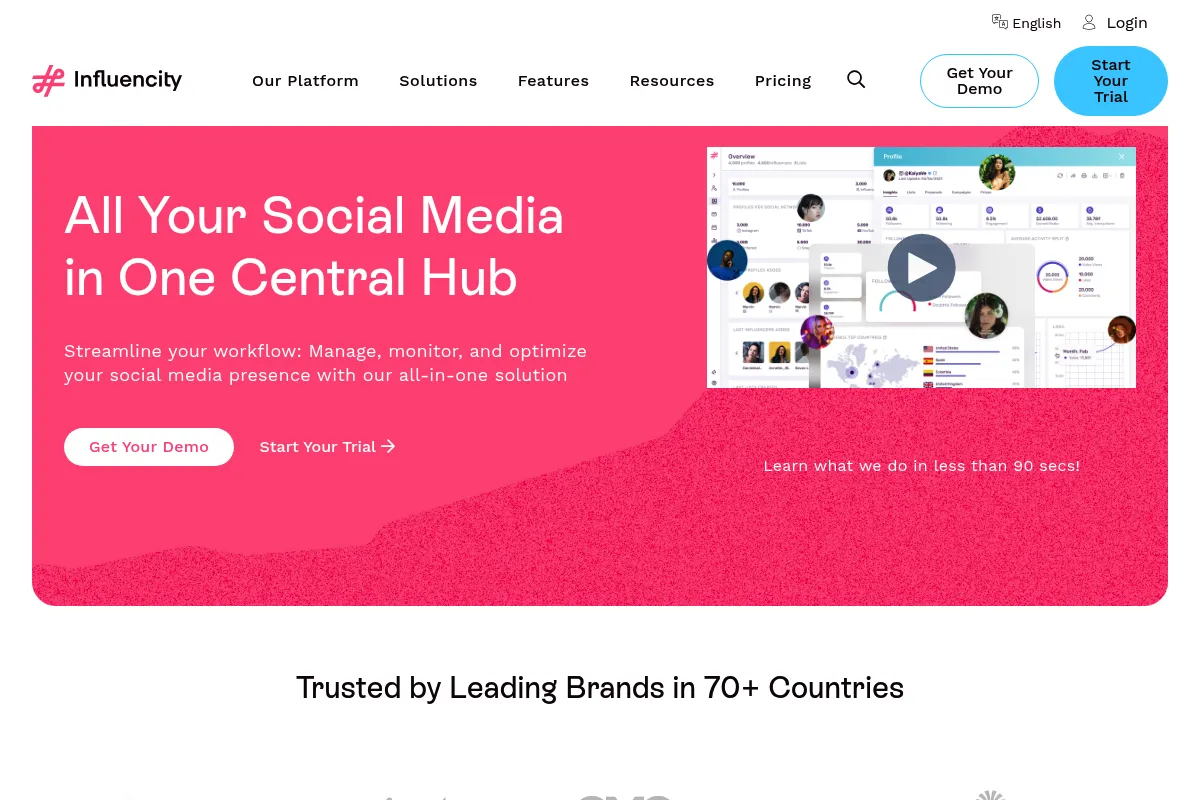
Influencity is an influencer marketing stack focused on discovery and relationship management. It aggregates data from over 170 million profiles to help marketers find creators based on audience demographics rather than just follower counts.
Official profiles
What it actually does
It provides a searchable database of influencers with deep-dive analytics on their audience quality and demographics. Users can organize creators in a dedicated CRM, track campaign performance, and generate automated reports for stakeholders.
What makes it different
Unlike platforms that require influencers to 'opt-in,' Influencity indexes the public web, offering a much larger database. Its modular pricing model allows users to pay specifically for the number of analyses or results they need, rather than being forced into rigid, overpriced tiers.
Ratings across the web


Ratings aggregated from independent review platforms.
Key Features
Audience Overlap
Identifies if two influencers share the same followers to avoid redundant reach.
Fake Follower Detection
Scores profiles based on bot-like behavior and inactive accounts to protect spend.
Custom CRM Fields
Allows teams to tag and categorize influencers by internal metrics or past performance.
Lookalike Search
Finds creators with similar audience profiles to your top-performing influencers.
Automated Campaign Reporting
Aggregates real-time data from active campaigns into shareable dashboards.
Email Integration
Connects your inbox to track communications directly within the influencer profile.
Granular Filtering
Search by audience age, gender, location, and even specific keywords in bios.
Pricing
Basic
- 5,000 Influencer monthly results
- 10 Influencer monthly analyses
- 100 Influencer monthly reports
- 1 User
Professional
- 10,000 Influencer monthly results
- 30 Influencer monthly analyses
- 250 Influencer monthly reports
- Unlimited users
Business
- Unlimited Influencer monthly results
- 100 Influencer monthly analyses
- 500 Influencer monthly reports
- Unlimited users
Pricing checked 5 months ago
Pricing guidance
- When you need to collaborate with more than one team member
- When you exceed your monthly 'Influencer Analysis' limit during vetting
- When you need to generate more than 100 reports per month
- Analysis credits do not roll over month-to-month
- The 'Basic' plan is strictly limited to a single user
- Exporting data to CSV is often gated or limited by plan tier
Mid-range pricing that becomes expensive quickly if you require high-volume profile analysis.
Pros & Cons
Strengths
-
Massive, non-opt-in database
Access to over 170 million profiles means you aren't limited to creators who have signed up for a specific network, providing a truer reflection of the market.
-
Deep audience vetting
The platform provides some of the most detailed audience breakdowns available, including 'notable followers' and audience reachability scores.
-
Flexible pricing structure
The 'Create Your Own' plan allows smaller teams to access professional-grade data without paying for enterprise features they won't use.
-
Strong CRM functionality
The IRM (Influencer Relationship Management) tool is built specifically for this workflow, making it superior to generic CRMs like HubSpot for this use case.
Weaknesses
-
No automated outreach sequences
While it integrates with email, it lacks the sophisticated automated follow-up sequences found in competitors like Modash or GRIN.
Affects: High-volume outreach teams
-
Lacks ecommerce/seeding logistics
There is no built-in way to manage product inventory, shipping labels, or automated tracking for product seeding campaigns.
Affects: D2C brands with physical products
-
Credit-based analysis limits
Deep-diving into an influencer's stats consumes 'analyses,' which can run out quickly if you are vetting a large list of prospects.
Affects: Power users and large agencies
Real User Sentiment
Users generally appreciate the depth of data and the ability to filter out fake followers, though some find the interface slightly less intuitive than newer competitors.
Users tend to like
- Accuracy of audience location data
- The 'Audience Overlap' tool for optimizing reach
- The flexibility of the custom pricing builder
- Comprehensive TikTok search filters
Users commonly complain about
- The UI can feel cluttered and slow when loading large lists
- Lack of automated outreach features
- The cost of additional analysis credits is high
Recurring tradeoffs
- You trade automated workflow (like product shipping) for superior data accuracy and search depth.
Happiest users
Data-driven marketers who need to justify influencer choices to clients using hard audience metrics.
Often frustrated
Small business owners looking for an 'all-in-one' tool that handles both discovery and physical product fulfillment.
Use Cases
Agency Client Pitching
Using audience data to prove why a specific influencer fits a client's target demographic.
Competitor Analysis
Tracking which influencers are working with rival brands and analyzing their performance.
Fraud Prevention
Vetting a list of potential partners to ensure their following isn't inflated by bots.
Global Expansion
Finding influencers with specific audience concentrations in new geographic markets.
Campaign Scaling
Using the lookalike tool to find 50 more creators similar to a successful pilot partner.
Frequently Asked Questions
Does Influencity have a free plan?
No, Influencity does not offer a permanent free plan. They provide a 7-day free trial that allows you to test the search filters and view limited data, but full access requires a paid subscription starting at $168/month.
How does Influencity compare to HypeAuditor?
Both are data-first platforms, but Influencity generally offers more flexible pricing for smaller teams. HypeAuditor is often cited as having slightly more advanced fraud detection, while Influencity is praised for its CRM (IRM) and campaign management workflow.
Can I manage product shipping through Influencity?
No. Influencity lacks built-in logistics for product seeding, such as inventory management or shipping label generation. For these features, you would need a tool like GRIN or Aspire.
Which social media platforms does it support?
Influencity currently supports Instagram, TikTok, and YouTube. It does not provide deep analytics for Twitter (X), Pinterest, or Twitch at this time.
What are 'Influencer Monthly Analyses'?
An analysis is a credit used whenever you want to see the full, deep-dive statistics of a specific profile (e.g., audience demographics, fake followers). Once you analyze a profile, you can view that data for the rest of the month without spending another credit.
Does it integrate with Shopify?
Influencity does not have a native Shopify integration for tracking sales or generating discount codes. It focuses on top-of-funnel metrics like reach, engagement, and audience alignment.
Why trust this page?
This evaluation combines product positioning, pricing analysis, traffic and market signals, and public user sentiment into a single decision-support page. Content is generated editorially — not copied from the vendor's website.
Funding & Company
Founded
2014
Stage
Seed
Total Raised
$2.2M
Latest Round
Seed (Mar 2019)
Notable Investors
Influencity has raised approximately $2.2 million (€2M) in a single disclosed funding round, likely a Seed or Angel round that occurred around 2019. This modest funding for a company founded in 2014 suggests a focus on capital efficiency and sustainable growth over rapid, venture-backed expansion.
Market Signals & Traffic
Estimated visits, global rank, geography, traffic sources, monthly visit trends, and organic search keywords (Similarweb)—on a dedicated page built for depth and search.
- Estimated visits
- 96,365
- Global rank
- #407,927
- Snapshot
- Mar 2026
- Traffic trend
- Falling
Estimated monthly visits
Similar Tools
Ocoya
Social Media, Marketing Automation, Content Creation

Create, schedule, and analyze social media content across multiple platforms.
Evidently AI
Developer Tools, Workflow, Research

Open-source framework for evaluating, testing, and monitoring machine learning models.
ActiveCampaign
Email Marketing, Marketing Automation, Automation

Marketing automation and CRM platform for personalized customer experiences.
VMEG AI
Video Creation, Content Creation, Marketing Automation

Create short-form social media videos from text scripts
White Circle
Privacy & Compliance, Developer Tools, Automation & Agents

Unified platform to monitor, secure, and optimize production models.
Zenlytic
AI Assistant, Automation & Agents, Productivity

Conversational business intelligence platform for self-service data analysis