

Coframe
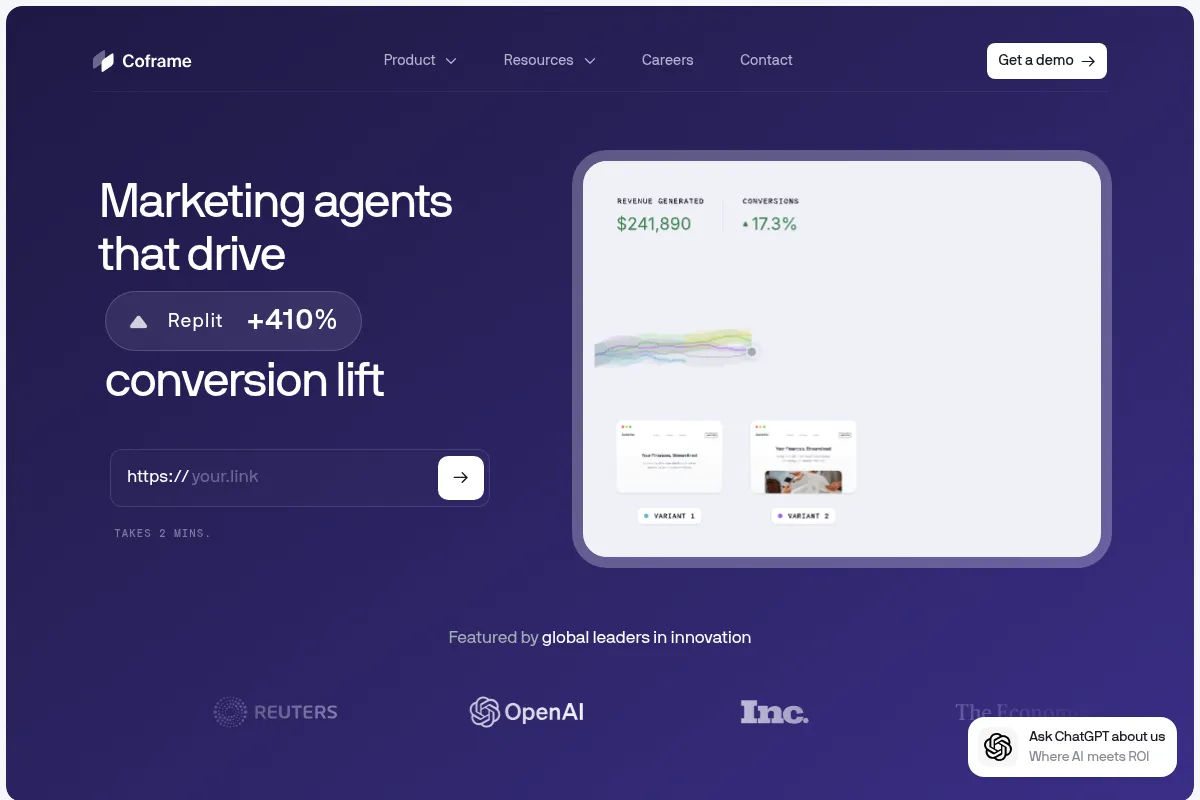
An autonomous optimization engine that generates and tests website variants in real-time, removing the manual effort of hypothesis testing for growth teams.
Excellent for high-traffic landing pages needing constant copy iteration, weaker for brands requiring strict manual approval of every word.
Analysis based on product data, pricing structure, traffic signals, and public user sentiment.
Who Should Use Coframe?
Typical users
Growth engineers, solo founders, and performance marketers at scaling startups using React or Next.js.
Maturity fit
scaling
Choose this if…
- You want to automate the entire A/B testing lifecycle from variant generation to deployment
- Your site has enough traffic to reach statistical significance quickly
- You use Next.js or React and want a component-based integration
- Your priority is conversion lift over total creative control
Skip this if…
- You have a strict legal or brand department that must approve every text variation
- Your site traffic is too low (under 1,000 visitors/month) to yield meaningful data
- You need to test complex UI changes or entire page layouts rather than just copy and images
About Coframe
Coframe is an AI-native optimization tool designed to replace static website elements with dynamic, self-improving components. It exists to solve the bottleneck of manual A/B testing by using LLMs to generate, test, and refine copy and images autonomously.
Official profiles
What it actually does
The tool replaces specific parts of a website—like headlines, CTAs, or hero images—with a 'Coframe' component. This component automatically generates multiple variations, splits traffic between them, and uses performance data to determine which versions convert best, eventually phasing out underperforming variants.
What makes it different
Unlike traditional A/B testing tools like VWO or Optimizely that require users to manually create every variant, Coframe uses AI to act as both the copywriter and the data scientist. It doesn't just report which version won; it generates the next 'challenger' variant based on what it learned from previous tests.
Key Features
Self-Evolving Variants
Generates new challengers automatically based on the performance of previous winners.
Component-Level Integration
Allows users to wrap specific UI elements in a Coframe tag for targeted testing.
Visual Editor
Enables non-technical users to select elements for optimization without writing code.
Multi-Armed Bandit Testing
Dynamically shifts traffic to winning variants faster than traditional A/B testing.
Performance Dashboard
Provides clear visibility into conversion lift and variant history.
Image Testing
Swaps and tests different visual assets to find the highest-converting imagery.
Contextual Awareness
Uses the rest of your page content to ensure generated variants remain relevant.
Pricing
Free
- 1 Coframe
- 1,000 impressions per month
- Basic analytics
- Community support
Starter
- 5 Coframes
- 10,000 impressions per month
- Standard AI generation
- Email support
Growth
- 20 Coframes
- 50,000 impressions per month
- Advanced AI models
- Priority support
Pro
- 50 Coframes
- 200,000 impressions per month
- Custom goals
- Dedicated account manager
Pricing checked 5 months ago
Pricing guidance
- When you exceed the monthly impression limit
- When you need to optimize more than 5 elements across your site
- When you want access to more advanced LLM models for copy generation
- Impressions are counted every time a Coframe element is loaded, not per unique visitor
- The number of 'Coframes' refers to the number of distinct elements you are testing
Mid-market pricing that is significantly cheaper than enterprise CRO suites but more expensive than basic static A/B tools.
Pros & Cons
Strengths
-
Eliminates testing friction
By automating variant generation, it removes the need for copywriters and designers to manually create dozens of test options.
-
Faster time-to-winner
Uses multi-armed bandit algorithms to shift traffic to high-performing variants in real-time, minimizing the 'cost' of showing users poor-performing variants.
-
Developer-friendly implementation
The React and Next.js components make it easy for engineering teams to integrate optimization directly into their existing codebase.
Weaknesses
-
Risk of brand voice drift
AI-generated copy can occasionally sound generic or deviate from a specific brand persona if not closely monitored.
Affects: Brand-heavy companies and luxury markets
-
Impression-based pricing
Costs scale with traffic, which can become expensive for high-volume sites that don't have high-margin conversions.
Affects: High-traffic media sites or low-margin e-commerce
-
Limited to surface-level changes
It is highly effective for copy and images but cannot autonomously test deep structural changes or complex user flows.
Affects: Product teams looking for deep UX optimization
Real User Sentiment
Users are generally impressed by the ease of setup and the 'magic' of seeing variants appear without manual work, though some express caution regarding SEO and brand consistency.
Users tend to like
- Speed of deployment compared to Google Optimize (deprecated) or Optimizely
- The 'set and forget' nature of the optimization
- Clean integration with modern frontend frameworks
Users commonly complain about
- Occasional generic or repetitive copy suggestions
- Lack of granular control over the AI's creative constraints
- Pricing jumps can feel steep for small projects
Recurring tradeoffs
- You trade total creative oversight for speed and automation
- You trade a flat fee for usage-based pricing that scales with your success
Happiest users
Growth engineers at Series A/B startups who need to move fast and don't have a dedicated CRO team.
Often frustrated
Brand managers at established companies who find the AI's suggestions too 'robotic' or off-brand.
Use Cases
Landing Page Optimization
Automatically testing headlines to lower bounce rates.
CTA Refinement
Testing different button text to increase click-through rates on signup forms.
Hero Image Rotation
Finding which visual style resonates best with incoming traffic.
Ad Destination Testing
Optimizing the specific landing pages that receive paid traffic to maximize ROAS.
Multi-language Expansion
Using AI to generate and test copy for new geographic markets.
Frequently Asked Questions
Does Coframe affect my site's SEO?
Coframe is designed to be SEO-friendly by serving a consistent 'original' version to search engine crawlers while only showing variants to real users. However, as with any dynamic content tool, it is recommended to monitor your rankings during initial implementation.
How does Coframe compare to Optimizely?
Optimizely is an enterprise-grade tool for manual A/B and multivariate testing with deep experimentation features. Coframe is much lighter and focuses on autonomous optimization—it writes the tests for you, whereas Optimizely requires you to bring your own ideas.
Can I use Coframe on a WordPress site?
Yes, while it has native React/Next.js support, you can also use a standard JavaScript snippet to integrate Coframe with WordPress, Webflow, or any other CMS.
What happens if I run out of impressions?
Once you hit your monthly impression limit, Coframe typically reverts to showing the 'original' version of your content until the next billing cycle or until you upgrade your plan.
Can I review the AI's copy before it goes live?
Yes, Coframe allows for an 'approval mode' where you can vet the generated variants before they are entered into the testing rotation, though this reduces the 'autonomous' benefit of the tool.
Does it work with images?
Yes, Coframe can test different image URLs to see which visuals drive better engagement, making it useful for hero sections and product displays.
Why trust this page?
This evaluation combines product positioning, pricing analysis, traffic and market signals, and public user sentiment into a single decision-support page. Content is generated editorially — not copied from the vendor's website.
Funding & Company
Founded
2023
Stage
Seed
Total Raised
$9.3M
Latest Round
Seed (Oct 2024)
Notable Investors
Coframe has raised a single Seed round of $9.3 million, led by prominent investors Khosla Ventures and NFDG. This funding provides the company with a solid initial runway to develop its AI-powered website optimization platform and begin customer acquisition.
Market Signals & Traffic
Estimated visits, global rank, geography, traffic sources, monthly visit trends, and organic search keywords (Similarweb)—on a dedicated page built for depth and search.
- Estimated visits
- 0
- Global rank
- —
- Snapshot
- Apr 2026
- Traffic trend
- —
Estimated monthly visits
Similar Tools
Balto
Communication, Automation, Training & Onboarding

Real-time guidance and conversation intelligence for contact center agents
HyperWrite
AI Assistant, Content Creation

AI-powered writing assistant for content creation, research, and task automation.
Axflow
Developer Tools, Workflow

TypeScript framework for building modular and scalable language model applications
Alteryx
Automation, Productivity, Research

Automated data analytics platform for end-to-end business insights
Fullstory
Automation & Agents, Developer Tools, Privacy & Compliance

Digital experience intelligence platform for tracking and analyzing user behavior.
Deepchecks
Developer Tools, Automation, Workflow

Testing and monitoring platform for machine learning and LLM applications.