

A high-performance AI 'brain' for industrial robots that masters high-SKU variability in warehouses—best for large-scale fulfillment operations, overkill for static manufacturing.
Excellent for high-volume piece picking with massive SKU variety, weaker for small-scale operations with predictable inventory.
Analysis based on product data, pricing structure, traffic signals, and public user sentiment.
Who Should Use Covariant?
Typical users
Operations directors at 3PLs, e-commerce giants, and pharmaceutical distributors managing high-volume fulfillment centers.
Maturity fit
advanced
Choose this if…
- You need to automate picking for millions of unique SKUs without manual programming
- Your inventory changes frequently and you cannot afford downtime for 'teaching' robots new items
- You want a hardware-agnostic AI that works with various robotic arm brands
Skip this if…
- Your warehouse handles a small number of uniform, predictable items
- You lack the budget for significant upfront integration and infrastructure changes
- You require a simple plug-and-play consumer-grade automation tool
About Covariant
Covariant develops the Covariant Brain, a universal AI platform designed to give industrial robots human-like situational awareness. It focuses on unstructured environments where items change constantly, moving robotics beyond repetitive, pre-programmed motions.
Official profiles
What it actually does
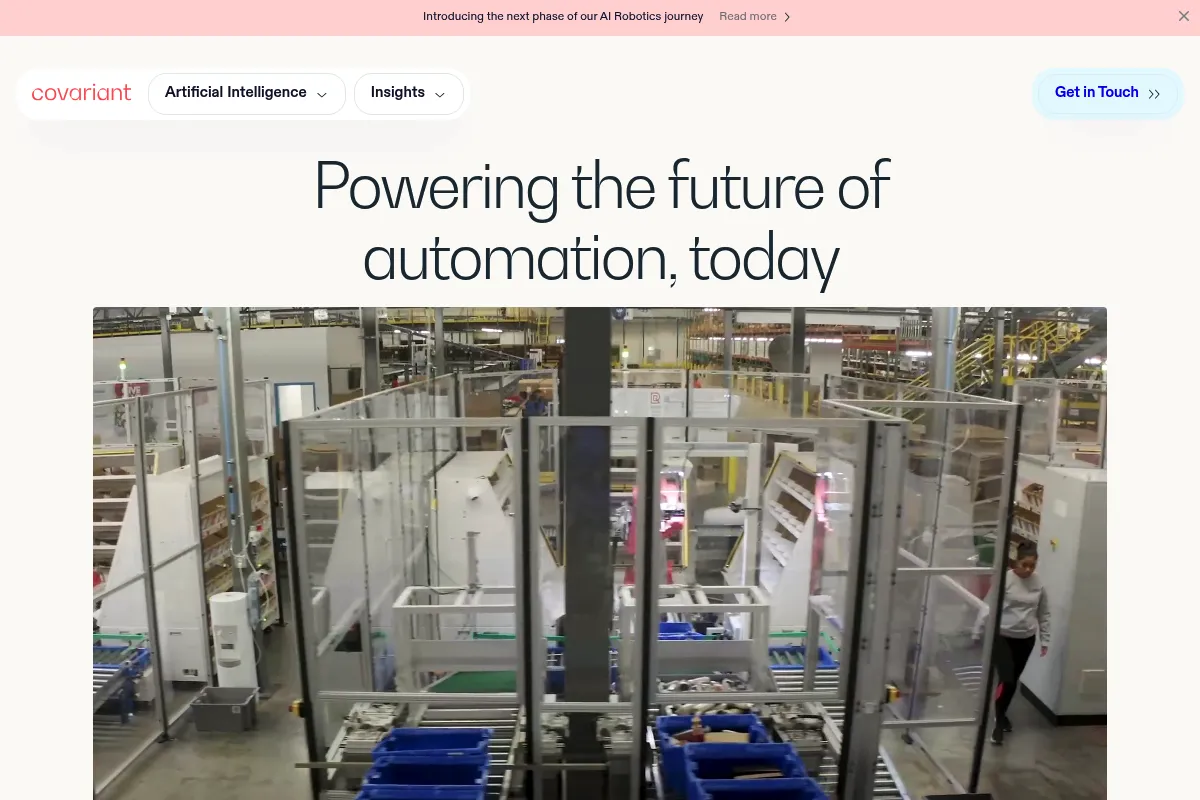
The platform enables robotic arms to identify, pick, and place millions of different items from bins or conveyors. It handles complex tasks like order picking, kitting, and induction into sorters by processing visual data and making real-time physical decisions.
What makes it different
Unlike traditional robotics software that relies on fixed coordinates, Covariant uses a Large Robotics Model (RFM-1). This allows the system to handle 'unseen' items—objects the robot has never encountered before—by reasoning through the best grip and movement based on its global training data.
Ratings across the web

Ratings aggregated from independent review platforms.
Key Features
RFM-1 Foundation Model
Uses generative AI to predict physical outcomes and handle complex edge cases in picking.
Hardware Agnosticism
Operates across different robotic hardware brands including ABB, FANUC, and KUKA.
Autonomous Exception Handling
Detects failed picks and automatically attempts alternative angles or pressures without human intervention.
Covariant Cloud
Aggregates learning from every robot in the network to improve performance for all users simultaneously.
High-Speed Induction
Automates the placement of items onto sorter trays or pocket sorters at speeds matching human operators.
Put-wall Automation
Sorts mixed batches of items into individual order cubbies autonomously.
Pricing
Enterprise
- Full Covariant Brain AI access
- Hardware integration support
- 24/7 performance monitoring
- Fleet-wide learning updates
- Custom WMS/WES integration
Pricing checked 5 months ago
Pricing guidance
- When moving from a pilot cell to full-scale warehouse deployment
- When adding more robotic arms to the fleet
- When requiring custom integration for proprietary warehouse software
- Maintenance costs for physical hardware are often separate from the AI software fee
- Performance guarantees may depend on specific lighting and bin configurations
Premium enterprise positioning justified by the high technical complexity of autonomous piece picking.
Pros & Cons
Strengths
-
Superior SKU adaptability
Handles polybags, transparent packaging, and fragile goods effectively, which are traditionally difficult for computer vision systems.
-
Reduced programming overhead
Eliminates the need for engineers to manually code movements for every new product added to a warehouse's inventory.
-
Continuous performance gains
The system's accuracy improves over time as it processes more data, leading to higher 'pick-per-hour' rates the longer it is deployed.
-
Vendor flexibility
Allows companies to choose the best robotic arm for their physical space while keeping the AI logic consistent across the fleet.
Weaknesses
-
High integration barrier
Requires deep integration with existing Warehouse Management Systems (WMS), which can take months to configure and test.
Affects: IT and Operations teams during the implementation phase
-
Opaque pricing structure
No public pricing makes it impossible to perform a preliminary ROI analysis without engaging in a lengthy sales process.
Affects: Financial planners and procurement officers
-
Physical footprint requirements
Robotic cells require significant floor space and safety guarding, which may necessitate a complete redesign of existing manual stations.
Affects: Facilities managers in older or space-constrained warehouses
Real User Sentiment
Highly respected in the logistics industry for its ability to handle 'the long tail' of SKUs that other systems fail to pick.
Users tend to like
- Reliability in handling difficult packaging like plastic wrap
- The 'set and forget' nature of the AI once calibrated
- Strong partnership with major system integrators like Knapp
Users commonly complain about
- Long lead times for initial deployment
- High cost of entry compared to manual labor in some regions
- Complexity of troubleshooting when the AI makes an unexpected decision
Recurring tradeoffs
- Users trade lower immediate flexibility for higher long-term throughput and reduced labor dependency.
Happiest users
Large-scale retailers and 3PLs with high labor turnover and massive product catalogs.
Often frustrated
Small warehouse operators who find the technical requirements and CAPEX too high for their volume.
Use Cases
E-commerce Order Fulfillment
Picking individual items from storage bins to fill customer orders.
Pharmacy Kitting
Selecting and grouping specific medical supplies for kit assembly.
Apparel Sorting
Handling soft, deformable items like t-shirts and polybagged clothing.
Grocery Induction
Placing individual grocery items onto high-speed sorters for distribution.
Depalletization
Breaking down pallets of mixed goods for individual storage.
Frequently Asked Questions
How much does Covariant cost?
Covariant does not publish pricing. It is typically sold as an enterprise solution involving an initial integration fee and an ongoing subscription for the 'Covariant Brain' software. Costs vary significantly based on the number of robotic cells and the complexity of the integration.
How does Covariant compare to RightHand Robotics?
Both are leaders in piece picking. Covariant emphasizes its 'Universal' AI that can be applied to many different types of robots and tasks (induction, kitting, picking), whereas RightHand Robotics often focuses on a more integrated, purpose-built hardware-software solution for specific fulfillment tasks.
Does Covariant provide the actual robotic arms?
Covariant is primarily an AI software company. While they offer turnkey systems through partners, their core product is the 'Brain' that can be integrated into arms from manufacturers like ABB, FANUC, and others.
What are the main limitations of the system?
The system requires a controlled environment with specific lighting and bin placement to reach maximum efficiency. It also struggles with extremely heavy items or objects that require complex two-handed manipulation, as it is primarily designed for single-arm piece picking.
Can it integrate with my existing Warehouse Management System (WMS)?
Yes, Covariant is designed to integrate with standard WMS and Warehouse Execution Systems (WES). However, this integration is a custom process handled during the deployment phase by their engineering team.
What is RFM-1?
RFM-1 (Robotics Foundation Model 1) is Covariant's generative AI model. It allows robots to 'reason' about the physical world, enabling them to handle new objects and scenarios by predicting the best way to interact with them based on a massive dataset of previous interactions.
Why trust this page?
This evaluation combines product positioning, pricing analysis, traffic and market signals, and public user sentiment into a single decision-support page. Content is generated editorially — not copied from the vendor's website.
Funding & Company
Founded
2017
Stage
Acquired
Total Raised
$222M
Latest Round
Series C (Apr 2023)
Notable Investors
Covariant raised a total of $222 million from prominent investors like Index Ventures and Radical Ventures, signaling strong early confidence in its AI robotics platform. However, the company's trajectory shifted dramatically in August 2024 with a strategic acquisition by Amazon, which involved hiring key founders and licensing its core technology.
Market Signals & Traffic
Estimated visits, global rank, geography, traffic sources, monthly visit trends, and organic search keywords (Similarweb)—on a dedicated page built for depth and search.
- Estimated visits
- 22,696
- Global rank
- #1,231,891
- Snapshot
- Apr 2026
- Traffic trend
- Cooling
Estimated monthly visits
Similar Tools
Casca
AI Assistant, Automation, Communication

Automated customer support platform for resolving inquiries across multiple channels.
Straiker
Sales, Automation & Agents, Marketing Automation

Autonomous sales agent for lead generation and personalized outreach.
Streamlit
Developer Tools, Website Builder, Research

Turn Python scripts into interactive web applications for data science.
Vayu Robotics
Automation, E-commerce

Autonomous delivery robots for cost-effective last-mile logistics.
Bland AI
AI Assistant, Automation

AI platform for automating inbound and outbound phone calls.
Parakeet
AI Assistant, Communication, Automation & Agents

Create and deploy human-like voice agents for business communication.