

A real-time unified API for HRIS, ATS, and CRM that prioritizes data privacy through a pass-through architecture rather than a centralized data warehouse.
Best for security-conscious B2B SaaS teams that need to scale integrations quickly without the compliance risk of third-party data storage.
Analysis based on product data, pricing structure, traffic signals, and public user sentiment.
Who Should Use StackOne?
Typical users
Product engineers and CTOs at B2B SaaS companies building tools for HR, recruitment, or sales departments.
Maturity fit
scaling to advanced
Choose this if…
- Your customers are enterprise-level and sensitive about where their PII data is stored.
- You need to support dozens of HRIS and ATS platforms but don't want to maintain individual API connections.
- Your priority is data privacy and GDPR compliance over high-speed cached querying.
Skip this if…
- You only need one or two specific integrations that are easy to build and maintain in-house.
- Your application requires sub-millisecond response times that only a cached database can provide.
- You are a solo developer looking for a fully transparent, low-cost self-serve pricing model.
About StackOne
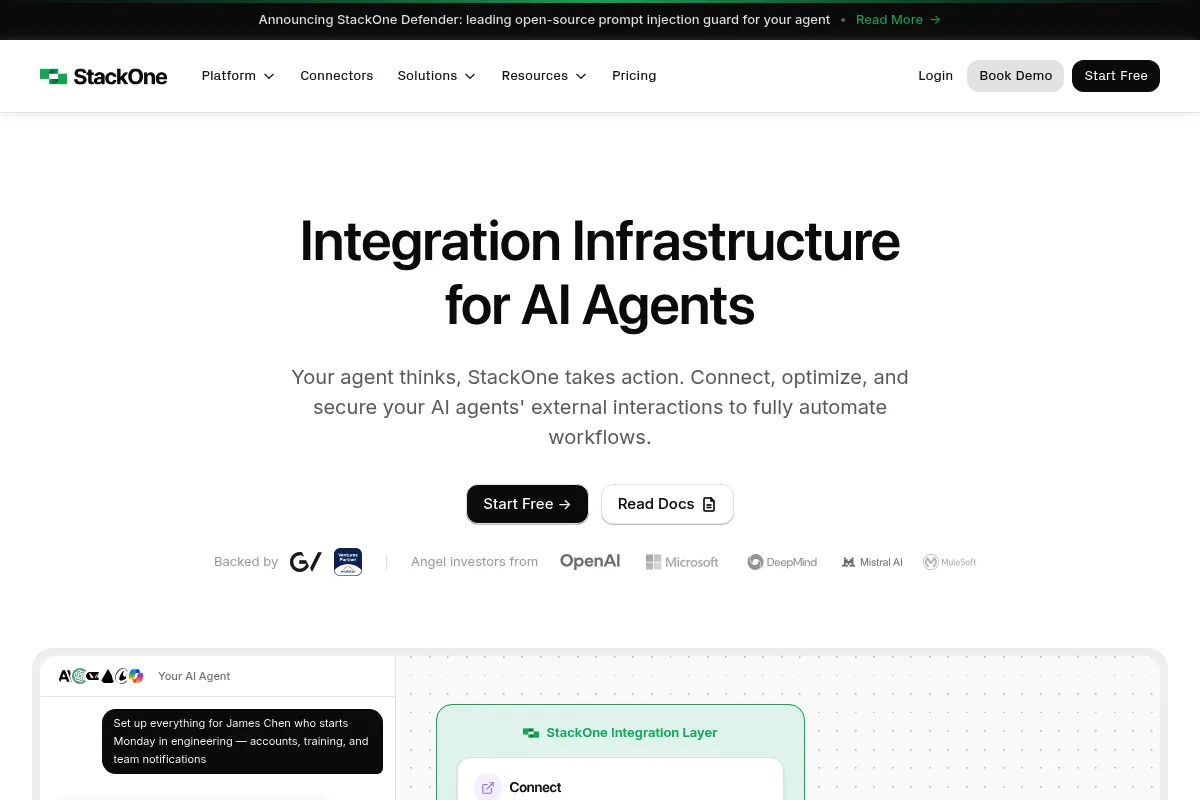
StackOne is a unified API provider focusing on the 'people' stack, including HRIS, ATS, CRM, and Marketing categories. It exists to solve the fragmentation of B2B software by providing a single interface for developers to interact with hundreds of different platforms.
Official profiles
What it actually does
It acts as a translation layer that maps disparate data structures from various software providers into a standardized API. When your application makes a request, StackOne fetches the data from the source in real-time, translates it, and passes it to you without storing the sensitive content on its own servers.
What makes it different
The primary differentiator is its pass-through architecture. While competitors like Merge.dev or Finch often cache and store your customers' data to improve performance, StackOne fetches data on-demand, ensuring that sensitive employee information never resides in a third-party database.
Ratings across the web

Ratings aggregated from independent review platforms.
Key Features
Pass-through Architecture
Ensures PII never touches StackOne's persistent storage, simplifying SOC2 and GDPR audits.
Unified Data Models
Standardizes fields like 'Job Title' or 'Salary' across platforms like Workday, BambooHR, and Greenhouse.
Integration Hub
A pre-built, embeddable UI that allows your customers to connect their accounts in minutes.
Real-time Sync
Fetches the most current data directly from the source system at the moment of the request.
Field Mapping
Enables end-users to map their unique custom fields to your application's requirements.
Automatic Auth Management
Handles the complexities of OAuth, API keys, and token refreshes for every provider.
Developer Sandbox
Provides a testing environment to simulate integrations before going live.
Pricing
Free
- Access to all categories
- Developer sandbox
- Limited number of linked accounts
- Standard support
Growth / Enterprise
- Unlimited linked accounts
- Advanced field mapping
- SLA guarantees
- Dedicated account manager
Pricing checked 4 months ago
Pricing guidance
- When you move from development to production
- When you exceed the linked account limit on the free tier
- When you require custom field mapping for enterprise clients
- Linked account limits on the free tier
- Rate limits on real-time API calls depending on the end-provider
Premium enterprise positioning with a focus on high-value, security-sensitive use cases.
Pros & Cons
Strengths
-
Superior data privacy posture
Because it doesn't store data, it is significantly easier to clear security reviews with enterprise customers who are wary of third-party data residency.
-
Real-time data accuracy
You are always viewing the 'source of truth' directly from the end-platform, eliminating issues with stale or out-of-sync cached data.
-
Broad HR and ATS coverage
They have deep support for the highly fragmented HR tech space, which is often the most difficult category to integrate manually.
Weaknesses
-
Higher latency for data requests
Fetching data in real-time from external APIs is inherently slower than querying a local cache, which may impact UI snappiness.
Affects: Applications requiring high-frequency data polling or instant dashboard loads.
-
Opaque pricing structure
The lack of public pricing tiers makes it difficult for startups to budget without engaging in a sales cycle.
Affects: Early-stage founders and small teams.
-
Complex custom field logic
While it standardizes common fields, complex custom logic across dozens of platforms still requires significant engineering oversight.
Affects: Teams with highly specialized data requirements.
Real User Sentiment
Users generally appreciate the technical focus on privacy and the responsiveness of the engineering team.
Users tend to like
- The pass-through architecture
- Ease of setting up the Integration Hub
- Responsive customer support
- Clean API documentation
Users commonly complain about
- Latency on real-time fetches
- Occasional bugs in specific niche integrations
- Lack of transparent pricing
Recurring tradeoffs
- Choosing StackOne means trading query speed (caching) for data security (pass-through).
Happiest users
Engineers at fintech or healthcare-adjacent SaaS companies where data security is the top priority.
Often frustrated
Developers building data-heavy dashboards that need to aggregate and filter large datasets instantly.
Use Cases
LMS Platforms
Syncing employee lists from an HRIS to automate course enrollment.
Recruiting Tools
Pushing candidate data from a sourcing tool directly into a client's ATS.
Payroll Apps
Fetching real-time time-tracking data from various HR platforms to calculate pay.
Employee Engagement
Triggering surveys based on 'new hire' events detected in the HRIS.
Sales Enablement
Syncing CRM contacts to ensure sales reps have the latest lead information.
Frequently Asked Questions
How does StackOne compare to Merge.dev?
The main difference is data storage. Merge.dev caches your customers' data on their servers to provide faster query speeds, while StackOne uses a pass-through model that fetches data in real-time. Choose StackOne if your customers forbid third-party data storage; choose Merge if you need high-speed data processing.
Is there a free version of StackOne?
Yes, StackOne offers a free tier specifically for developers to test integrations and build prototypes. However, production use cases with multiple live customers typically require a custom-priced Growth or Enterprise plan.
Which categories does StackOne support?
StackOne currently focuses on HRIS (Human Resource Information Systems), ATS (Applicant Tracking Systems), CRM (Customer Relationship Management), and Marketing Automation platforms.
Does StackOne store my customers' passwords or API keys?
StackOne manages the authentication tokens and API keys required to connect to the platforms, but it does not store the actual data (PII) that passes through the API during a request.
Can I use my own branding for the integration process?
Yes, StackOne provides a white-labeled 'Integration Hub' that you can embed in your application, allowing you to maintain your own brand look and feel while they handle the backend connection logic.
What happens if a provider's API changes?
StackOne's engineering team monitors and maintains the mappings. If a provider like Workday or Salesforce updates their API, StackOne updates their unified model so your integration continues to work without you needing to change your code.
Why trust this page?
This evaluation combines product positioning, pricing analysis, traffic and market signals, and public user sentiment into a single decision-support page. Content is generated editorially — not copied from the vendor's website.
Funding & Company
Founded
2023
Stage
Series a
Total Raised
$24.4M
Latest Round
Series A (May 2025)
Notable Investors
StackOne has raised a total of $24.4 million over two funding rounds, a Seed round in March 2024 and a significant Series A in May 2025. The backing by prominent investors like GV (Google Ventures) and Workday Ventures indicates strong market confidence in their AI-powered integration platform.
Market Signals & Traffic
Estimated visits, global rank, geography, traffic sources, monthly visit trends, and organic search keywords (Similarweb)—on a dedicated page built for depth and search.
- Estimated visits
- 24,381
- Global rank
- #930,826
- Snapshot
- Apr 2026
- Traffic trend
- Surging
Estimated monthly visits
Similar Tools
Aisera
AI Assistant, Automation & Agents, Communication

Enterprise platform for automating IT, HR, and customer service workflows.
OnBrand
Workflow, Design, E-commerce

Product lifecycle management platform for fashion and apparel brands.
MindOS
AI Assistant, Automation & Agents, Productivity

Create and deploy autonomous agents for professional and personal tasks.
Dust
AI Assistant, Automation & Agents, Productivity

Custom assistants that connect internal company data to language models.
Mastra
Developer Tools, Automation & Agents, Workflow

TypeScript framework for building and deploying production-ready agents.
Navattic
Training & Onboarding, Marketing Automation, Automation & Agents

Create interactive, self-guided product demos for sales and marketing.