

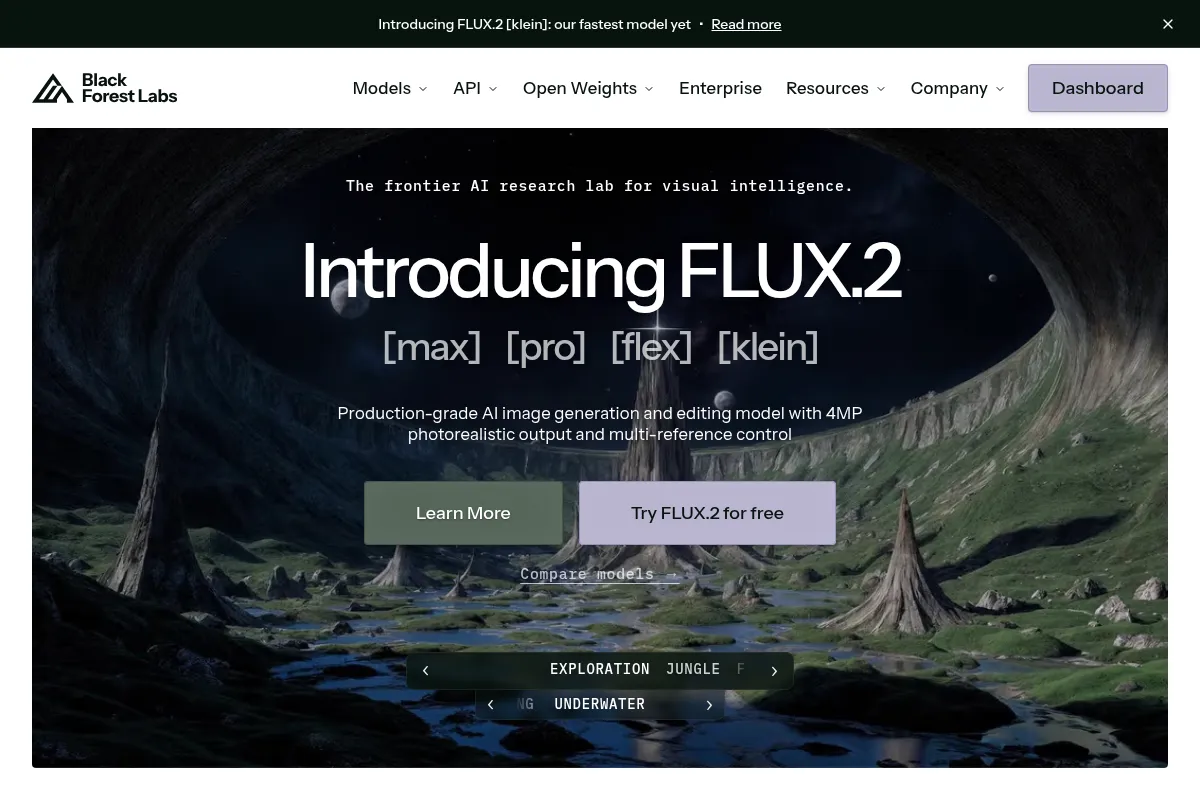
Flux is a text-to-image AI model family that produces high-quality, photorealistic visuals with strong prompt adherence, suitable for professional creative workflows.
Excellent for photorealistic image generation and design tasks, weaker for artistic style exploration.
Analysis based on product data, pricing structure, traffic signals, and public user sentiment.
Who Should Use Flux?
Typical users
Creative professionals, designers, marketers, and developers who need to generate high-fidelity images for commercial projects. This includes individuals and teams looking for precise visual output and efficient workflows.
Maturity fit
scaling to advanced
Choose this if…
- You prioritize photorealism and precise prompt interpretation.
- Your workflow requires consistent, high-quality image generation for commercial use.
- You need to generate legible text within images.
- You are looking for advanced editing capabilities like inpainting and outpainting.
Skip this if…
- You primarily need abstract or highly artistic image styles.
- Your budget is extremely limited and you require extensive free usage.
- You rely heavily on negative prompts for image generation.
- You need advanced video generation capabilities (though text-to-video is in development).
About Flux
Flux is a suite of text-to-image AI models developed by Black Forest Labs, a company founded by former Stability AI employees. It aims to provide high-quality, photorealistic image generation with strong prompt adherence, catering to professional creative and design workflows. Flux models are built on advanced transformer architectures and offer variants optimized for speed, quality, and development.
Official profiles
What it actually does
Flux generates images from text descriptions, offering high fidelity, realistic outputs, and precise control over visual elements. It also includes tools for image editing such as inpainting and outpainting, allowing for modifications and enhancements to generated or existing images.
What makes it different
Flux distinguishes itself through its advanced rectified flow transformer architecture, leading to superior prompt adherence and photorealistic quality compared to many competitors. It also offers strong capabilities in rendering legible text within images and maintaining character consistency across multiple generations, addressing common AI image generation challenges.
Ratings across the web

Ratings aggregated from independent review platforms.
Key Features
Flux Pro
Flagship model for production-grade imagery with maximum quality and 4MP output.
Flux Dev
Optimized for development and iterative workflows, offering a balance of quality and speed.
Flux Schnell
Prioritizes speed for rapid generation, suitable for quick iterations.
Precise Prompt Adherence
Interprets complex prompts with high accuracy, ensuring generated images match user intent.
Text Rendering
Capable of generating clear and readable text within images, a significant advantage over many AI models.
Multi-Reference Conditioning
Allows for maintaining character or object consistency across multiple image generations.
Flux Kontext
Suite of models for in-context image generation and editing, including text removal and style transformation.
API Access
Available through APIs for integration into custom workflows and applications.
Pricing
Free Trial
- Access to Flux models
- Cancel anytime
Starter
- 1200 credits/month
- 1200 Schnell generations
- 120 Dev generations
- All models access
- Private generation
- Commercial License
Starter (Annual)
- 1200 credits/month
- 1200 Schnell generations
- 120 Dev generations
- All models access
- Private generation
- Commercial License
Pro (Monthly)
- 4000 credits/month
- 4000 Schnell generations
- 400 Dev generations
- Advanced prompt optimization
- Commercial License
Pro (Annual)
- 4000 credits/month
- 4000 Schnell generations
- 400 Dev generations
- Advanced prompt optimization
- Commercial License
Premium (Monthly)
- 10000 credits/month
- 10000 Schnell generations
- 1000 Dev generations
- Advanced prompt optimization
- Commercial License
Premium (Annual)
- 10000 credits/month
- 10000 Schnell generations
- 1000 Dev generations
- Advanced prompt optimization
- Commercial License
Pricing checked 6 months ago
Pricing guidance
- When you consistently exceed your monthly credit limit.
- When you require access to advanced prompt optimization tools.
- When you need private generation and a commercial license for professional use.
- When you need higher generation limits for rapid prototyping or production.
- Credit system can be complex and may lead to unexpected charges if not managed carefully.
- While models are powerful, specific artistic styles or complex scenes might require extensive prompt engineering or may not be fully achievable.
- Upscaling speed can be a bottleneck for high-resolution needs.
Flux offers a tiered credit-based system with annual plans providing better value, positioning itself as a premium tool for professionals and businesses needing high-quality AI image generation.
Pros & Cons
Strengths
-
High-Quality Photorealistic Output
Flux generates detailed and realistic images that rival professional photography, making it suitable for demanding creative projects.
-
Strong Prompt Adherence
The model accurately interprets and renders complex text prompts, ensuring generated images closely match user expectations.
-
Legible Text Generation
Flux excels at rendering clear and readable text within images, a feature often lacking in other AI image generators.
-
Advanced Editing Capabilities
Tools like Flux Kontext offer sophisticated inpainting, outpainting, and text removal, enhancing usability for professional editing workflows.
-
Multiple Model Variants
Offers different versions (Pro, Dev, Schnell) optimized for various needs, from maximum quality to speed, providing flexibility for users.
Weaknesses
-
Artistic Style Limitations
While strong in realism, Flux may not offer the same breadth of artistic styles or 'magical' creative flair as some competitors like Midjourney.
-
Limited Negative Prompt Support
Flux's architecture does not support negative prompts; users must focus on positive phrasing to guide image generation.
-
Potential for 'Same Face' Issue
Some users report a tendency for the model to converge on similar facial features, a common challenge in AI image generation.
-
Upscaling Speed
High-resolution upscaling can be slow, taking over 10 minutes in some user experiences, which may impact workflows requiring rapid high-res output.
Real User Sentiment
Users generally praise Flux for its photorealistic output, prompt adherence, and text rendering capabilities, though some find its artistic style less versatile than competitors and note limitations in user interface and speed for certain tasks.
Users tend to like
- Photorealistic image quality
- Accurate prompt interpretation
- Ability to render legible text
- Advanced editing features (Flux Kontext)
- Speed of the 'Schnell' model
Users commonly complain about
- Artistic style can be less varied than competitors like Midjourney
- Potential for 'same face' issue and odd artifacts
- Upscaling can be slow
- User interface (e.g., ComfyUI) can be clunky for some
- Credit system complexity and potential for unexpected charges
Recurring tradeoffs
- Realism and prompt adherence vs. artistic flair and stylistic versatility.
- Speed vs. image quality and detail.
- Advanced features vs. potential learning curve or UI complexity.
Happiest users
Designers, marketers, and professionals who require high-fidelity, photorealistic images with precise control and clear text.
Often frustrated
Users seeking highly artistic or abstract styles, those who struggle with the credit system, or individuals finding the interface less intuitive.
Use Cases
Generating photorealistic product mockups for e-commerce.
Creating concept art and character designs for games or films.
Designing marketing materials and social media graphics with precise visual elements.
Producing editorial illustrations for articles and publications.
Developing brand scenes with specific lighting and environmental conditions.
Editing existing images by removing text or altering elements with Flux Kontext.
Prototyping visual assets for applications and websites.
Frequently Asked Questions
What is Flux AI?
Flux AI is a suite of text-to-image generation models developed by Black Forest Labs, a company founded by former Stability AI employees. It is designed to produce high-quality, photorealistic images with strong prompt adherence, catering to professional creative and design workflows. Flux offers different model variants like Flux Pro, Flux Dev, and Flux Schnell, each optimized for specific use cases, and includes advanced editing capabilities.
How does Flux AI compare to Midjourney?
Flux is often praised for its superior photorealism, precise prompt adherence, and ability to render legible text within images, making it strong for design and commercial applications. Midjourney is generally considered to have a more artistic and 'magical' flair, excelling in diverse artistic styles and complex scenes. Users may find Flux better for realistic outputs and Midjourney for more stylized or abstract artistic creations.
What are the limitations of Flux AI?
Flux AI's primary limitations include a less versatile range of artistic styles compared to some competitors, potential issues with generating 'same face' features, and slower upscaling speeds for high-resolution images. It also does not support negative prompts, requiring users to focus on positive phrasing for image generation.
Does Flux AI offer integrations?
Yes, Flux AI can be integrated into various workflows through APIs and platforms like Replicate, fal.ai, and Zapier. It is also integrated into enterprise solutions by partners such as Adobe, Canva, Meta, and Microsoft.
What are the pricing options for Flux AI?
Flux AI offers tiered pricing based on credits, with plans ranging from a free trial to monthly and annual subscriptions like Starter, Pro, and Premium. The Pro Annual plan is often recommended for its balance of cost and features. Pricing varies, with plans starting around $6.99/month for the Starter plan (billed annually).
Is Flux AI suitable for commercial use?
Yes, paid versions of Flux AI, particularly the Flux Pro and Premium plans, come with commercial licenses, allowing for professional and commercial use of generated images. The Flux.1 Schnell model is also available under the Apache 2.0 license for commercial use.
Can Flux AI generate text within images?
Yes, Flux AI is notably capable of rendering clear and legible text within generated images, which is a significant advantage over many other AI image generation models that struggle with this feature.
What is the difference between Flux Pro, Dev, and Schnell?
Flux Pro is the flagship model for maximum quality and photorealism, ideal for production. Flux Dev is optimized for development and iterative workflows, offering a balance of quality and speed. Flux Schnell prioritizes speed for rapid generation, making it suitable for quick iterations and is often available for free or at a lower cost.
Why trust this page?
This evaluation combines product positioning, pricing analysis, traffic and market signals, and public user sentiment into a single decision-support page. Content is generated editorially — not copied from the vendor's website.
Funding & Company
Founded
2024
Stage
Series b
Total Raised
$450M
Latest Round
Series B (Dec 2025)
Notable Investors
Black Forest Labs has raised a total of $450 million, culminating in a $300 million Series B in December 2025 that valued the company at $3.25 billion. This substantial backing from elite investors like Andreessen Horowitz, Salesforce Ventures, and Nvidia provides significant capital for long-term R&D and infrastructure scaling, ensuring product stability.
Market Signals & Traffic
Estimated visits, global rank, geography, traffic sources, monthly visit trends, and organic search keywords (Similarweb)—on a dedicated page built for depth and search.
- Estimated visits
- 2,578
- Global rank
- #5,566,341
- Snapshot
- Apr 2026
- Traffic trend
- Surging
Estimated monthly visits
Alternatives to Flux
View all alternativesMidjourney
Content Creation

AI tool that generates images from natural language text prompts.
Adobe Firefly
Content Creation, Video Creation

Generative AI tools for creating and editing images, video, and more.
Stable Diffusion
Content Creation, Developer Tools, AI Assistant

Open-source generative AI models for image, video, audio, and code.
Similar Tools
AirBrush
Content Creation, Design

Generate professional stock photos and illustrations from text prompts
FaceApp
Content Creation, Design

AI-powered mobile app for realistic photo and video editing.
Mage
Content Creation, Design

Generate and edit high-quality images using various diffusion models.
Artbreeder
Content Creation, Design

AI-powered platform for creating and manipulating images.
Magnific AI
Content Creation, Design

AI-powered tool to upscale and enhance images with incredible detail.
Generated Photos
Content Creation, Design

AI-generated images for any project, royalty-free.