

CAMEL-AI
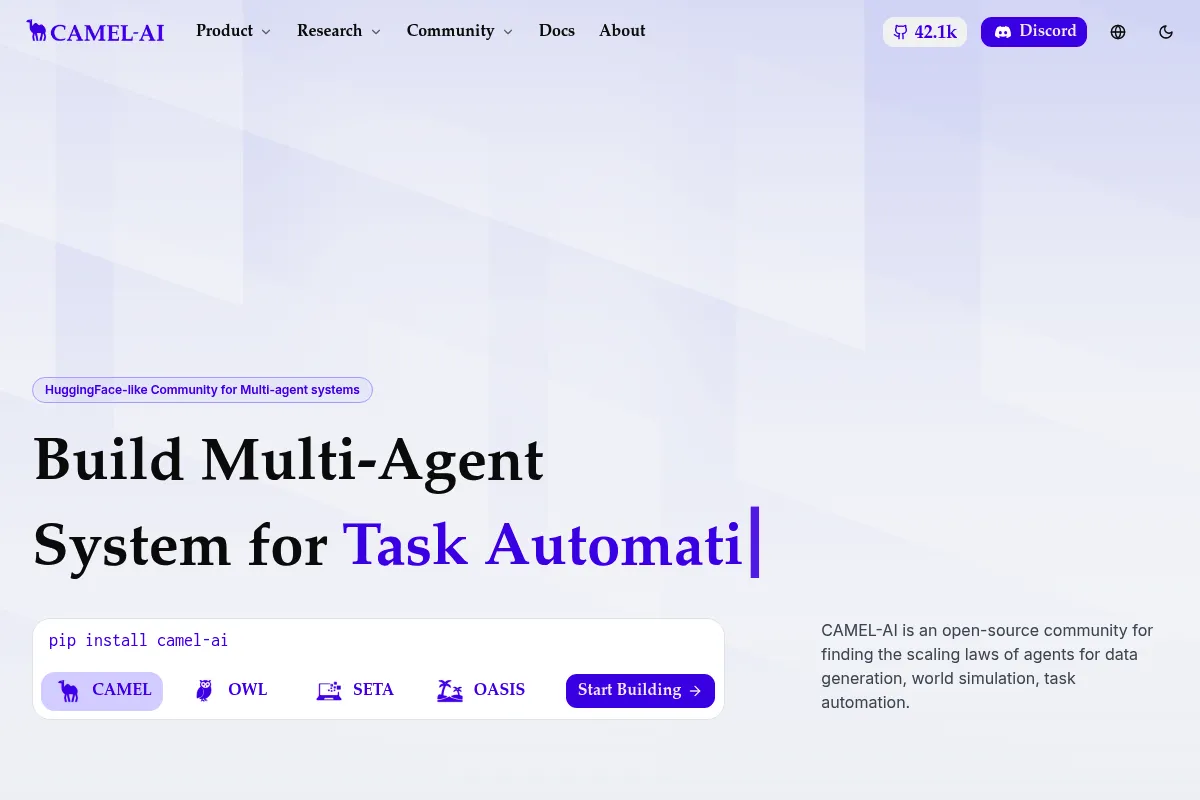
A research-oriented Python framework for building role-playing agent societies, best for developers who need structured, autonomous multi-agent orchestration rather than simple chatbot wrappers.
Excellent for academic research and complex multi-agent simulations, weaker for production-ready business process automation compared to higher-level frameworks like CrewAI.
Analysis based on product data, pricing structure, traffic signals, and public user sentiment.
Who Should Use CAMEL-AI?
Typical users
AI researchers, backend developers building complex LLM workflows, and data scientists generating synthetic datasets.
Maturity fit
advanced
Choose this if…
- You need fine-grained control over how agents communicate and maintain their personas.
- Your priority is building autonomous systems that can self-correct and refine tasks without human intervention.
- You want to use the 'Inception Prompting' technique to minimize agent drift during long conversations.
Skip this if…
- You need a no-code or low-code interface for building agents.
- Your project only requires a simple single-agent RAG (Retrieval-Augmented Generation) setup.
- You require built-in enterprise features like SOC2 compliance or managed hosting out of the box.
About CAMEL-AI
CAMEL-AI is an open-source communicative agent framework designed to facilitate autonomous cooperation between multiple LLM agents. It originated as a research project to explore how 'agent societies' can solve complex tasks through structured, role-playing dialogues.
Official profiles
What it actually does
The framework provides a Python library to define specific agent roles—such as a 'Programmer' and a 'User'—and automates their interaction to achieve a goal. It manages the prompt engineering, message history, and task-tracking logic required for agents to collaborate autonomously.
What makes it different
Unlike general-purpose tools like LangChain, CAMEL-AI is built specifically around the 'Inception Prompting' methodology. This architectural choice forces agents to adhere strictly to assigned personas and task boundaries, which reduces the common issue of agents 'hallucinating' their way out of a workflow.
Key Features
Inception Prompting
A specialized prompting technique that keeps agents focused on their specific roles and the end goal.
Task Specifier Agent
An intermediate agent that refines vague user requests into concrete, actionable task descriptions before execution.
Role-Playing Framework
Pre-defined classes for 'AI Assistant' and 'AI User' to simplify the setup of cooperative pairs.
Data Generation Pipeline
Built-in tools to create high-quality instruction-following datasets for fine-tuning other models.
Multi-Model Orchestration
The ability to assign different LLMs to different agents within the same system to optimize for cost or performance.
Agent Memory Management
Structured handling of conversation history to prevent context window overflow in long-running tasks.
Pricing
Open Source
- Full access to Python library
- Apache 2.0 License
- Community support via Discord/GitHub
- Unlimited agent creation
- Local model support
Pricing checked 5 months ago
Pricing guidance
- When you need managed infrastructure (not currently offered by CAMEL-AI)
- When you require professional services for custom agent development
- No built-in GUI for monitoring agent conversations
- No managed hosting or deployment environment provided
- API costs are external and can scale rapidly
Completely free open-source framework; costs are strictly tied to third-party LLM providers.
Pros & Cons
Strengths
-
Research-backed stability
The framework is based on peer-reviewed methodologies, offering a more predictable foundation for autonomous loops than many 'wrapper' libraries.
-
High degree of customization
Developers can modify the underlying communication protocols and prompt structures, which is essential for specialized industrial or academic use cases.
-
Open-source and extensible
The Apache 2.0 license allows for full commercial use and deep integration into proprietary stacks without licensing fees.
Weaknesses
-
High technical barrier
Requires significant Python proficiency and an understanding of LLM architecture; it is not a 'plug-and-play' solution for non-developers.
Affects: Product managers and junior developers
-
Token consumption risks
Autonomous agent dialogues can quickly consume thousands of tokens as agents 'talk' to each other, leading to high API costs if not monitored.
Affects: Teams with limited LLM budgets
-
Documentation gaps
While the core library is well-documented, newer features and complex multi-agent topologies often lack detailed tutorials.
Affects: Developers looking for rapid implementation
Real User Sentiment
Generally positive among the developer community, praised for its academic rigor and structured approach to agent communication.
Users tend to like
- The role-playing concept
- Ability to generate synthetic data
- Flexibility with different LLM providers
- Clean Pythonic implementation
Users commonly complain about
- Difficulty in setting up complex multi-agent graphs
- Lack of a visual debugger
- High latency in multi-agent loops
Recurring tradeoffs
- Structure vs. Speed: It takes longer to set up than AutoGPT but is much less likely to go off the rails.
Happiest users
Research scientists and R&D engineers building experimental autonomous systems.
Often frustrated
Business users looking for a quick way to automate simple office tasks without writing code.
Use Cases
Synthetic Data Generation
Creating large datasets of agent interactions to fine-tune smaller, specialized LLMs.
Software Development Simulation
Assigning roles like 'Architect', 'Coder', and 'Reviewer' to build small applications autonomously.
Market Research
Simulating different consumer personas to test product messaging or brand sentiment.
Educational Tools
Creating interactive, role-playing tutors that can debate or collaborate with students.
Complex Problem Solving
Breaking down a large project into sub-tasks handled by specialized agents in a 'society' structure.
Frequently Asked Questions
Is CAMEL-AI free to use?
Yes, the CAMEL-AI framework is open-source under the Apache 2.0 license. You can download and use it for free, but you will still be responsible for the costs of the LLM APIs (like OpenAI or Anthropic) that you connect to the agents.
How does CAMEL-AI compare to Microsoft AutoGen?
While both manage multi-agent systems, CAMEL-AI focuses heavily on the 'role-playing' and 'Inception Prompting' aspect to maintain agent consistency. AutoGen is often seen as more flexible for general programming tasks, whereas CAMEL-AI is more structured for autonomous dialogue and research.
Does it support local models like Llama-3?
Yes, CAMEL-AI can be integrated with local models using tools like Ollama or vLLM, allowing you to run agent societies entirely on your own hardware to save on API costs and improve privacy.
Do I need to be a programmer to use it?
Yes. CAMEL-AI is a Python library, not a standalone application. You will need to write Python code to define your agents, their roles, and the tasks you want them to perform.
Can CAMEL-AI agents use external tools?
Yes, the framework supports function calling, which allows agents to interact with external APIs, search the web, or execute code to complete their assigned tasks.
What are the main limitations of CAMEL-AI?
The primary limitations are the lack of a built-in graphical user interface (GUI) for monitoring agents and the potential for high latency and cost when running complex, multi-turn autonomous conversations.
Why trust this page?
This evaluation combines product positioning, pricing analysis, traffic and market signals, and public user sentiment into a single decision-support page. Content is generated editorially — not copied from the vendor's website.
Funding & Company
Founded
2023
Stage
Bootstrapped
Total Raised
Bootstrapped
Latest Round
Grant (Sep 2025)
Notable Investors
CAMEL-AI is an open-source research community, not a venture-backed company, and appears to be unfunded from an equity perspective. [1] It received a grant from GitHub's Secure Open Source Fund to improve its security, which signals its importance in the developer ecosystem but does not represent typical venture capital investment. [13]
Market Signals & Traffic
Estimated visits, global rank, geography, traffic sources, monthly visit trends, and organic search keywords (Similarweb)—on a dedicated page built for depth and search.
- Estimated visits
- 46,122
- Global rank
- #720,637
- Snapshot
- Apr 2026
- Traffic trend
- Rising
Estimated monthly visits
Alternatives to CAMEL-AI
View all alternatives
Similar Tools
Julius
AI Assistant, Research, Productivity

Analyze data and create visualizations using natural language prompts.
Thunkable
Developer Tools, Design, Automation

No-code platform for building and publishing native mobile apps
LanceDB
Developer Tools, Search

Open-source vector database for multi-modal search and RAG applications
Fiddler
Developer Tools, Privacy & Compliance, Automation

Monitor, explain, and analyze machine learning models and LLMs.
Relevance AI
Automation & Agents, Developer Tools, Productivity

Build and deploy autonomous agents to automate complex business workflows.
Zep
Developer Tools, Automation & Agents

Long-term memory and data persistence layer for LLM applications.