

A block-based no-code builder for native mobile apps that prioritizes logic over design flexibility—best for functional prototypes and internal tools, but struggles with high-end UI customization.
Excellent for logic-heavy native apps and rapid prototyping, weaker for pixel-perfect design or high-performance consumer applications.
Analysis based on product data, pricing structure, traffic signals, and public user sentiment.
Who Should Use Thunkable?
Typical users
Product managers, educators, and solo founders building functional MVPs or internal utilities without a development team.
Maturity fit
beginner to scaling
Choose this if…
- You want native app store presence without writing a single line of code
- Your priority is functional logic over bespoke visual design
- You need access to hardware features like Bluetooth, GPS, or the accelerometer
- You prefer a visual 'puzzle-piece' logic system over traditional syntax
Skip this if…
- You need a highly custom design system or complex animations
- Your workflow requires full ownership and export of the source code
- You are building a high-traffic consumer app that requires maximum performance optimization
About Thunkable
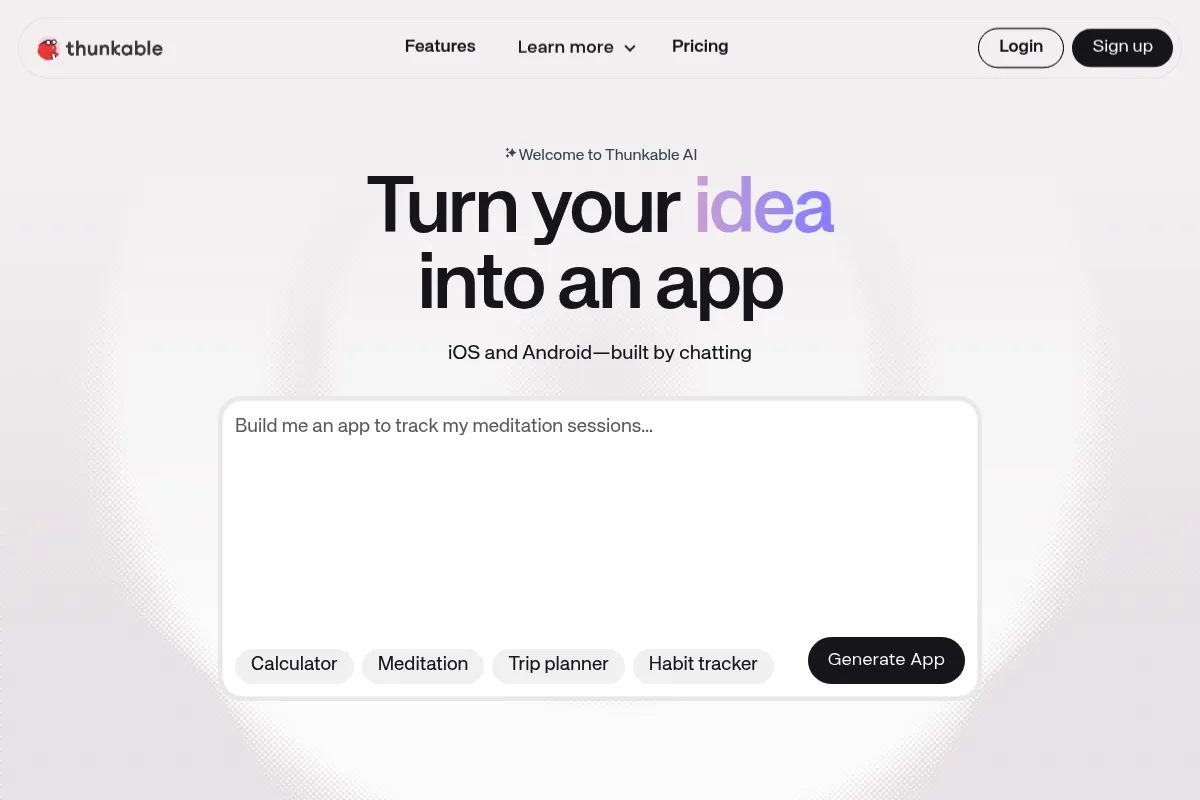
Thunkable is a cross-platform app builder that uses a drag-and-drop interface and block-based logic to create native iOS and Android applications. It exists to bridge the gap between simple web-wrappers and complex manual coding, allowing non-developers to access native device features.
Official profiles
What it actually does
It converts visual logic blocks into functional mobile code, enabling users to build screens, manage databases, and integrate APIs. The platform handles the packaging and deployment process for the Apple App Store and Google Play Store.
What makes it different
Unlike many no-code tools that produce mobile-responsive websites, Thunkable builds native components. Its logic system is based on Google’s Blockly, which provides more granular control over app behavior than the simple 'if-this-then-that' menus found in competitors like Glide or Adalo.
Ratings across the web

Ratings aggregated from independent review platforms.
Key Features
Block-based Logic
Simplifies complex conditional logic without syntax errors using a visual interface.
Direct App Store Publishing
Handles the technical packaging for Apple and Google stores within the platform.
Figma Integration
Imports design assets directly to reduce manual UI recreation time.
Device Feature Access
Connects to camera, GPS, and accelerometer natively for utility-focused apps.
AI App Generator
Creates a starting project structure and basic logic from a text prompt.
Data Sources
Connects to Airtable, Google Sheets, and Web APIs for dynamic content management.
Thunkable Live
Allows instant previewing of app changes on a physical device via a companion app.
Pricing
Free
- 10 Public projects
- Thunkable branding
- Community support
- 200MB storage
Starter
- 20 Private projects
- Basic app features
- Standard support
- 500MB storage
Pro
- Unlimited projects
- Remove Thunkable branding
- AdMob integration
- 1GB storage
- Personalized splash screen
Business
- Priority support
- 5GB storage
- White-labeling
- Advanced integrations
Pricing checked 6 months ago
Pricing guidance
- When you need to keep your project private
- When you want to remove the Thunkable splash screen
- When you need to integrate AdMob for revenue
- When you exceed the 200MB/500MB asset storage limits
- Asset storage is strictly capped by tier
- Publishing to app stores requires active paid subscriptions
- Legacy projects may count against project limits on newer plans
Mid-market pricing that is affordable for individuals but scales quickly for business needs.
Pros & Cons
Strengths
-
Native hardware access
Handles Bluetooth and device sensors effectively, making it a viable choice for IoT controllers or utility apps that web-based builders can't support.
-
Logic flexibility
The block system allows for sophisticated multi-step logic and math operations that are often restricted in simpler no-code builders.
-
Cross-platform parity
A single project builds for both iOS and Android simultaneously, ensuring feature parity without maintaining two separate logic trees.
Weaknesses
-
Rigid UI Design
The drag-and-drop editor is less flexible than modern design tools; achieving a bespoke, high-end look is difficult compared to FlutterFlow.
Affects: Design-conscious founders and UI/UX professionals
-
No Source Code Export
You cannot export the underlying Java or Swift code. If you outgrow the platform, you must rebuild the app from scratch elsewhere.
Affects: Scaling startups and enterprise teams
-
Performance Overhead
Complex apps with extensive logic blocks can experience lag or slower load times compared to hand-coded native apps.
Affects: Users building high-performance or data-heavy applications
Real User Sentiment
Users generally appreciate the low barrier to entry and the logic system, but often express frustration with UI limitations and the 'walled garden' ecosystem.
Users tend to like
- Intuitive block-based logic
- Fast deployment to physical devices for testing
- Native hardware integration capabilities
- Strong community forum and documentation
Users commonly complain about
- Lack of source code export
- Clunky UI design interface
- Occasional bugs in the block editor
- High price jump for business features
Recurring tradeoffs
- Ease of logic building vs. limited design customization
- Fast time-to-market vs. long-term platform lock-in
Happiest users
Educators teaching app logic and founders building simple utility MVPs.
Often frustrated
Professional designers and developers who need fine-grained control over the codebase or UI.
Use Cases
IoT Controller
Using Bluetooth to manage and monitor hardware devices.
Internal Business Tool
A custom inventory tracker connected to an Airtable backend.
Educational App
Teaching programming logic and app development to students without syntax hurdles.
Service Marketplace MVP
Testing a local service app with push notifications and user profiles.
Niche Utility
A specialized calculator or data entry tool for field workers using GPS.
Frequently Asked Questions
Can I export my code from Thunkable?
No, Thunkable does not allow you to export the source code (Java, Swift, or React Native). You must maintain your subscription to keep the app functional and updated within their ecosystem.
Is there a free plan available?
Yes, Thunkable offers a free plan, but it is limited to 10 projects and all projects must be public. This means anyone in the Thunkable gallery can see and 'remix' your work.
How does Thunkable compare to FlutterFlow?
FlutterFlow offers significantly more design flexibility and allows for source code export, but it has a steeper learning curve. Thunkable is easier for absolute beginners due to its block-based logic system.
Can I monetize my app on Thunkable?
Yes, you can monetize your app using AdMob integration, but this feature is only available on the Pro plan ($38/mo) and higher.
Does Thunkable support offline functionality?
Thunkable supports local storage, allowing some data to be saved on the device. However, complex data syncing and API-dependent features will still require an active internet connection.
Can I use my own database with Thunkable?
Yes, Thunkable integrates natively with Airtable, Google Sheets, and Firebase. You can also connect to any custom backend using their Web API component.
Why trust this page?
This evaluation combines product positioning, pricing analysis, traffic and market signals, and public user sentiment into a single decision-support page. Content is generated editorially — not copied from the vendor's website.
Funding & Company
Founded
2015
Stage
Series b
Total Raised
$33.64M
Latest Round
Series B (Apr 2022)
Notable Investors
Thunkable has raised over $33.6 million, culminating in a significant $30 million Series B in April 2022 led by edtech-focused Owl Ventures. [8] This funding provides substantial runway to enhance its no-code platform, particularly for enterprise and educational users. The lack of funding since 2022 is typical for a Series B company focusing on growth before a future round.
Market Signals & Traffic
Estimated visits, global rank, geography, traffic sources, monthly visit trends, and organic search keywords (Similarweb)—on a dedicated page built for depth and search.
- Estimated visits
- 447,138
- Global rank
- #56,747
- Snapshot
- Apr 2026
- Traffic trend
- Surging
Estimated monthly visits
Similar Tools
Ruh
Automation & Agents, AI Assistant, Productivity

Operating system for building and deploying digital employees and workflows.
Gumloop
Automation & Agents, Productivity

No-code platform for building AI agents and automating complex workflows.
Botsonic
AI Assistant, Automation, Communication
No-code platform for building custom chatbots using company data.
Wavespeed
Developer Tools

Serverless GPU infrastructure for high-speed AI model inference
Retell AI
Communication, Automation & Agents, AI Assistant

Build and deploy human-like conversational voice agents for business.
Groq
Developer Tools, AI Assistant

AI inference acceleration platform with specialized LPU chips.