

Relevance AI offers a low-code platform for building autonomous AI agents and multi-agent teams to automate business workflows, best suited for teams that need custom automation and can manage a usage-based pricing model.
Excellent for custom AI workflow automation, weaker for predictable budgeting.
Analysis based on product data, pricing structure, traffic signals, and public user sentiment.
Who Should Use Relevance AI?
Typical users
Operations teams, developers, and business analysts looking to automate complex, custom workflows without extensive coding. Suitable for small to large businesses needing to scale repetitive tasks.
Maturity fit
scaling to advanced
Choose this if…
- You need to build highly customized AI agents for unique business processes.
- You want to orchestrate multiple AI agents to work together on complex tasks.
- You are comfortable with a usage-based pricing model and can track AI usage.
- Your priority is automating internal workflows rather than customer-facing applications.
Skip this if…
- You require a fixed monthly cost and predictable budgeting for AI tools.
- You need to deploy complex automation workflows very quickly with minimal setup.
- Your primary use case is customer support automation where specialized tools might be more efficient.
- You prefer a platform with simpler, per-seat pricing models.
About Relevance AI
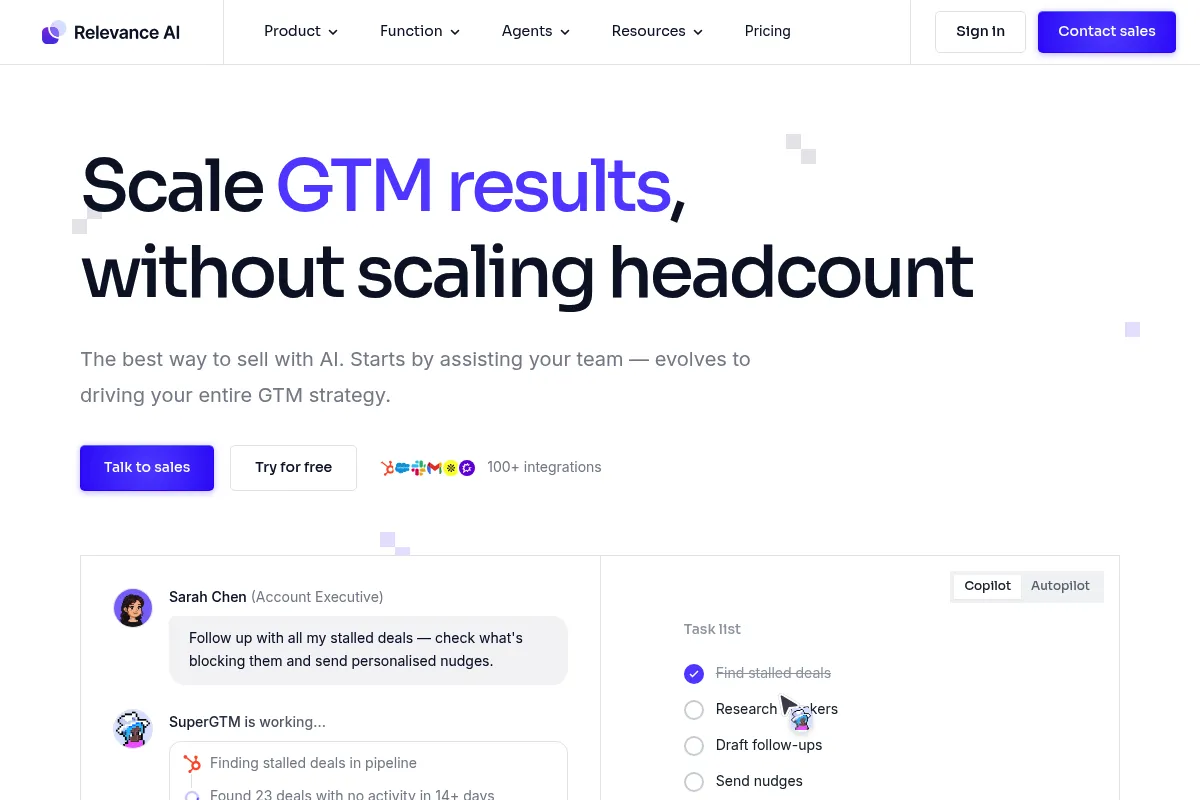
Relevance AI is a low-code platform for building and deploying autonomous AI agents and multi-agent teams. It aims to automate complex business workflows across sales, research, and operations by connecting LLMs with internal data and tools. The platform is designed for users who want to create custom AI solutions without deep coding expertise.
Official profiles
What it actually does
It allows users to build AI agents using a drag-and-drop interface, connect them to various data sources and tools, and orchestrate them into multi-agent teams. These agents can then autonomously execute tasks, automate repetitive processes, and handle complex workflows.
What makes it different
Relevance AI differentiates itself by focusing on the orchestration of autonomous AI agents and multi-agent teams, allowing them to make independent decisions within defined parameters. This contrasts with platforms that focus solely on building rigid, step-by-step workflows.
Ratings across the web

Ratings aggregated from independent review platforms.
Key Features
Visual Drag-and-Drop Builder
Enables users to create complex AI workflows and agents without extensive coding knowledge, speeding up development.
Autonomous Agents
Agents can operate independently, making decisions and taking actions to complete tasks, reducing the need for constant human oversight.
Multi-Agent Workforces
Allows for the creation of teams of specialized agents that collaborate on complex, multi-step workflows, mimicking human team structures.
Knowledge Integration (RAG)
Connects agents to internal data sources, enabling them to provide accurate, context-aware responses and actions.
Extensive Integrations
Connects with over 2,000 business tools and APIs, allowing agents to act across a user's existing tech stack.
Credit-Based Pricing Model
Offers flexibility by charging for actions and AI model usage, with the option to bring your own API keys to bypass vendor credits.
Pricing
Free
- 200 Actions per month
- $2 in bonus vendor credits
- Unlimited agents and tools
- 1 user
- 1 project
Team
- 7,000 Actions per month
- $70 in Vendor Credits per month
- 5 build users
- 45 end users
- 5 shared projects
- Calling and meeting agents
- Analytics
Enterprise
- Custom Actions and Vendor Credits
- SSO and RBAC
- Multi-region support
- Priority support
- Comprehensive audit trails
- Dedicated account management
Pricing checked 6 months ago
Pricing guidance
- When you exceed the monthly Action limit of your current plan.
- When you need to add more users for building or running agents.
- When your AI model usage (Vendor Credits) consistently exceeds the included amount.
- When you require advanced features like multi-agent orchestration or dedicated analytics.
- Action top-ups purchased do not roll over to the next billing cycle if unused.
- Knowledge storage limits may require additional costs if exceeded.
- While Vendor Credits roll over, Action credits reset monthly.
- Bringing your own API keys to bypass Vendor Credits is only available on paid plans.
Usage-based pricing with tiered plans, where costs can increase significantly with higher AI usage and actions, making budgeting a key consideration.
Pros & Cons
Strengths
-
Flexible No-Code Builder
The drag-and-drop interface makes it accessible for users without deep coding expertise to build custom AI agents and workflows.
-
Autonomous Agent Capabilities
Agents can operate independently, making decisions and executing tasks, which is ideal for automating complex, multi-step processes.
-
Multi-Agent Orchestration
The ability to create teams of agents that collaborate allows for more sophisticated automation of intricate business processes.
-
Extensive Integration Library
Connects with over 2,000 tools, allowing agents to interact with a wide range of existing business applications and data sources.
-
Model Agnosticism
Supports multiple LLM providers and allows users to bring their own API keys, offering flexibility in AI model selection and cost management.
Weaknesses
-
Unpredictable Pricing Model
The credit-based system (Actions and Vendor Credits) can make budgeting difficult, as costs can escalate with increased usage.
Affects: Teams needing predictable monthly costs
-
Learning Curve for Complex Setups
While no-code, advanced agent customization and multi-agent system configurations can require a moderate technical understanding and time investment.
Affects: Users new to AI agent orchestration or those needing rapid deployment
-
Debugging Challenges
Some users report difficulties in debugging agent behavior and understanding credit usage, especially in complex multi-agent systems.
Affects: Users running high-volume or intricate workflows
-
Limited Direct Integrations for Specific Tools
While extensive, some users note the absence of direct integrations for certain enterprise tools (e.g., BigQuery), requiring custom API development.
Affects: Enterprise users with specialized tech stacks
Real User Sentiment
Users generally find Relevance AI to be a powerful and flexible platform for building custom AI agents and workflows, particularly appreciating its no-code builder and autonomous agent capabilities. However, concerns about pricing predictability and a steeper learning curve for complex setups are common.
Users tend to like
- The intuitive no-code/low-code builder for creating AI agents and workflows.
- The ability of agents to operate autonomously and make decisions.
- The power of multi-agent systems for complex task orchestration.
- The extensive library of integrations with other business tools.
- The flexibility of bringing your own LLM API keys.
Users commonly complain about
- The credit-based pricing model (Actions and Vendor Credits) is often cited as confusing and difficult to budget for.
- Some users experience challenges with debugging complex agent behaviors and understanding credit consumption.
- A learning curve exists for advanced customization and multi-agent system setup.
- Occasional requests for more direct integrations with specific enterprise tools.
- Lack of prorated refunds for unused credits.
Recurring tradeoffs
- Balancing the flexibility of autonomous agents with the need for predictable workflow control and cost management.
- The power of customizability versus the time investment required for setup and fine-tuning.
- The accessibility of no-code for basic tasks versus the complexity for advanced multi-agent systems.
Happiest users
Users who need to automate highly custom internal workflows and are comfortable managing a usage-based pricing model, often technical users or operations teams.
Often frustrated
Users who require strict budget predictability, need very rapid deployment of simple automations, or are primarily focused on customer support automation where specialized tools might be more straightforward.
Use Cases
Automating sales outreach and lead qualification by building AI BDR agents.
Streamlining market research and data analysis through automated data aggregation and summarization agents.
Handling repetitive customer support inquiries with AI agents that can provide instant responses and escalate complex issues.
Enriching sales leads by automatically gathering information from various online sources.
Generating drafts of marketing content, social media posts, or reports using AI agents.
Automating internal operational tasks such as data entry, report generation, or scheduling.
Building custom AI applications for specific business needs, like recommendation systems or chatbots.
Frequently Asked Questions
What is Relevance AI's pricing model?
Relevance AI uses a hybrid pricing model that combines tiered subscriptions with usage-based charges. Each plan includes a certain number of 'Actions' (units of work an agent performs) and 'Vendor Credits' (for AI model costs). You can purchase additional Actions and Vendor Credits if you exceed your plan's limits. The platform also allows users to bring their own API keys for LLMs to bypass Vendor Credits. Pricing details are available on their website, with plans ranging from a Free tier to custom Enterprise solutions.
How does Relevance AI compare to tools like Make.com or n8n?
Relevance AI focuses on building autonomous AI agents and multi-agent teams that can make decisions and operate with a degree of independence. While Make.com and n8n are powerful workflow automation tools with visual builders, they typically require more explicit, step-by-step logic definition. Relevance AI's strength lies in its agentic-first approach, enabling more dynamic and adaptive automation, whereas Make.com and n8n excel at connecting diverse applications with predefined workflows.
What are the limitations of Relevance AI?
Key limitations include the complexity and potential unpredictability of its credit-based pricing model, which can make budgeting challenging. Some users also note a learning curve for advanced customization and debugging complex multi-agent systems. While it offers many integrations, specific enterprise tools might require custom API development. The autonomous nature of agents, while powerful, can also lead to less predictable outcomes compared to strictly defined workflows.
What integrations does Relevance AI offer?
Relevance AI integrates with over 2,000 tools and APIs, including popular platforms like Slack, HubSpot, Google Workspace (Gmail, Sheets, Calendar), Salesforce, Notion, and Canva. These integrations allow AI agents to access and act across a user's existing tech stack, enabling end-to-end automation. They also support custom API integrations and connections via Zapier.
Is the Free plan sufficient for testing Relevance AI?
The Free plan is suitable for initial exploration and testing the platform's core features, offering 200 Actions per month and bonus vendor credits. However, its limitations on users and projects, along with the low Action count, make it insufficient for any significant or ongoing automation needs. For substantial testing or small-scale projects, upgrading to a paid plan is necessary.
Can I use my own LLM API keys with Relevance AI?
Yes, Relevance AI allows users on paid plans to bring their own API keys from various LLM providers (like OpenAI, Anthropic, Google). This feature bypasses Relevance AI's Vendor Credits for LLM usage, potentially offering more cost control and flexibility if you have existing API agreements or prefer specific models.
How does Relevance AI handle data privacy and security?
Relevance AI emphasizes enterprise-grade security and compliance. The platform is SOC 2 Type II compliant and GDPR compliant, with options for data storage in the US, EU, or AU. They implement robust data security, encryption, and privacy controls to ensure that AI-driven operations adhere to major data protection standards.
What is the difference between Actions and Vendor Credits?
Actions are units of work that represent a single run of a tool or a step within an agent's workflow. Vendor Credits are used to cover the cost of running AI models (LLMs) and tools. Both are metered and contribute to your overall usage costs, with different plans including a set amount of each per month.
Why trust this page?
This evaluation combines product positioning, pricing analysis, traffic and market signals, and public user sentiment into a single decision-support page. Content is generated editorially — not copied from the vendor's website.
Funding & Company
Founded
2020
Stage
Series b
Total Raised
$37M
Latest Round
Series B (May 2025)
Notable Investors
Relevance AI has raised a total of $37 million across four funding rounds, culminating in a $24 million Series B in May 2025. This consistent fundraising from notable investors like Bessemer Venture Partners and Insight Partners indicates strong market confidence in their AI agent and automation platform.
Market Signals & Traffic
Estimated visits, global rank, geography, traffic sources, monthly visit trends, and organic search keywords (Similarweb)—on a dedicated page built for depth and search.
- Estimated visits
- 0
- Global rank
- —
- Snapshot
- May 2026
- Traffic trend
- Falling
Estimated monthly visits
Alternatives to Relevance AI
View all alternativesGumloop
Automation & Agents, Productivity

No-code platform for building AI agents and automating complex workflows.
Lindy
AI Assistant, Automation, Productivity

No-code AI agent builder for automating business workflows.
n8n
Automation, Automation & Agents, Developer Tools

Workflow automation platform for connecting apps and building complex sequences.
Similar Tools
Anything
AI Assistant, Content Creation

An AI-powered platform that builds web and mobile applications from text prompts.
FlexClip
Video Creation, Content Creation, Design

AI-powered online video editor with templates and stock media.
HappyRobot
Automation & Agents, Communication, Workflow

Automated communication platform for logistics and supply chain operations
Jimdo AI
Website Builder, AI Assistant, Productivity

AI-powered website builder for easy online presence and business growth.
Fish Audio
Content Creation, Developer Tools

High-fidelity text-to-speech and voice cloning platform.
Labelbox
Developer Tools, Research, Automation

Platform for data labeling, management, and model evaluation workflows.