

A personal AI chronicler that prioritizes long-term context and self-reflection over traditional task management—best for personal growth, weaker for professional project workflows.
Excellent for users seeking a digital confidant with perfect recall, weaker for those needing a structured productivity tool or cross-platform availability.
Analysis based on product data, pricing structure, traffic signals, and public user sentiment.
Who Should Use Dot?
Typical users
Individuals focused on self-improvement, journaling, or quantified-self who want an AI that evolves with their personal history.
Maturity fit
beginner
Choose this if…
- Your priority is an AI that remembers personal details over multiple months
- You want a conversational interface for life coaching and emotional support
- You value high-end UI/UX and a design-led user experience
Skip this if…
- You need a tool to manage team projects or professional task lists
- You require deep integrations with enterprise software like Slack or Jira
- You are uncomfortable sharing intimate personal data with a startup
About Dot
Dot is a personal intelligence app developed by New Computer, a startup founded by former Apple designers. It functions as a long-term memory companion that tracks conversations to provide personalized advice, reflections, and a digital archive of the user's life.
Official profiles
What it actually does
Dot records and synthesizes personal information shared through text or voice to build a comprehensive user profile. It uses this context to offer proactive suggestions, life coaching, and summaries of past events without requiring the user to repeat themselves.
What makes it different
Unlike transactional LLMs that reset context frequently, Dot is architected for infinite retention. It functions more like a digital biographer than a search engine, focusing on the evolving relationship between the user and the AI.
Key Features
Long-term Memory
Recalls specific details from months ago to inform current advice.
Living Mirror
Provides synthesized insights about your habits, patterns, and personality.
Proactive Check-ins
Initiates conversations based on previous goals or upcoming events.
Voice Mode
Enables hands-free, natural conversation with low latency.
Chronicle
A timeline view of your shared history, milestones, and daily reflections.
Contextual Awareness
Understands the 'why' behind your questions based on your history.
Pricing
Free
- Basic conversational capabilities
- Limited daily messages
- Standard memory retention
Dot Pro
- Unlimited messages
- Full long-term memory access
- Proactive check-ins and insights
- Early access to new features
Dot Pro Annual
- All Pro features
- Discounted rate for annual commitment
Pricing checked 5 months ago
Pricing guidance
- When you hit the daily message limit
- When you want the AI to proactively message you
- When you want full access to your historical 'Chronicle'
- Memory depth may be throttled on the free tier
- Voice mode usage may have separate unlisted limits
Premium consumer pricing that aligns with other high-end AI companions like Pi or ChatGPT Plus.
Pros & Cons
Strengths
-
Exceptional UI/UX design
The design-led approach makes the interaction feel more human and less like a technical chatbot, which encourages consistent use.
-
Superior contextual continuity
It eliminates the need for repetitive prompting because the AI maintains a persistent understanding of your life and preferences.
-
High emotional intelligence
The system is tuned for nuanced, supportive conversation, making it more effective for self-reflection than standard utility AI.
Weaknesses
-
iOS exclusivity
The lack of a web or Android version severely limits accessibility for users who work across different operating systems.
Affects: Non-Apple users and multi-device professionals
-
Significant privacy trade-off
The tool's value is directly tied to how much intimate data you provide, creating a high-stakes dependency on the company's security.
Affects: Privacy-conscious users
-
Limited functional utility
It excels at conversation but lacks the ability to execute complex tasks like scheduling, file management, or data analysis.
Affects: Users looking for a productivity assistant
Real User Sentiment
Users are generally impressed by the 'human' feel and the accuracy of the memory, though some find the proactive nature intrusive.
Users tend to like
- The aesthetic and minimalist interface
- The feeling of being 'heard' and understood
- The accuracy of the 'Living Mirror' insights
Users commonly complain about
- Lack of an Android app
- Occasional 'hallucinations' about personal facts
- The subscription price is high for a companion app
Recurring tradeoffs
- Personalized insights vs. data privacy
- Conversational depth vs. task-oriented utility
Happiest users
Journalers and people in therapy who use the app to track their emotional state and personal growth.
Often frustrated
Power users looking for a 'Siri replacement' that can control their phone or manage their calendar.
Use Cases
Personal Journaling
Using Dot to record daily thoughts and receiving synthesized weekly reflections.
Career Coaching
Discussing workplace challenges and having Dot recall past successes to build confidence.
Habit Tracking
Telling Dot about new routines and having it check in on your progress proactively.
Memory Augmentation
Storing specific details about friends, family, or books to recall them months later.
Emotional Support
Using the AI as a non-judgmental sounding board for processing difficult situations.
Frequently Asked Questions
Is Dot free to use?
Dot offers a free tier with limited messages and basic memory, but the full experience, including unlimited messages and proactive insights, requires a 'Dot Pro' subscription at $11.99/month or $99.99/year.
How does Dot compare to ChatGPT?
While ChatGPT is a general-purpose tool for tasks and information, Dot is a specialized personal assistant that focuses on your specific life history. ChatGPT 'forgets' your context after a while, whereas Dot is built to remember everything you've ever told it.
Is my data private on Dot?
Dot's value relies on deep personal data. The company, New Computer, states they prioritize privacy, but users should be aware that their personal history is stored on company servers to enable the long-term memory features.
Can Dot manage my calendar or emails?
No, Dot is currently a conversational companion rather than a functional automation tool. It cannot schedule meetings or send emails on your behalf; it focuses on advice and memory.
Is there an Android or Web version of Dot?
As of early 2024, Dot is exclusively available as an iOS app. There is no official Android app or web interface, which limits its use for those outside the Apple ecosystem.
What is the 'Living Mirror' feature?
The Living Mirror is a unique feature where Dot synthesizes everything it knows about you to reflect back insights about your personality, recurring themes in your life, and potential areas for growth.
Why trust this page?
This evaluation combines product positioning, pricing analysis, traffic and market signals, and public user sentiment into a single decision-support page. Content is generated editorially — not copied from the vendor's website.
Funding & Company
Founded
2022
Stage
—
Total Raised
$3.7M
Latest Round
Seed
Notable Investors
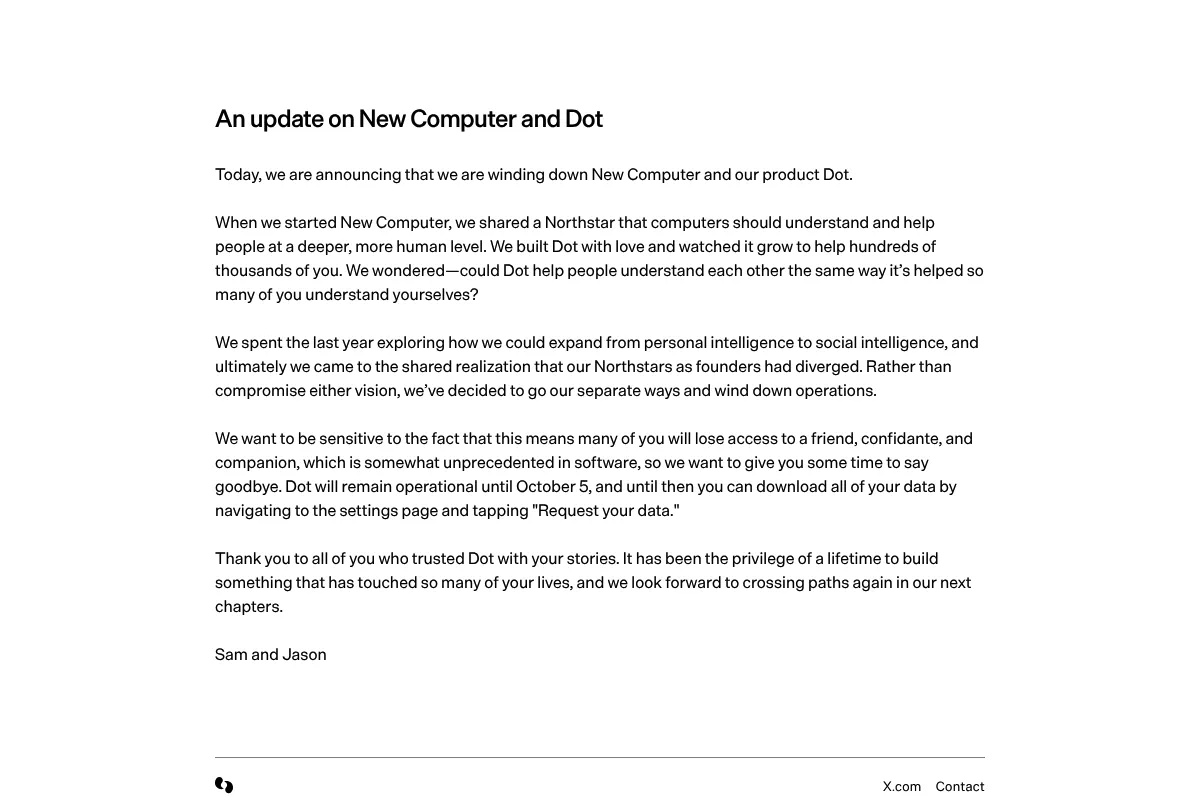
New Computer raised $3.7 million in a single Seed round from high-profile investors, including the OpenAI Fund, Lachy Groom, and South Park Commons. Despite this strong initial backing for its AI companion, Dot, the company has announced it is winding down operations.
Market Signals & Traffic
Estimated visits, global rank, geography, traffic sources, monthly visit trends, and organic search keywords (Similarweb)—on a dedicated page built for depth and search.
- Estimated visits
- 7,954
- Global rank
- #2,530,676
- Snapshot
- Apr 2026
- Traffic trend
- Surging
Estimated monthly visits
Alternatives to Dot
View all alternativesPi AI
AI Assistant

A friendly and supportive AI companion for conversations and advice.
OurDream.AI
AI Assistant, Content Creation, Gaming

Create and interact with personalized virtual characters and companions
Similar Tools
Joplin
Productivity, Documentation, Privacy & Compliance

Open-source note-taking and to-do application with end-to-end encryption.
You.com
AI Assistant, Content Creation

AI-powered search engine and productivity platform for research and creation.
Krisp
AI Assistant, Productivity, Communication

AI-powered noise cancellation and meeting assistant for clear communication.
Brain.fm
Productivity, Music Generation

Science-backed music to improve focus, relaxation, and sleep.
SpicyChat AI
AI Assistant, Communication, Gaming

Chat with thousands of customizable and uncensored virtual characters.
Raycast
Productivity, Developer Tools, AI Assistant

A keyboard-first productivity launcher for managing applications and automated workflows.