

Granica
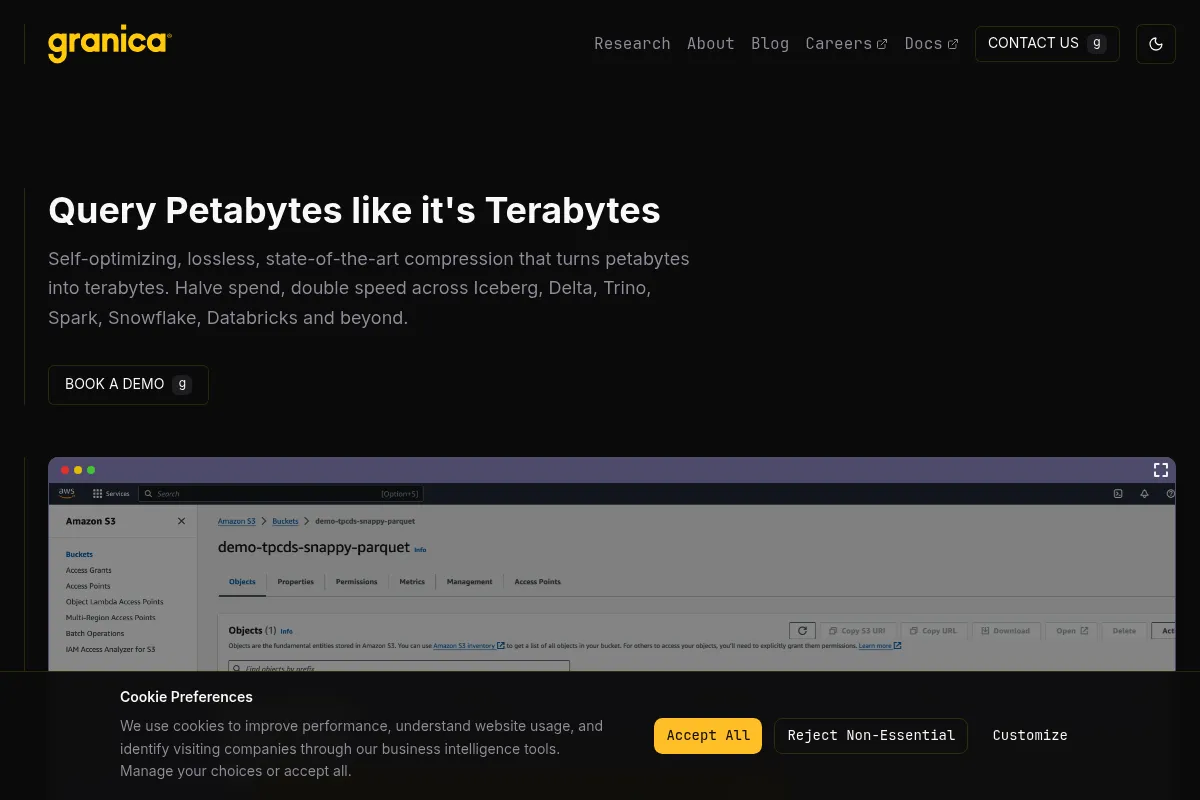
Granica is a specialized efficiency layer for petabyte-scale cloud storage that uses byte-level compression and VPC-native PII detection to reduce storage costs and compliance risks.
Best for enterprises with massive S3 or GCS data lakes that need to cut storage bills without moving data to cold archive tiers.
Analysis based on product data, pricing structure, traffic signals, and public user sentiment.
Who Should Use Granica?
Typical users
Data engineers, FinOps leads, and AI infrastructure teams managing petabytes of training data in AWS or GCP.
Maturity fit
advanced
Choose this if…
- Your annual cloud storage spend exceeds $1M
- You need to compress data while keeping it 'hot' and accessible for AI training
- Your security policy forbids sensitive data from leaving your VPC for processing
Skip this if…
- You have less than 500TB of data (the ROI won't justify the setup)
- You primarily use Azure (support is currently limited compared to AWS/GCP)
- You only need simple lifecycle rules like S3 Intelligent-Tiering
About Granica
Granica is an AI efficiency platform designed to optimize the cost and privacy of large-scale cloud data. It operates as a managed service within a customer's own cloud environment, focusing on reducing the physical footprint of data and identifying sensitive information. The platform exists to solve the 'data gravity' problem where massive datasets become too expensive to store but too valuable to delete.
Official profiles
What it actually does
The platform provides lossless, byte-level compression for structured and semi-structured data to lower storage and transfer fees. It also automates the detection and masking of PII across massive datasets and LLM prompts. Users get a visibility dashboard to track data access patterns and identify further optimization opportunities.
What makes it different
Unlike cloud-native tiering which moves data to slower hardware, Granica reduces the actual size of the data while keeping it in high-performance tiers. Its 'outcome-based' pricing model is also unique; the vendor only takes a percentage of the actual savings generated, removing the risk of paying for software that doesn't deliver ROI.
Key Features
Granica Crunch
Uses proprietary algorithms to compress data by up to 80% without losing information.
Granica Screen
Scans data for 80+ types of PII across 100+ languages to ensure compliance.
Granica Chronicle
Provides a GenAI-powered interface to query data usage and storage trends.
In-VPC Deployment
Runs entirely within your security perimeter so raw data never reaches Granica's servers.
Outcome-Based Billing
Charges are tied directly to the dollar amount saved on cloud bills.
Lossless Guarantee
Ensures that compressed data remains bit-for-bit identical when decompressed for model training.
Pricing
Outcome-Based
- Full access to Granica Crunch
- Full access to Granica Screen
- In-VPC deployment
- No upfront costs
- Pay only a percentage of verified savings
Pricing checked 5 months ago
Pricing guidance
- When moving from pilot to full-scale production data lakes
- When adding PII screening to existing compression workflows
- Minimum data volume requirements often apply for sales engagement
- Cloud infrastructure costs for running the Granica nodes are paid by the customer
Performance-driven pricing that aligns vendor revenue with customer cost-reduction goals.
Pros & Cons
Strengths
-
Risk-free pricing model
Because you only pay a fraction of what you save, there is no upfront cost or risk of the tool becoming 'shelfware'.
-
Maintains data performance
Unlike Glacier or cold storage, data remains in active tiers, meaning training jobs and queries don't suffer from retrieval latency.
-
High security posture
The in-VPC architecture satisfies strict enterprise security requirements because sensitive data never transits to a third-party SaaS.
Weaknesses
-
High entry threshold
The platform is built for petabyte-scale; teams with smaller datasets will find the infrastructure overhead outweighs the savings.
Affects: Mid-sized startups and small data teams
-
Infrastructure complexity
Requires deploying and managing a service within your VPC, which involves more coordination with DevOps than a simple SaaS API.
Affects: Teams with limited DevOps resources
-
Limited cloud provider parity
While AWS and GCP are well-supported, Azure features often lag behind, making it less ideal for multi-cloud stacks centered on Microsoft.
Affects: Azure-heavy enterprises
Real User Sentiment
Users generally view Granica as a highly effective, low-risk way to manage massive cloud costs, though setup is noted as an enterprise-level undertaking.
Users tend to like
- The 'pay-as-you-save' model
- Accuracy of PII detection compared to standard regex tools
- Data stays within the VPC
Users commonly complain about
- Initial setup requires significant cloud permissioning
- Documentation can be dense for non-infrastructure engineers
Recurring tradeoffs
- You trade some architectural complexity for significant long-term storage savings.
Happiest users
FinOps leads at large tech companies who can show immediate, multi-million dollar reductions in S3 spend.
Often frustrated
Developers at smaller companies who want a simple 'plug-and-play' API without VPC configuration.
Use Cases
Reducing S3 costs
Compressing 10PB+ of log data to save millions annually.
AI Training Privacy
Automatically scrubbing PII from datasets before they are used to train LLMs.
LLM Prompt Security
Using Granica Screen to mask sensitive info in real-time as users interact with chatbots.
Compliance Auditing
Using Chronicle to identify which datasets contain sensitive info and who is accessing them.
Cloud Migration
Reducing data footprint before moving massive datasets between regions to save on egress fees.
Frequently Asked Questions
How much does Granica cost?
Granica uses an outcome-based pricing model. Instead of a flat monthly fee, you pay a percentage of the actual savings Granica generates on your cloud bill. If the tool doesn't save you money, you don't pay for the software.
How is this different from S3 Intelligent-Tiering?
S3 Intelligent-Tiering moves files to cheaper, slower storage classes based on access frequency. Granica Crunch actually compresses the data at the byte level, reducing the physical size of the files. You can use Granica on top of Intelligent-Tiering to double your savings.
Does my data leave my cloud environment?
No. Granica is deployed as managed software within your own AWS or GCP VPC. Your raw data is processed locally and never sent to Granica's servers, which is critical for SOC2 and GDPR compliance.
What file formats does Granica support?
It is optimized for common enterprise and AI formats including Parquet, JSON, CSV, and various log formats. It uses format-aware compression to achieve higher ratios than generic tools like Gzip.
Is the compression lossless?
Yes. Granica Crunch is 100% lossless. When you read the data back, it is bit-for-bit identical to the original, ensuring no impact on the accuracy of your AI models or analytics.
Does Granica support Microsoft Azure?
As of current reporting, Granica's primary support is for AWS and GCP. While Azure support has been on the roadmap, organizations on a pure Azure stack should verify current feature parity with the sales team before proceeding.
Why trust this page?
This evaluation combines product positioning, pricing analysis, traffic and market signals, and public user sentiment into a single decision-support page. Content is generated editorially — not copied from the vendor's website.
Funding & Company
Founded
2019
Stage
Series a
Total Raised
$45M
Latest Round
Series A (Jun 2023)
Notable Investors
Granica launched from stealth with a significant $45 million Series A round co-led by top-tier firms New Enterprise Associates and Bain Capital Ventures. This substantial early-stage investment provides the company with a long runway to develop its AI efficiency platform and scale its go-to-market efforts.
Market Signals & Traffic
Estimated visits, global rank, geography, traffic sources, monthly visit trends, and organic search keywords (Similarweb)—on a dedicated page built for depth and search.
- Estimated visits
- 6,418
- Global rank
- #2,849,832
- Snapshot
- Apr 2026
- Traffic trend
- Falling
Estimated monthly visits
Similar Tools
Refiant AI
Privacy & Compliance, Automation, Marketing Automation

Automated compliance review for marketing materials and regulatory risk management.
Labelbox
Developer Tools, Research, Automation

Platform for data labeling, management, and model evaluation workflows.
Label Studio
Developer Tools, Research
Open-source data labeling platform for training machine learning models.
Outspeed
Developer Tools, Communication, Automation & Agents

Infrastructure for building real-time voice and video applications.
Cohere
Developer Tools, Automation & Agents

Enterprise large language models for search, discovery, and generation.
Glama
AI Assistant, Developer Tools, Productivity

Unified workspace for accessing multiple models and MCP services