

Outspeed
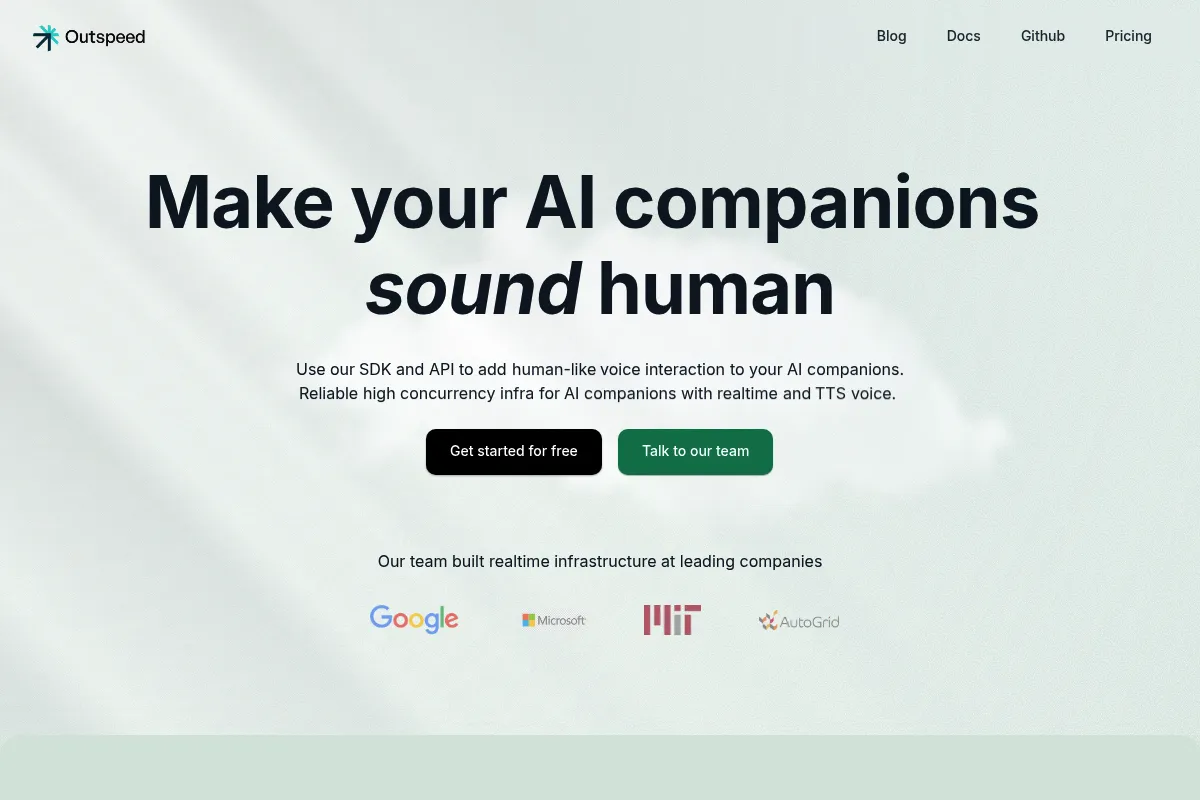
Outspeed is a real-time AI orchestration layer that manages the complex plumbing of low-latency voice and video interactions, specifically for developers who need more control than a standard wrapper provides.
Best for developers building high-performance voice assistants or video AI, weaker for non-technical teams looking for a no-code bot builder.
Analysis based on product data, pricing structure, traffic signals, and public user sentiment.
Who Should Use Outspeed?
Typical users
Software engineers and AI product founders building interactive voice agents, real-time translation tools, or AI-driven video applications.
Maturity fit
scaling
Choose this if…
- You need sub-500ms latency for voice-to-voice interactions
- Your application requires real-time video processing alongside audio
- You want to swap between different STT, LLM, and TTS providers without rewriting your entire media stack
- Handling 'interruptibility' and natural turn-taking is a core requirement
Skip this if…
- You need a no-code interface to build a simple phone bot
- You are looking for a finished customer service product rather than an infrastructure tool
- Your project doesn't require real-time interaction (asynchronous processing is cheaper elsewhere)
About Outspeed
Outspeed provides the infrastructure to build real-time AI applications. It handles the difficult parts of WebRTC, media streaming, and model orchestration so developers can focus on the application logic rather than network jitter or audio buffering.
Official profiles
What it actually does
The tool connects users to AI models via a low-latency media gateway. It orchestrates Speech-to-Text (STT), Large Language Models (LLMs), and Text-to-Speech (TTS) in a single stream, ensuring that the AI can hear, think, and speak with human-like timing.
What makes it different
Unlike many competitors that focus solely on voice, Outspeed was built to handle video natively. It offers a Python-centric SDK that gives developers granular control over the media pipeline, allowing for custom logic during the 'listening' and 'speaking' phases that simpler wrappers often hide.
Key Features
Real-time Video Processing
Enables AI to 'see' and react to visual input in the same stream as audio.
Sub-500ms Latency
Optimizes the entire stack from packet ingestion to model response for near-instant replies.
Interruption Handling
Manages the logic of stopping the AI's speech immediately when the user starts talking.
Python SDK
Allows developers to write complex backend logic for AI agents using familiar tools.
Provider Flexibility
Connects to OpenAI, Groq, Deepgram, ElevenLabs, and others through a single interface.
Custom VAD Tuning
Adjusts how sensitive the AI is to background noise versus actual speech.
State Management
Maintains context across the real-time session without manual overhead.
Pricing
Developer
- 60 free minutes per month
- Access to all standard models
- Community support
- Standard latency
Pro
- Pay-as-you-go pricing
- Priority infrastructure access
- Advanced VAD and interruption logic
- Email support
Enterprise
- Volume discounts
- Dedicated infrastructure
- SLA guarantees
- Custom model integrations
Pricing checked 4 months ago
Pricing guidance
- When moving from local testing to a live staging environment
- When you need consistent low-latency performance for production users
- When your monthly usage exceeds the 60-minute free tier
- Model costs are often bundled into the per-minute rate but can vary if using premium models
- Concurrent call limits may apply on the Pro tier without prior arrangement
Competitive usage-based pricing that aligns with other high-end AI orchestration platforms like Vapi or Retell AI.
Pros & Cons
Strengths
-
Unified Media Stack
By handling WebRTC and AI orchestration in one place, it eliminates the need for developers to build their own media servers or manage complex audio buffering.
-
Native Video Support
Most voice-first competitors struggle with video; Outspeed handles visual data streams, making it viable for AI avatars or visual inspection tools.
-
Developer-First Control
The Python SDK allows for deep customization of the agent's behavior, which is critical for complex enterprise use cases that go beyond simple Q&A.
Weaknesses
-
Higher Technical Barrier
This is not a 'plug-and-play' bot builder. It requires significant engineering effort to implement and deploy effectively.
Affects: Small teams without dedicated backend/AI engineers
-
Usage-Based Cost Volatility
Per-minute pricing can become expensive at high volumes, and costs are tied to the underlying model providers which may change.
Affects: High-volume B2C applications
-
Smaller Ecosystem
Compared to established players like LiveKit, the community resources and third-party integrations are currently more limited.
Affects: Developers looking for extensive pre-built templates
Real User Sentiment
Generally positive among developers who appreciate the reduction in 'plumbing' work, though some find the learning curve steeper than no-code alternatives.
Users tend to like
- Low latency performance
- Ease of switching between AI models
- The Python-based approach to agent logic
- Reliable handling of audio interruptions
Users commonly complain about
- Documentation can be sparse for complex edge cases
- Initial setup requires a solid understanding of WebRTC
- Pricing can be difficult to predict for high-traffic apps
Recurring tradeoffs
- You trade ease-of-use (no-code) for much higher flexibility and lower latency.
Happiest users
Engineers building custom AI voice assistants who need to integrate specific business logic into the conversation flow.
Often frustrated
Product managers trying to build a quick demo without engineering resources.
Use Cases
AI Customer Support
Building voice bots that can handle complex queries and interrupt naturally.
Language Learning Apps
Creating real-time conversation partners that correct pronunciation and grammar on the fly.
AI Sales Agents
Automating outbound or inbound calls with high-fidelity voice and low delay.
Real-time Translation
Building tools that translate speech or video calls with minimal lag.
Interactive AI Avatars
Powering video-based AI characters for gaming or virtual receptionists.
Frequently Asked Questions
How does Outspeed compare to Vapi or Retell AI?
Vapi and Retell AI are higher-level abstractions that are easier to start with but offer less control over the underlying media stream. Outspeed provides a lower-level SDK (especially for Python) and native video support, making it better for developers who need to customize the 'guts' of the interaction.
What is the actual latency I can expect?
Outspeed typically delivers end-to-end latency (from user finishing a sentence to AI starting to speak) of under 500ms, depending on the models used. Using faster models like Groq or specialized STT providers helps maintain this speed.
Does Outspeed support video?
Yes, unlike many voice-only AI platforms, Outspeed was designed to handle real-time video streams, allowing for AI applications that can see and react to visual data.
Is there a free version available?
Yes, Outspeed offers a Developer plan that includes 60 free minutes per month for testing and prototyping. Once you exceed that, you must move to the Pro pay-as-you-go tier.
What models can I use with Outspeed?
Outspeed is provider-agnostic. You can use LLMs from OpenAI, Anthropic, or Groq; STT from Deepgram or Whisper; and TTS from ElevenLabs, Cartesia, or Play.ht.
Do I need to know WebRTC to use Outspeed?
While Outspeed abstracts most of the WebRTC complexity, a basic understanding of how real-time media works will help you debug and optimize your application more effectively.
Why trust this page?
This evaluation combines product positioning, pricing analysis, traffic and market signals, and public user sentiment into a single decision-support page. Content is generated editorially — not copied from the vendor's website.
Funding & Company
Founded
2024
Stage
Pre seed
Total Raised
—
Latest Round
Pre-Seed (Dec 2024)
Notable Investors
Outspeed secured a Pre-Seed funding round in December 2024 from a group of early-stage venture capital firms. While the specific amount was not disclosed, the investment provides the necessary capital to develop its core infrastructure for real-time AI voice and video applications and begin initial go-to-market efforts.
Market Signals & Traffic
Estimated visits, global rank, geography, traffic sources, monthly visit trends, and organic search keywords (Similarweb)—on a dedicated page built for depth and search.
- Estimated visits
- 2,958
- Global rank
- #5,056,920
- Snapshot
- Apr 2026
- Traffic trend
- Falling
Estimated monthly visits
Alternatives to Outspeed
View all alternativesAgora.io
Communication, Developer Tools

Real-time engagement platform for voice, video, and live streaming.
100ms
Communication, Developer Tools

Infrastructure for building real-time video and audio communication experiences.
Similar Tools
Flux
Content Creation, Design

AI-powered text-to-image generation and editing models.
NXCode
Developer Tools, AI Assistant

Coding assistant for generating, debugging, and optimizing software code.
Zhipu AI
AI Assistant, Developer Tools, Content Creation

Advanced large language models for conversational and multimodal content generation.
Neynar
Developer Tools, Social Media, Automation

Developer infrastructure and APIs for building on Farcaster protocol.
Qdrant
Developer Tools, Search

High-performance vector database and search engine for unstructured data.
Adept
Automation & Agents, Productivity, Workflow

Automate complex workflows across any software tool or website