

Velo AI
A hardware-software hybrid that uses computer vision to identify and categorize approaching vehicles, offering more granular safety data than traditional radar but at a higher price and bulkier form factor.
Excellent for urban commuters and road cyclists who want visual confirmation of threats, weaker for weight-conscious racers or those needing long-distance battery life.
Analysis based on product data, pricing structure, traffic signals, and public user sentiment.
Who Should Use Velo AI?
Typical users
Safety-focused road cyclists and daily commuters navigating high-traffic urban environments.
Maturity fit
scaling to advanced
Choose this if…
- You want to distinguish between a car passing safely and a distracted driver veering toward you
- You need video evidence of close calls or incidents for insurance/legal purposes
- You prefer audible and visual alerts via your smartphone over simple dots on a bike computer
Skip this if…
- You are a weight-weenie or racer where a 160g device on your seatpost is a dealbreaker
- You already own a Garmin Varia and only care about knowing 'something' is behind you
- You ride for 6+ hours regularly and cannot charge mid-ride
About Velo AI
Velo AI produces Copilot, an AI-powered bike camera and sensor designed to prevent collisions. Founded by robotics experts from the autonomous vehicle industry, the company focuses on proactive threat detection rather than just reactive recording.
Official profiles
What it actually does
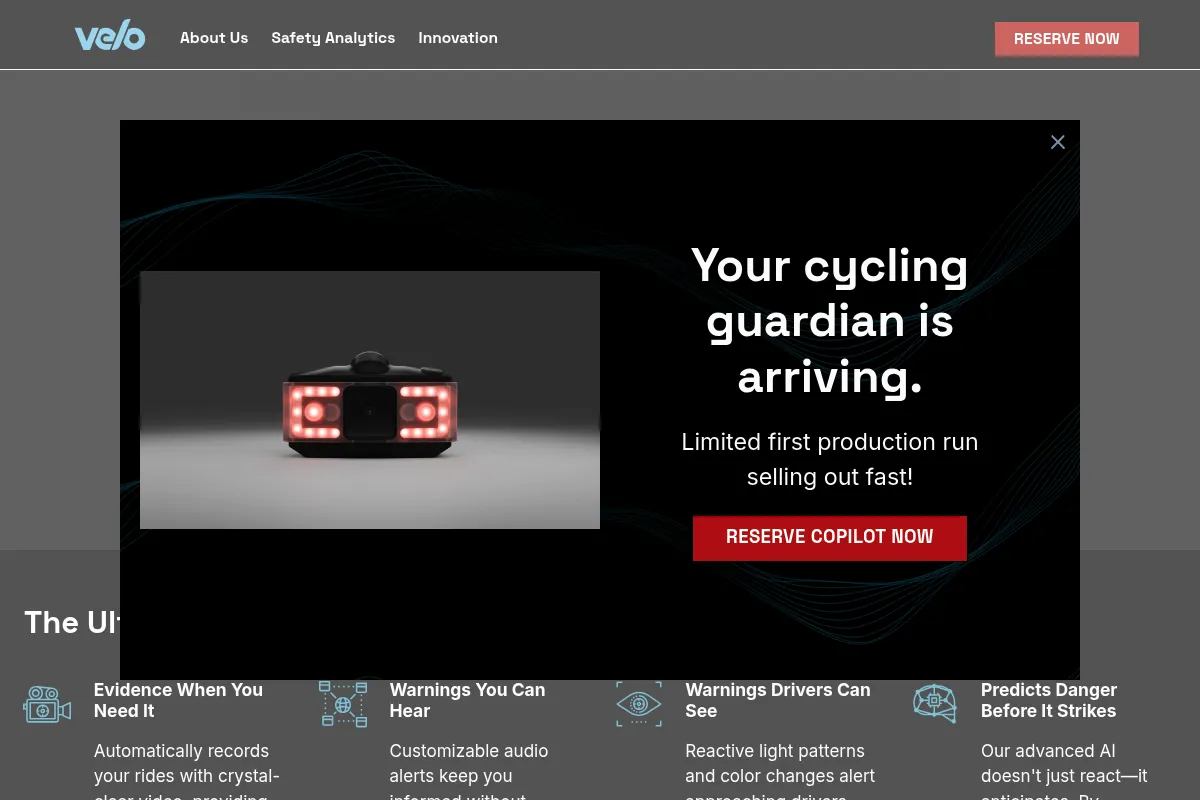
The device mounts to a seatpost and uses a camera combined with an onboard AI processor to track vehicles in real-time. It alerts the cyclist via a paired smartphone app with specific sounds and visuals based on the threat level and vehicle behavior.
What makes it different
Unlike the Garmin Varia which uses radar to detect distance and speed, Copilot uses computer vision. This allows it to identify vehicle types (car vs. bike) and, more importantly, trajectory—detecting if a car is actually entering your lane rather than just passing by.
Key Features
AI Threat Detection
Analyzes vehicle trajectory to warn specifically about aggressive or distracted driving patterns.
Visual Rearview Mirror
Streams a live feed to your mounted phone, eliminating the need to look over your shoulder.
Intelligent Light Patterns
Changes the rear light flash frequency when a vehicle is detected to grab the driver's attention.
Automatic Incident Capture
Saves footage automatically when the AI detects a near-miss or collision.
Vehicle Classification
Distinguishes between cars, trucks, and other cyclists to reduce false positives.
USB-C Fast Charging
Modern charging standard for the internal battery.
Over-the-Air Updates
Improves detection algorithms and adds features via firmware updates.
Pricing
Copilot Hardware
- Copilot AI Camera/Light unit
- Standard seatpost mount
- Velo AI Mobile App access
- USB-C charging cable
Pricing checked 4 months ago
Pricing guidance
- When you need a secondary mount for another bike
- When the company releases specialized mounting brackets
- Requires a modern smartphone for full functionality
- Video storage is limited by the internal/SD card capacity
- Battery life degrades faster with high-intensity light settings
Premium safety tech pricing, positioned significantly higher than basic radar but competitive with high-end camera/radar combos.
Pros & Cons
Strengths
-
Superior situational awareness
By identifying the type of vehicle and its path, it provides more actionable data than standard radar 'dots'.
-
Evidence-ready recording
Combines safety sensor and dashcam into one unit, ensuring you have footage of any dangerous driver behavior.
-
Reduced false alarms
The AI is trained to ignore stationary objects and vehicles that aren't on a collision course, reducing alert fatigue.
-
Active driver alerting
The light doesn't just stay on; it actively 'communicates' with approaching drivers by changing patterns as they get closer.
Weaknesses
-
Short battery life
Lasts roughly 5 hours depending on settings, which is significantly less than the 12-15 hours found on radar-only competitors.
Affects: Endurance riders and long-distance tourers
-
Bulky form factor
The device is noticeably larger and heavier than a Garmin Varia or a standard rear light.
Affects: Performance cyclists and those with limited seatpost real estate
-
Smartphone dependency
To get the full visual/audio experience, you must have your phone mounted on your handlebars, which drains phone battery.
Affects: Cyclists who prefer minimalist cockpits or use dedicated bike computers
Real User Sentiment
Generally positive among early adopters who value the 'extra set of eyes' and the specific threat detection capabilities.
Users tend to like
- The accuracy of the 'threat' vs 'non-threat' logic
- The peace of mind provided by the video recording
- The responsive customer support from a small, focused team
- Regular firmware updates that actually improve performance
Users commonly complain about
- The size of the unit is off-putting for some bike aesthetics
- Battery life is insufficient for century rides
- The app can be a heavy drain on smartphone battery
Recurring tradeoffs
- Users trade aerodynamic efficiency and weight for significantly better data on rearward traffic.
Happiest users
Urban commuters who deal with aggressive city traffic and want video proof of infractions.
Often frustrated
Road racers who find the device too heavy and the battery life too short for long training blocks.
Use Cases
City Commuting
Navigating bike lanes where cars frequently turn across your path.
Solo Rural Riding
Getting early warnings of high-speed vehicles approaching on narrow backroads.
Group Ride Safety
Acting as the 'rear guard' for a group to alert others of approaching traffic.
Insurance Protection
Maintaining a continuous video log to protect against 'he-said-she-said' scenarios in accidents.
Driver Education
Using the reactive light patterns to encourage drivers to give more passing clearance.
Frequently Asked Questions
How does Velo AI Copilot compare to the Garmin Varia?
The Garmin Varia uses radar to detect distance and speed, showing dots on your bike computer. Copilot uses a camera and AI to identify the *type* of vehicle and its specific path. While Varia has better battery life and integration with bike computers, Copilot offers video recording and more intelligent threat assessment.
Do I need a subscription to use Velo AI?
No, as of current standing, the core AI detection features, video recording, and app alerts are included with the one-time hardware purchase of $399.
Does it work with my bike computer (Garmin/Wahoo)?
Copilot primarily relies on its own smartphone app for visual and audio alerts. While it can function as a standard light, the advanced AI visuals require your phone to be mounted on the handlebars.
How long does the battery last?
The battery typically lasts around 5 hours. This is enough for most commutes and standard fitness rides, but may require a power bank for all-day endurance events.
Is the video quality good enough for license plates?
Yes, the 1080p camera is designed to capture license plate details in daylight and well-lit night conditions, though performance can vary based on relative speed and lighting.
How does it mount to the bike?
It comes with a universal seatpost mount that uses heavy-duty rubber straps, compatible with most round and aero seatposts.
Why trust this page?
This evaluation combines product positioning, pricing analysis, traffic and market signals, and public user sentiment into a single decision-support page. Content is generated editorially — not copied from the vendor's website.
Funding & Company
Founded
2022
Stage
Seed
Total Raised
$4.35M
Latest Round
Undisclosed (May 2025)
Notable Investors
Velo AI has raised a total of $4.35 million, primarily through a Seed round and a grant from the U.S. Department of Transportation. This funding supports the development and production of its AI-powered bike light and camera, as well as its expansion into data services for urban planning.
Market Signals & Traffic
Estimated visits, global rank, geography, traffic sources, monthly visit trends, and organic search keywords (Similarweb)—on a dedicated page built for depth and search.
- Estimated visits
- 3,615
- Global rank
- #4,637,032
- Snapshot
- Apr 2026
- Traffic trend
- Surging
Estimated monthly visits
Similar Tools
Alpha Drive AI
Developer Tools, Research, Automation

Cloud-based testing and validation platform for autonomous driving algorithms.
Rain AI
Developer Tools, Research

Energy-efficient hardware for on-device AI and edge computing.
Tecton
Developer Tools, Automation

Feature platform for building and serving real-time machine learning
Tractable
Automation, Workflow, Data Extraction

Visual assessment for automotive and property insurance claims.
Supermaven
Developer Tools, Productivity

High-speed code completion assistant with a million-token context window
Scale
Developer Tools, Research, Automation

Data infrastructure for training, labeling, and evaluating machine learning models.