

Hyperspell
Hyperspell has evolved from a specialized LinkedIn outreach tool into a sophisticated 'memory layer' for AI agents, providing the infrastructure needed for agents to recall company data and past conversations.
Excellent for developers building context-aware sales agents, but too complex for users seeking a simple, plug-and-play LinkedIn automation bot.
Analysis based on product data, pricing structure, traffic signals, and public user sentiment.
Who Should Use Hyperspell?
Typical users
AI engineers, product teams building agentic workflows, and high-growth sales organizations developing custom outreach agents.
Maturity fit
scaling to advanced
Choose this if…
- You are building custom AI agents that need to 'remember' past interactions across Slack, Gmail, and Notion
- Your priority is reducing AI hallucinations in sales outreach by using grounded company data
- You need a SOC2-compliant infrastructure to handle sensitive workspace data for AI processing
Skip this if…
- You want a simple Chrome extension for basic LinkedIn connection requests
- You do not have developer resources to integrate an SDK or API
- Your outreach strategy relies on generic templates rather than deep, data-driven personalization
About Hyperspell
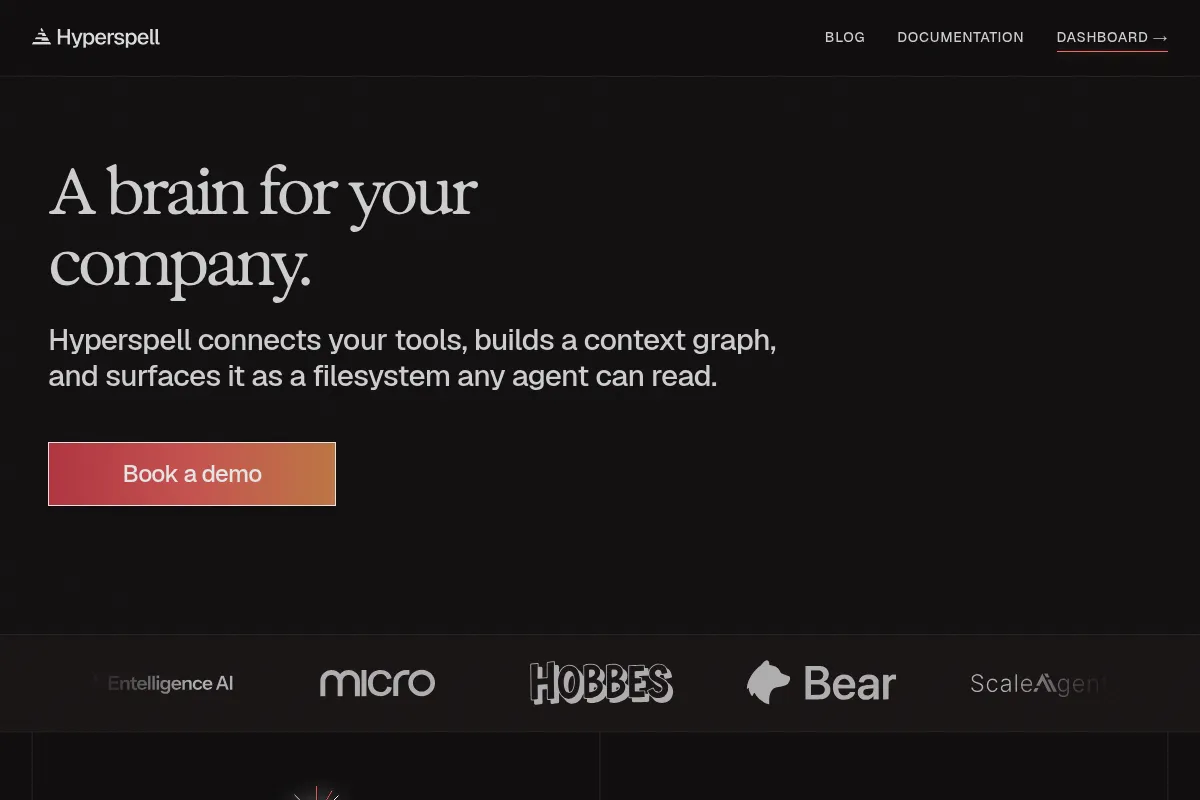
Hyperspell is a Y Combinator-backed (F25) infrastructure platform that provides a persistent memory and context layer for AI agents. It bridges the gap between raw LLMs and a company's internal knowledge, allowing agents to perform tasks with the same context a human employee would have.
What it actually does
The platform connects to workspace tools like Slack, Notion, and Gmail to build a 'context graph' of a company's projects and people. It then surfaces this data via an API or SDK, enabling AI agents to retrieve relevant facts and history in real-time during customer interactions.
What makes it different
Unlike traditional RAG (Retrieval-Augmented Generation) setups that require manual data pipelines, Hyperspell offers a 'self-integrating' SDK and continuous learning. It doesn't just search documents; it builds a memory network that improves with every query and conversation.
Key Features
Agentic Memory Network
Why it matters: Allows AI agents to maintain long-term context across different sessions and platforms.
Continuous Ingestion
Why it matters: Ensures the AI's knowledge base is always up-to-date with the latest emails and documents without manual uploads.
Context Graph
Why it matters: Maps relationships between people and projects, allowing agents to understand 'who is who' in a sales cycle.
One-Line Integration
Why it matters: Reduces the engineering overhead required to build complex RAG pipelines from months to minutes.
Structured Data Retrieval
Why it matters: Returns data in LLM-ready formats, minimizing the need for extensive prompt engineering.
Privacy Guardrails
Why it matters: Provides PII masking and audit logs, essential for enterprise-grade AI deployments.
Pricing
Developer / Sandbox
- Access to SDK and API
- Limited data source connections
- Sandbox environment for testing
Enterprise / Production
- Full Agentic Memory Network
- Unlimited workspace integrations
- SOC2 & GDPR compliance
- Dedicated support
Pricing checked 4 months ago
Pricing guidance
- When moving from a prototype to a production environment
- When requiring SOC2 compliance for customer data
- When data ingestion volume exceeds sandbox limits
- Data ingestion speed may vary by source API limits (e.g., Slack/Notion rate limits)
- Context window limits still apply based on the underlying LLM used
Premium infrastructure positioning aimed at the 'AI-native' enterprise market.
Pros & Cons
Strengths
-
Eliminates 'Clueless' AI behavior
By providing agents with real-world context, it prevents the generic or incorrect responses common in standard outreach bots.
-
Infrastructure-level security
Being SOC2 certified and GDPR compliant makes it a viable choice for enterprises that cannot use 'black box' automation tools.
-
High developer velocity
The SDK handles the heavy lifting of authentication and data indexing, allowing teams to focus on agent logic rather than data plumbing.
Weaknesses
-
Not a standalone outreach tool
Users expecting a dashboard to send LinkedIn messages will be disappointed; this is a backend component that powers such tools.
Affects: Non-technical marketers and solo recruiters
-
Steep learning curve for 'Memory' concepts
Understanding how to properly weight and query the memory network requires a solid grasp of AI agent architecture.
Affects: Beginner AI developers
-
Opaque pricing
Without public tiers, it is difficult for small teams to assess cost-effectiveness before engaging in a sales cycle.
Affects: Startups and small agencies
Real User Sentiment
Early adopters praise the technical depth and the founders' expertise in knowledge graphs, though some are confused by the pivot from outreach to infrastructure.
Users tend to like
- Ease of connecting disparate data sources
- The 'memory' actually works to reduce hallucinations
- Responsive founding team (YC F25)
Users commonly complain about
- Lack of a self-service UI for non-developers
- Documentation can be sparse for complex edge cases
- Confusion over the product's core identity (Sales vs. Infra)
Recurring tradeoffs
- You gain deep context but lose the 'plug-and-play' simplicity of traditional LinkedIn bots.
Happiest users
Founding engineers at AI startups who need to add RAG capabilities to their product overnight.
Often frustrated
Sales managers looking for a quick way to automate their personal LinkedIn inbox without writing code.
Use Cases
Sales Agent Memory
Enabling an AI SDR to remember a prospect's previous objections from a Slack thread.
Customer Support Context
Giving a support bot access to all previous Jira tickets and Notion docs for a specific client.
Personalized Marketing
Generating outreach messages based on a lead's actual recent activity in shared documents.
Internal Knowledge Retrieval
Building a 'company brain' that employees can query via a Slack bot.
Agentic Recruiting
Powering agents that can interview candidates based on the company's specific technical documentation.
Frequently Asked Questions
Is Hyperspell a LinkedIn automation tool?
While it can power LinkedIn automation by providing context to sales agents, Hyperspell is technically a memory and context layer for AI agents. It is not a simple 'point-and-click' LinkedIn bot like Dripify or Expandi.
How much does Hyperspell cost?
Hyperspell does not list public pricing. As a YC-backed infrastructure startup, they typically require a demo or sales consultation to provide a quote based on data volume and agent count.
How does it compare to Pinecone or other vector databases?
Pinecone is a raw database; Hyperspell is a full context layer. Hyperspell handles the data ingestion, cleaning, and 'memory' logic, whereas a vector database requires you to build those pipelines yourself.
Is it safe to connect my company's Slack and Gmail?
Hyperspell is SOC2 and GDPR compliant. They use enterprise-grade encryption and provide data isolation, making it significantly safer than many 'unofficial' browser-based automation tools.
Does it require coding knowledge?
Yes. To get the most out of Hyperspell, you will need to work with their SDK or API. It is designed for developers and product teams, not for non-technical end-users.
Can I use it for cold email outreach?
Yes, by connecting it to your CRM and email history, you can use Hyperspell to provide the 'memory' that an AI agent needs to write highly personalized cold emails.
Why trust this page?
This evaluation combines product positioning, pricing analysis, traffic and market signals, and public user sentiment into a single decision-support page. Content is generated editorially — not copied from the vendor's website.
Market Signals & Traffic
Estimated visits, global rank, geography, traffic sources, monthly visit trends, and organic search keywords (Similarweb)—on a dedicated page built for depth and search.
- Estimated visits
- 15,186
- Global rank
- #1,429,319
- Snapshot
- May 2026
- Traffic trend
- Surging
Estimated monthly visits
Similar Tools
Sierra AI
AI Assistant, Automation

AI platform for building autonomous customer support agents.
Amplitude
Research, Marketing Automation, Automation & Agents

Digital analytics platform for tracking user behavior and product growth.
Mirrago
E-commerce, Sales, Design

Virtual fitting room for realistic clothing visualization and online shopping.
Anara AI
Music Marketing, Productivity, Automation

Music rights management and sync licensing platform for artists.
Flowhunt
Automation & Agents, Workflow, Productivity

Visual platform for building custom automation workflows and agents
Brickanta
Automation & Agents, Productivity, Workflow

Agentic platform for construction cost estimation and procurement automation.