

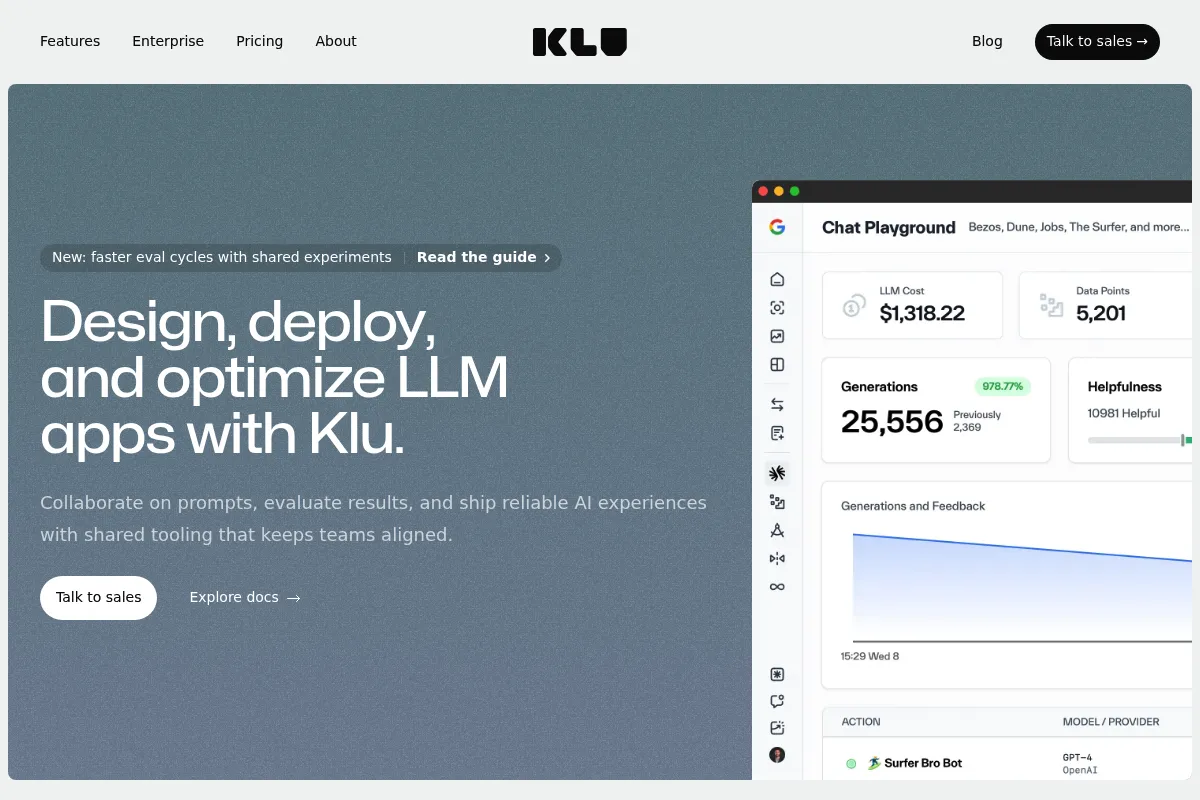
A centralized workspace for the LLM application lifecycle that combines prompt engineering, evaluation, and observability into a single interface for developers and product teams.
Excellent for teams that need non-technical stakeholders to manage prompts, but potentially expensive for high-volume applications compared to pure observability tools.
Analysis based on product data, pricing structure, traffic signals, and public user sentiment.
Who Should Use Klu?
Typical users
Product managers and software engineers building LLM-powered features who need to collaborate on prompt iteration and performance monitoring.
Maturity fit
scaling
Choose this if…
- You want a UI that allows non-developers to edit and test prompts without touching code.
- You need to compare outputs across different models (OpenAI, Anthropic, Google) in one place.
- Your priority is reducing the friction between prompt experimentation and production deployment.
Skip this if…
- You only need basic request logging and cost tracking (cheaper alternatives like Helicone exist).
- Your application handles millions of requests monthly where per-request pricing becomes prohibitive.
- You require a self-hosted or air-gapped solution for strict data residency.
About Klu
Klu is an AI application platform designed to streamline the development of LLM-based software. It provides a collaborative environment where teams can design prompts, evaluate model performance, and monitor production data to improve AI accuracy over time.
Official profiles
What it actually does
Klu provides a hosted environment to manage the entire AI feature lifecycle. It allows users to version prompts, run A/B tests across different models, log production interactions, and collect user feedback to fine-tune model behavior.
What makes it different
Unlike pure observability tools that focus on logging, Klu emphasizes the 'Studio' experience, making prompt management a collaborative task for the whole team. It treats prompts as managed assets that can be updated via the UI and fetched via API, decoupling prompt logic from application code.
Key Features
Klu Studio
A no-code interface for designing and testing prompts across various LLMs.
Prompt API
Decouples prompts from code, allowing updates in the UI to reflect instantly in production.
Evaluation Frameworks
Tools to run batch tests and score model outputs against ground truth data.
Observability Dashboard
Real-time tracking of latency, token usage, and costs per model.
Context Management
Simplifies the injection of dynamic data and RAG results into prompts.
Collaboration Tools
Comments and shared workspaces for engineers and product managers to iterate together.
Pricing
Free
- 1 User
- 100 Requests per month
- 1 Project
- Basic prompt management
- Community support
Pro
- 1 User
- 10,000 Requests per month
- Unlimited Projects
- Advanced versioning
- Standard support
Team
- 5 Users included
- 50,000 Requests per month
- Collaboration tools
- Shared workspaces
- Priority support
Enterprise
- Unlimited Users
- Custom request volume
- SLA guarantees
- Dedicated account manager
- Custom integrations
Pricing checked 4 months ago
Pricing guidance
- When you need more than one person to collaborate on prompts.
- When production traffic exceeds 10,000 requests per month.
- When you need to organize multiple distinct AI features into separate projects.
- Request limits apply to both testing in the Studio and production API calls.
- Data retention periods may vary by plan level.
- Additional seats on the Team plan incur extra costs beyond the initial five.
Mid-market pricing that is affordable for small teams but scales quickly with usage volume.
Pros & Cons
Strengths
-
Decouples prompts from deployments
By managing prompts in Klu, product teams can tweak wording or switch models without requiring a full code deployment or developer intervention.
-
Unified multi-provider access
It abstracts the complexity of managing multiple API keys and SDKs for OpenAI, Anthropic, and others into a single interface.
-
Integrated feedback loops
The ability to link production logs directly to evaluation datasets makes it easier to identify and fix edge cases based on real user behavior.
Weaknesses
-
Request-based pricing limits
The tiered pricing model based on request volume can lead to unpredictable costs as your application scales.
Affects: High-growth startups and high-volume consumer apps
-
UI learning curve
The interface packs many features (Studio, Engine, Insights) into one view, which can feel overwhelming for users who just want simple logging.
Affects: Solo developers or teams with very simple AI needs
-
Dependency on a third-party middleware
Routing production traffic through Klu adds a minor latency overhead and introduces a third-party dependency in the critical path.
Affects: Latency-sensitive applications
Real User Sentiment
Generally positive, with users praising the speed of iteration it enables for prompt engineering.
Users tend to like
- The intuitive UI for prompt testing
- Ease of switching between different LLM providers
- The ability to version prompts without redeploying code
Users commonly complain about
- Pricing tiers feel a bit restrictive for high-volume apps
- Occasional UI bugs in the Studio
- Documentation could be more comprehensive for complex RAG setups
Recurring tradeoffs
- Users trade a small amount of latency and cost for significantly faster development cycles and better prompt organization.
Happiest users
Teams where product managers are actively involved in refining the 'personality' or accuracy of the AI.
Often frustrated
Developers who prefer managing everything in code/Git and find a GUI-based prompt manager redundant.
Use Cases
Customer Support Bots
Iterating on system prompts to handle edge cases without code changes.
Content Generation
Testing different models (e.g., Claude vs GPT-4) to find the best quality-to-cost ratio.
Internal Tools
Allowing non-technical staff to update the knowledge or tone of internal AI assistants.
AI Feature Prototyping
Rapidly testing ideas in the Studio before committing to an architecture.
Quality Assurance
Running automated evaluations to ensure prompt changes don't cause regressions.
Frequently Asked Questions
How does Klu.ai compare to LangSmith?
LangSmith is deeply integrated with the LangChain ecosystem and is more focused on complex trace debugging. Klu is more of a standalone platform that prioritizes prompt management and team collaboration, making it more accessible to non-technical users than LangSmith.
Does Klu.ai host the models?
No, Klu is a management layer. You still need your own API keys for providers like OpenAI or Anthropic. Klu routes your requests to these providers and logs the results.
Is there a free version of Klu.ai?
Yes, there is a Free plan, but it is limited to 100 requests per month and one user. It is best used for a quick proof-of-concept rather than any sustained development or production use.
Can I use Klu with local models?
Klu primarily supports major cloud-based LLM providers. Support for local models usually requires a proxy or custom integration, which is typically handled at the Enterprise level.
How does Klu handle data privacy?
Klu logs the prompts and completions sent through its API to provide observability. For teams with high security requirements, they offer Enterprise options with specific data handling and retention policies.
What integrations does Klu support?
Klu integrates with major LLM providers including OpenAI, Anthropic, Google Vertex AI, and Cohere. It also provides SDKs for Python and TypeScript to integrate into your application code.
Why trust this page?
This evaluation combines product positioning, pricing analysis, traffic and market signals, and public user sentiment into a single decision-support page. Content is generated editorially — not copied from the vendor's website.
Funding & Company
Founded
2022
Stage
Pre seed
Total Raised
$1.7M
Latest Round
Pre-Seed (Oct 2023)
Notable Investors
Klu secured a $1.7 million Pre-seed round in October 2023, led by Firstminute Capital. The investment syndicate includes an exceptional roster of top-tier VCs such as a16z, Sequoia, and Atomico, signaling strong early confidence in the company's vision for LLM application development.
Market Signals & Traffic
Estimated visits, global rank, geography, traffic sources, monthly visit trends, and organic search keywords (Similarweb)—on a dedicated page built for depth and search.
- Estimated visits
- 35,880
- Global rank
- #907,351
- Snapshot
- Apr 2026
- Traffic trend
- Falling
Estimated monthly visits
Alternatives to Klu
View all alternatives
Similar Tools
Doodle
Productivity, Communication, Automation

Online scheduling tool for coordinating meetings and group events
Lexica
Search, Design, Content Creation

Search engine and gallery for generated images and prompts.
Abacus.ai
Developer Tools, Automation & Agents, Workflow

Platform for building and deploying enterprise-scale machine learning models.
Whimsical
Design, Documentation, Productivity

Collaborative workspace for flowcharts, wireframes, mind maps, and documentation.
Hume AI
AI Assistant, Content Creation, Developer Tools

AI that understands and generates human emotions through voice and text.
Jumpshare
Communication, Productivity, Video Creation

Visual communication platform for screen recording, screenshots, and file sharing.