

Stagehand
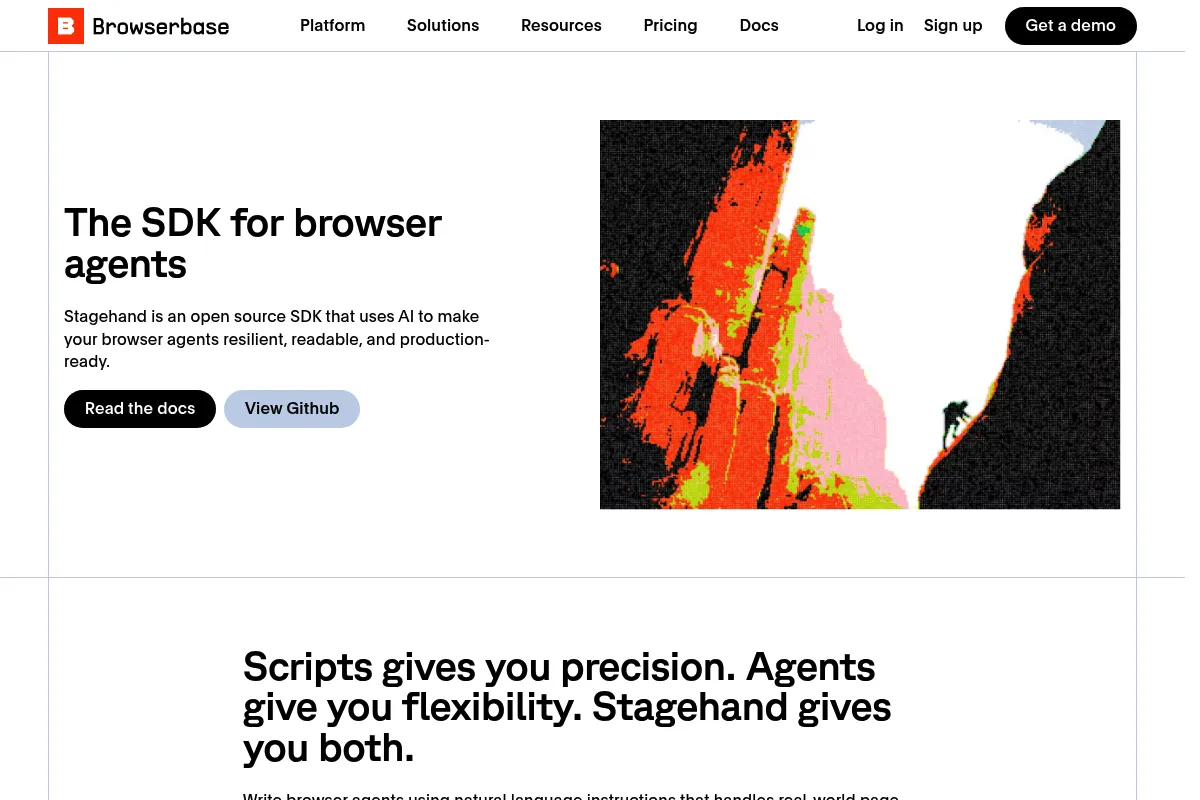
Stagehand is an open-source Playwright wrapper that replaces fragile CSS selectors with LLM-driven natural language actions—best for complex, frequently changing sites where traditional scripts break.
Excellent for developers building resilient web agents and scrapers, but weaker for high-speed, high-volume data extraction due to LLM latency and costs.
Analysis based on product data, pricing structure, traffic signals, and public user sentiment.
Who Should Use Stagehand?
Typical users
Software engineers and AI researchers building web-based agents or scrapers for sites with non-standard UIs.
Maturity fit
scaling
Choose this if…
- You want to write automation scripts in plain English instead of hunting for CSS selectors
- Your target websites change their layout or class names frequently
- You need to extract structured data into JSON without writing custom parsing logic
- You are already using Playwright and want to add AI capabilities to your existing stack
Skip this if…
- You need sub-second execution speeds for your automation
- You have a zero-budget for LLM API tokens (OpenAI/Anthropic)
- You are scraping simple, static sites where basic CSS selectors are 100% reliable
About Stagehand
Stagehand is an open-source browser automation framework built on top of Playwright. It exists to solve the 'brittle selector' problem by using LLMs to interpret page content and execute actions. It allows developers to treat the web as a structured API rather than a mess of HTML.
What it actually does
It provides a simplified SDK with three core functions: act, extract, and observe. Users provide a natural language prompt, and Stagehand uses an LLM to identify the correct elements, perform clicks or typing, and return structured data based on a defined schema.
What makes it different
Unlike proprietary 'AI agent' platforms, Stagehand is an open-source library that gives you full access to the underlying Playwright page object. It is model-agnostic, allowing you to swap between OpenAI, Anthropic, or local models, and it focuses on developer experience rather than a no-code interface.
Key Features
Act Method
Executes complex sequences like 'find the cheapest flight' using English instructions.
Extract Method
Pulls data directly into a typed JSON object without manual mapping.
Observe Method
Generates a list of possible actions on the current page for autonomous agents.
Zod Integration
Ensures extracted data strictly follows your application's data types.
Vision Support
Uses multimodal LLMs to 'see' the page, bypassing hidden or obfuscated elements.
Open Source
MIT licensed, allowing for local hosting and full customization.
Browserbase Integration
Built-in support for hosted browser infrastructure to handle scaling and stealth.
Model Flexibility
Works with GPT-4o, Claude 3.5 Sonnet, or local models via LiteLLM.
Pricing
Stagehand SDK
- Open-source MIT License
- Full access to all SDK methods
- Local execution support
- Community support
LLM Costs
- Pay-as-you-go to OpenAI/Anthropic
- Cost depends on model choice (e.g., GPT-4o vs 4o-mini)
- Vision-enabled models cost more
Browserbase (Optional Infra)
- Hosted browser sessions
- Stealth mode to avoid detection
- Session recording and debugging
- 50 hours of browser time
Pricing checked 4 months ago
Pricing guidance
- When local browser execution is blocked by anti-bot measures
- When you need to scale to hundreds of concurrent browser sessions
- When you need persistent sessions or proxy rotation
- LLM rate limits can throttle your automation speed
- Large DOM sizes may exceed the context window of cheaper LLM models
- Vision-based actions are significantly more expensive than text-based ones
Disruptive open-source model that shifts costs from software licensing to infrastructure and AI tokens.
Pros & Cons
Strengths
-
Significant maintenance reduction
Because it doesn't rely on hardcoded IDs or classes, scripts continue to work even after a website undergoes a major redesign.
-
Fast development cycle
Writing 'click the login button' is significantly faster than inspecting the DOM and writing complex XPath or CSS selectors.
-
Handles unstructured data natively
The extract method can pull information from messy text or varied layouts and format it into clean JSON automatically.
-
Developer-first architecture
It functions as a library, not a walled garden, making it easy to integrate into existing CI/CD pipelines and Node.js projects.
Weaknesses
-
High execution latency
Every AI-driven action requires a round-trip to an LLM provider, making it much slower than traditional scripts.
Affects: Performance-critical applications
-
Variable token costs
Complex pages with large DOM trees consume significant tokens, which can make high-volume scraping expensive.
Affects: Bootstrapped startups and high-scale operations
-
Non-deterministic behavior
LLMs can occasionally hallucinate or fail to find an element that is clearly visible, requiring retry logic.
Affects: Mission-critical automation
Real User Sentiment
Developers are generally impressed by the 'magic' of natural language actions but remain cautious about the cost and speed trade-offs.
Users tend to like
- The simplicity of the 'extract' method with Zod
- Not having to deal with CSS selectors ever again
- Seamless integration with existing Playwright workflows
- The ability to use any LLM provider
Users commonly complain about
- Latency makes it feel sluggish for interactive tasks
- Cost can spike if the DOM is not properly cleaned before sending to the LLM
- Occasional flakiness in complex multi-step flows
Recurring tradeoffs
- You trade execution speed and token cost for significantly lower developer hours and maintenance.
Happiest users
Developers building internal tools or niche scrapers for sites that are notoriously difficult to automate.
Often frustrated
Users trying to build high-speed price trackers or those on a very tight budget for API costs.
Use Cases
E-commerce price monitoring
Extracting product details from sites with dynamic layouts.
Automated QA testing
Writing test cases in English that don't break when the UI changes.
Lead generation
Scraping contact info from LinkedIn or directories into structured JSON.
AI Web Agents
Building bots that can perform tasks like 'book a table' or 'buy a ticket' autonomously.
Competitive intelligence
Monitoring competitor sites for updates without manual script maintenance.
Frequently Asked Questions
Is Stagehand free to use?
The Stagehand SDK is open-source (MIT) and free. However, you must pay for the LLM tokens (e.g., OpenAI or Anthropic) used to process your instructions, and you may choose to pay for hosted browser infrastructure like Browserbase.
How does Stagehand compare to Skyvern?
Skyvern is a full-featured platform/agent, while Stagehand is a lightweight SDK. Stagehand is designed to be imported into your own code as a library, giving you more control over the browser logic compared to Skyvern's more managed approach.
Can I use Stagehand with local LLMs?
Yes. Stagehand uses LiteLLM under the hood, which supports local providers like Ollama or vLLM, though performance will depend on the reasoning capabilities of the local model.
Does it work on sites with CAPTCHAs?
Stagehand itself does not solve CAPTCHAs. You will need to use a browser provider with built-in solvers (like Browserbase) or integrate a third-party CAPTCHA solving service.
Is it faster than Playwright?
No, it is significantly slower. While Playwright executes commands instantly, Stagehand must wait for an LLM to process the page and decide on the next action, adding several seconds of latency per step.
What programming languages are supported?
Currently, Stagehand is primarily a TypeScript/JavaScript library. There is no official Python version as of early 2024, though the community often creates wrappers.
Why trust this page?
This evaluation combines product positioning, pricing analysis, traffic and market signals, and public user sentiment into a single decision-support page. Content is generated editorially — not copied from the vendor's website.
Funding & Company
Founded
2024
Stage
Series b
Total Raised
$67.5M
Latest Round
Series B (Jun 2025)
Notable Investors
Browserbase, the company behind Stagehand, has raised a total of $67.5 million across three rounds since its founding in 2024. [1, 11, 14] The company is backed by top-tier venture firms including Kleiner Perkins, CRV, and Notable Capital, indicating strong investor confidence in its mission to provide browser infrastructure for AI agents. [1, 2, 3]
Market Signals & Traffic
Estimated visits, global rank, geography, traffic sources, monthly visit trends, and organic search keywords (Similarweb)—on a dedicated page built for depth and search.
- Estimated visits
- 0
- Global rank
- —
- Snapshot
- May 2026
- Traffic trend
- Falling
Estimated monthly visits
Alternatives to Stagehand
View all alternativesGitHub Copilot
Developer Tools, AI Assistant

AI-powered coding assistant that suggests and generates code.
Skyvern
Automation, Automation & Agents, Productivity

AI-powered browser automation for complex web workflows.
Firecrawl
Data Extraction, Developer Tools

An API to crawl and scrape any website, turning web data into a structured, LLM-ready format.
Similar Tools
Finic
Automation & Agents, Developer Tools, Data Extraction

Browser automation platform for building and scaling reliable web agents.
browser-use
Automation & Agents, Developer Tools, Data Extraction

Connect LLMs to any website for autonomous browser interaction.
Serval
Automation & Agents, Developer Tools, Data Extraction

Build autonomous agents that navigate and automate web browser tasks.
LaVague
Automation & Agents, Developer Tools, Data Extraction

Open-source framework for building autonomous web agents and automation.
Cookiebot
Privacy & Compliance

Automated cookie consent solution for website privacy law compliance.
Reclaim AI
AI Assistant, Automation, Productivity

AI-powered calendar assistant that automatically schedules tasks, habits, and focus time.