

A procurement orchestration layer that centralizes vendor intake and approvals, best for mid-market teams outgrowing spreadsheets but not ready for legacy ERP bloat.
Excellent for companies needing to control shadow IT and spend, weaker for organizations without a dedicated finance or procurement function.
Analysis based on product data, pricing structure, traffic signals, and public user sentiment.
Who Should Use Omnea?
Typical users
Finance, IT, and Procurement leaders at companies with 200 to 2,000 employees managing high volumes of SaaS and vendor contracts.
Maturity fit
scaling to advanced
Choose this if…
- Your current procurement process relies on fragmented Slack messages and email chains.
- You want to force employees through a single 'front door' for all purchase requests.
- Your priority is reducing manual data entry for Legal and Security teams during vendor onboarding.
Skip this if…
- You have a low volume of new vendor requests and can manage spend via simple credit card controls.
- Your organization lacks the internal resources to define and map complex approval workflows.
- You require a tool with a built-in marketplace for direct purchasing rather than an orchestration layer.
About Omnea
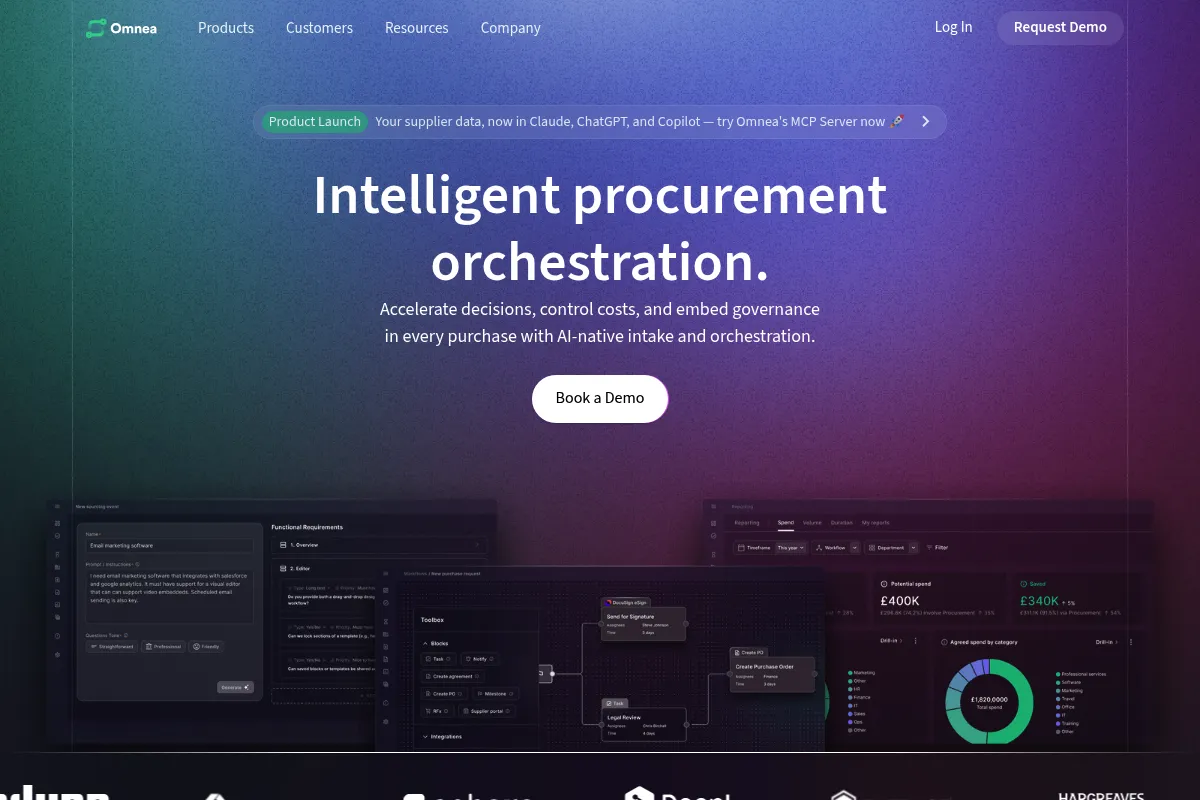
Omnea is a procurement orchestration platform designed to manage the end-to-end lifecycle of supplier spend. It acts as a unified intake portal that connects employees with the necessary finance, legal, and security stakeholders.
Official profiles
What it actually does
The platform automates the intake-to-pay process by routing purchase requests through custom approval chains based on spend amount or department. It centralizes vendor risk assessments, contract renewals, and spend data into a single dashboard.
What makes it different
Unlike legacy procurement tools that focus on the transaction, Omnea focuses on the 'messy middle' of approvals. It prioritizes the employee experience to ensure high adoption, preventing users from bypassing official procurement channels.
Ratings across the web
Ratings aggregated from independent review platforms.
Key Features
Smart Intake Portal
Provides a single entry point for employees to request new software or services.
Cross-Functional Workflows
Parallelizes approvals across Legal, IT, and Finance to reduce cycle times.
Renewal Calendar
Automatically flags upcoming contract expirations to prevent unwanted auto-renewals.
Security Questionnaire Automation
Centralizes SOC2 and security documentation during the onboarding phase.
ERP Integration
Pushes approved vendor and PO data directly into systems like NetSuite or Sage Intacct.
Audit Trails
Maintains a complete history of who approved what and why for compliance purposes.
Pricing
Enterprise
- Full intake-to-pay orchestration
- Unlimited requester users
- Custom approval workflows
- ERP & Slack integrations
- Dedicated Customer Success Manager
Pricing checked 4 months ago
Pricing guidance
- When manual spend management leads to missed renewals
- When the legal/security bottleneck slows down business operations
- When you need to sync procurement data directly to a core ERP
- Implementation fees may apply
- Certain advanced integrations might require higher-tier support
Premium enterprise positioning with pricing based on company size and spend complexity.
Pros & Cons
Strengths
-
High employee adoption
The interface is intuitive enough that employees actually use it, which reduces shadow IT and unapproved spend.
-
Reduced procurement cycle times
By running legal and security reviews in parallel rather than sequentially, teams can onboard vendors significantly faster.
-
Proactive renewal management
Gives finance teams 90-day head starts on renewals, providing the necessary time to negotiate or cancel unused seats.
Weaknesses
-
High implementation effort
Mapping complex, multi-departmental approval logic requires significant time and coordination during the initial setup.
Affects: Operations teams during the first 60 days
-
Integration-dependent value
The tool's effectiveness is limited if it cannot deeply integrate with your specific ERP or SSO provider.
Affects: IT teams with niche tech stacks
-
Enterprise-only pricing
The cost structure is likely prohibitive for small startups with limited vendor counts.
Affects: Early-stage companies
Real User Sentiment
Users generally appreciate the modern UI and the way it simplifies the 'black box' of internal approvals.
Users tend to like
- Clean and modern user interface
- Ease of tracking request status
- Slack integration for quick approvals
- Responsive customer support
Users commonly complain about
- Initial configuration can be tedious
- Reporting features could be more granular
- Occasional lag when updating large vendor databases
Recurring tradeoffs
- Users trade deep, native accounting features for a better 'front-end' orchestration experience.
Happiest users
Finance managers at 500+ person companies who are tired of chasing people for contract signatures.
Often frustrated
Small teams who find the structured workflows too rigid for their informal culture.
Use Cases
SaaS Management
Tracking software licenses and preventing auto-renewals.
New Vendor Onboarding
Routing a new vendor through Security, Legal, and Finance reviews simultaneously.
Spend Control
Ensuring all purchases have an approved PO before money leaves the bank.
Audit Readiness
Keeping a clean record of all vendor contracts and approval history for SOC2 or IPO prep.
Budget Tracking
Giving department heads visibility into their remaining budget before they commit to new spend.
Frequently Asked Questions
How much does Omnea cost?
Omnea does not publish its pricing publicly. It follows a custom enterprise model where pricing is typically based on company size, user count, and the complexity of integrations required. You must book a demo to receive a quote.
How does Omnea compare to Zip?
Both are intake-to-pay orchestration platforms. While Zip is the market leader in the US, Omnea is a strong competitor with a heavy focus on the UK and European markets, often cited for having a more streamlined UI and localized support.
Does Omnea replace my ERP like NetSuite?
No. Omnea sits on top of your ERP. It handles the 'intake' and 'approval' phases, then syncs the finalized data into your ERP (like NetSuite, Sage, or Xero) to handle the actual accounting and payment execution.
What are the main limitations of Omnea?
The primary limitation is the setup time; you cannot simply 'turn it on' and expect it to work without first documenting your internal approval rules. It also lacks a built-in B2B marketplace, meaning it manages your existing vendors rather than helping you find new ones.
Which integrations does Omnea support?
Omnea integrates with major ERPs (NetSuite, Sage Intacct, Microsoft Dynamics), communication tools (Slack, Microsoft Teams), and CLM/Security tools (Ironclad, Jira, OneTrust).
Is there a free trial available?
No, there is no self-service free trial. Because the tool requires integration with your financial systems, onboarding typically involves a guided implementation process with their team.
Why trust this page?
This evaluation combines product positioning, pricing analysis, traffic and market signals, and public user sentiment into a single decision-support page. Content is generated editorially — not copied from the vendor's website.
Funding & Company
Founded
2022
Stage
Series b
Total Raised
$75M
Latest Round
Series B (Sep 2025)
Notable Investors
Omnea has raised a total of $75 million, culminating in a significant $50 million Series B in September 2025 led by premier firms Insight Partners and Khosla Ventures. This substantial and recent funding provides a very strong financial runway, signaling high investor confidence and ensuring operational stability for customers committing to its platform.
Market Signals & Traffic
Estimated visits, global rank, geography, traffic sources, monthly visit trends, and organic search keywords (Similarweb)—on a dedicated page built for depth and search.
- Estimated visits
- 0
- Global rank
- —
- Snapshot
- Apr 2026
- Traffic trend
- —
Estimated monthly visits
Similar Tools
Circleback
AI Assistant, Communication, Productivity

Automated meeting notes, action items, and follow-up emails.
Bolna
AI Assistant, Automation & Agents, Communication

Conversational voice agents for automated phone support and sales calls.
Operator
AI Assistant, Automation & Agents, Communication

Autonomous agents for customer service and support workflows.
v0
Developer Tools, Website Builder, AI Assistant

AI-powered platform to generate full-stack web apps from prompts.
Getty Images (Generative AI)
Content Creation, Design

Create commercially safe images using a licensed creative library.
AppSheet
Automation, Developer Tools, Productivity

No-code platform for building custom business applications and automations.