

A specialized Text-to-SQL infrastructure layer that prioritizes data privacy and schema accuracy over generic chat features, making it a top choice for embedding natural language data access into enterprise applications.
Excellent for developers building secure, data-heavy internal tools, weaker for teams looking for a plug-and-play BI dashboard.
Analysis based on product data, pricing structure, traffic signals, and public user sentiment.
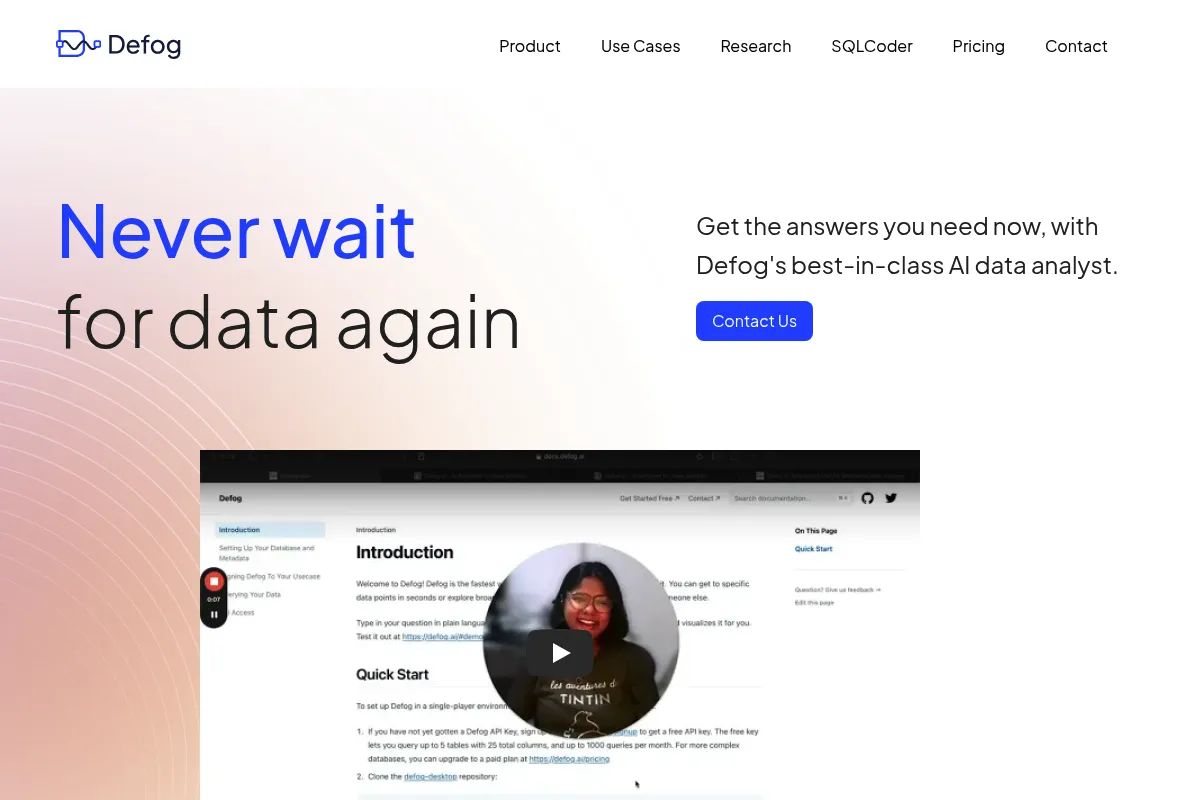
Who Should Use Defog?
Typical users
Product engineers, data analysts, and CTOs at mid-to-large enterprises who need to scale data access without compromising security.
Maturity fit
scaling to advanced
Choose this if…
- You need high accuracy on complex joins and multi-table schemas
- Data privacy is a non-negotiable requirement for your industry
- You want to self-host your LLM to keep all processing on-prem
- You are building a custom data product and need a reliable API
Skip this if…
- You want a standalone BI tool with built-in drag-and-drop dashboards
- Your database schema is messy, undocumented, or lacks clear relationships
- You lack the engineering resources to integrate an API or manage metadata
About Defog
Defog is an infrastructure layer for natural language data querying that bridges the gap between non-technical questions and structured database schemas. It provides specialized LLMs and an API designed to be embedded directly into existing software products.
Official profiles
What it actually does
Defog translates plain English questions into precise SQL queries by analyzing database metadata rather than the raw data itself. It executes these queries within the user's secure environment and can return results as raw data, visualizations, or multi-step reports.
What makes it different
Unlike generic wrappers for OpenAI, Defog uses its own fine-tuned models called SQLCoder, which are specifically optimized for SQL generation and frequently outperform GPT-4 on complex schema benchmarks. Its architecture is strictly metadata-only, ensuring that sensitive customer data never reaches Defog's servers.
Ratings across the web
Ratings aggregated from independent review platforms.
Key Features
SQLCoder LLM
Specialized models (8B to 70B) that match or exceed GPT-4 accuracy for database tasks.
Defog Agents
AI assistants that decompose complex questions into discrete, executable sub-tasks.
Metadata Indexing
Maps your database schema so the AI understands table relationships without seeing your data.
On-Prem Deployment
Option to host the entire stack locally for maximum security compliance.
Metric Definitions
Allows teams to define 'source of truth' business metrics once for consistent AI answers.
Statistical Modeling
Built-in support for running t-tests and regressions via natural language.
Slack Integration
Query your database and get charts directly within team chat workflows.
Pricing
Open Source (SQLCoder)
- Access to SQLCoder-8B, 14B, 32B, and 70B models
- Self-managed infrastructure
- Community support via GitHub
- Full control over data and model
Enterprise (Cloud Hosted)
- 20,000+ queries per month
- One-click Docker deployment
- SSO Authentication
- Custom AI tools and fine-tuning
- White-glove onboarding
- Priority support
Enterprise (Self-hosted)
- Unlimited queries
- Hosted on your own infrastructure
- No rate limits
- Custom model fine-tuning
- SLA, MSA, and DPA available
Pricing checked 4 months ago
Pricing guidance
- When you need SSO for team-wide access
- When query volume exceeds 20,000 per month
- When you require custom fine-tuning on your specific business logic
- Self-hosting the 70B model requires at least 40GB+ of VRAM
- Cloud tier query limits are based on questions asked, not just successful SQL generations
Premium enterprise positioning justified by specialized model performance and high security standards.
Pros & Cons
Strengths
-
Superior accuracy on complex schemas
SQLCoder is trained on hand-crafted datasets that handle difficult joins and aggregations better than general-purpose models like GPT-3.5.
-
Zero-data privacy model
By only sending metadata (table and column names) to the model, it satisfies strict compliance requirements in healthcare and finance.
-
Developer-first integration
The API-first approach and Docker support make it easy for product teams to add 'Ask your data' features to their own SaaS products.
Weaknesses
-
High hardware requirements for self-hosting
Running the larger SQLCoder models (34B or 70B) requires significant VRAM, typically necessitating A100 or H100 GPUs.
Affects: Teams opting for the self-hosted enterprise tier
-
Requires clean metadata
The system's accuracy is heavily dependent on how well your tables and columns are named and documented.
Affects: Organizations with legacy databases or poor documentation
-
Steep entry price for managed cloud
The $5,000/month starting price for the Enterprise Cloud tier is a significant jump from basic AI tools.
Affects: Early-stage startups and small teams
Real User Sentiment
Users generally praise Defog for its technical depth and the fact that it doesn't require moving data to a third-party cloud.
Users tend to like
- SQLCoder's performance on complex queries
- The metadata-only privacy architecture
- Availability of high-quality open-source models
- Responsiveness of the engineering team
Users commonly complain about
- High cost for the managed version
- Initial effort required to 'teach' the AI about custom business definitions
- Hardware costs for running large models locally
Recurring tradeoffs
- You trade a higher setup effort (metadata mapping) for significantly higher query accuracy compared to GPT-4.
Happiest users
Security-conscious CTOs and product managers building data-heavy features for enterprise clients.
Often frustrated
Non-technical business owners looking for a quick, zero-setup dashboard tool.
Use Cases
Embedded Analytics
Adding a natural language search bar to your SaaS product for customer data.
Internal Data Access
Letting non-technical PMs and Sales teams query the production database safely.
Automated Reporting
Using Defog Agents to generate weekly performance reports in Slack.
Privacy-Compliant Analysis
Querying sensitive healthcare or financial data without it leaving the VPC.
Database Exploration
Helping developers quickly find data across hundreds of tables without writing manual joins.
Frequently Asked Questions
Does Defog ever see my actual database records?
No. Defog only processes your database metadata (table names, column names, and types). The actual data stays within your infrastructure, and the generated SQL is executed locally by a microservice.
How does Defog compare to Vanna.ai?
Vanna is an open-source Python framework that is highly customizable for developers. Defog is more of a production-ready infrastructure layer with its own specialized models (SQLCoder) and a focus on enterprise-grade security and managed services.
Is there a free version of Defog?
Yes, Defog has open-sourced its SQLCoder models on HuggingFace and GitHub. You can use these models for free if you have the hardware to host them yourself.
What databases does Defog support?
It supports most major structured databases and data warehouses, including PostgreSQL, MySQL, Snowflake, BigQuery, Redshift, and SQL Server.
Can it handle complex queries with many joins?
Yes, this is Defog's primary strength. Its SQLCoder models are specifically trained on complex schemas with 4 to 20+ tables, making it much more reliable than generic LLMs for deep relational queries.
Do I need to be a developer to set up Defog?
Yes, the initial setup requires connecting to your database and mapping metadata, which typically requires a data engineer or developer. Once set up, non-technical users can use the interface easily.
Why trust this page?
This evaluation combines product positioning, pricing analysis, traffic and market signals, and public user sentiment into a single decision-support page. Content is generated editorially — not copied from the vendor's website.
Funding & Company
Founded
2023
Stage
Seed
Total Raised
$2.7M
Latest Round
Seed (Nov 2023)
Notable Investors
Defog has raised a total of $2.7M over two rounds in 2023, including a $2.2M Seed round. Backed by prominent investors like Y Combinator and Script Capital, the funding provides a solid foundation for developing its open-source LLMs for data analysis and establishing its enterprise offering.
Market Signals & Traffic
Estimated visits, global rank, geography, traffic sources, monthly visit trends, and organic search keywords (Similarweb)—on a dedicated page built for depth and search.
- Estimated visits
- 0
- Global rank
- —
- Snapshot
- May 2026
- Traffic trend
- Falling
Estimated monthly visits
Alternatives to Defog
View all alternatives
Similar Tools
SGLang
Developer Tools, Automation & Agents, Workflow

High-performance framework for structured and efficient model inference.
Creatomate
Video Creation, Automation, Marketing Automation

Automate video and image creation through templates and data feeds
Airia
Developer Tools, Automation, Privacy & Compliance

Enterprise orchestration platform for managing and scaling model deployments.
AI21 Labs
Developer Tools, AI Assistant, Content Creation

Foundation models and developer tools for building language-based applications.
Back4App
Developer Tools, Automation & Agents, Workflow

Backend-as-a-Service platform for building and scaling applications.
Atomic AI
Research, Health & Wellness

Platform for RNA-targeted drug discovery and structural biology research