

SillyTavern
A specialized local frontend for LLM roleplay that prioritizes deep customization and context management over user-friendliness.
Excellent for power users who want uncensored, character-driven storytelling, but too complex for those seeking a simple chat interface.
Analysis based on product data, pricing structure, traffic signals, and public user sentiment.
Who Should Use SillyTavern?
Typical users
Individual hobbyists, creative writers, and roleplayers who use local LLMs or paid APIs like OpenRouter and Anthropic.
Maturity fit
advanced
Choose this if…
- You want total control over character 'memory' and world-building lore
- You need to bypass the restrictive filters of mainstream web platforms
- You want to use one interface to switch between local models and various cloud APIs
- Your priority is privacy and keeping your chat logs on your own hardware
Skip this if…
- You are uncomfortable using GitHub, Node.js, or command-line interfaces
- You want a 'plug-and-play' mobile app experience without self-hosting
- You only need a basic assistant for productivity tasks rather than creative roleplay
About SillyTavern
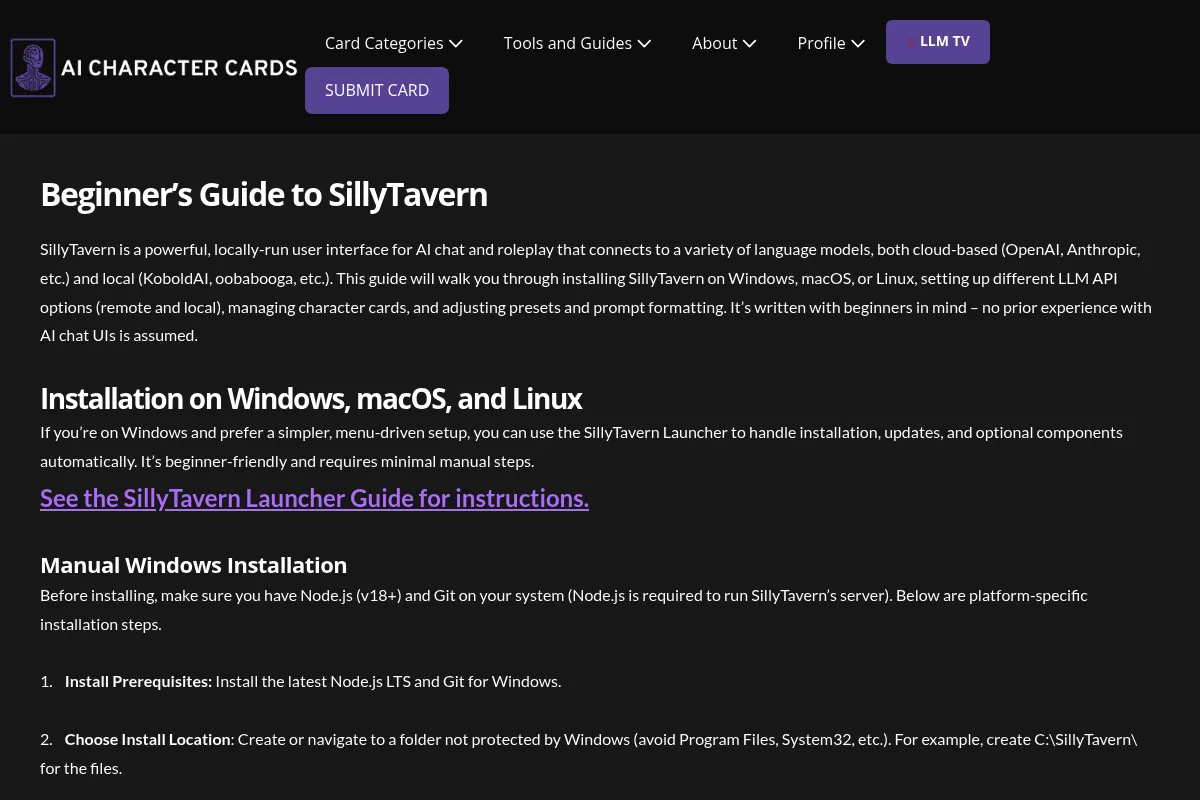
SillyTavern is an open-source, self-hosted interface designed to sit between a user and a Large Language Model (LLM). It is a fork of the original TavernAI project, built specifically to enhance character-based interactions through advanced prompt management and local extensions.
What it actually does
It provides a rich UI for managing character cards, world-building 'Lorebooks,' and group chats. It formats user input and character data into complex prompts that it sends to backends like KoboldCPP, Oobabooga, OpenAI, or OpenRouter, then displays the AI's response with custom avatars and formatting.
What makes it different
Unlike standard chat interfaces, SillyTavern treats the LLM as a backend engine rather than a product. It allows for 'World Info'—a system that injects specific lore into the AI's memory only when relevant keywords are mentioned—preventing the model from forgetting crucial details in long stories.
Key Features
Lorebooks
Automatically injects relevant world details into the context window based on keyword triggers.
Character Cards
Portable files containing a character's personality, history, and speech patterns.
Group Chats
Enables multiple AI characters to interact with each other and the user in a single thread.
Expression Sets
Swaps character avatars dynamically by analyzing the sentiment of the AI's response.
Extension Support
Connects to Stable Diffusion for visual character responses or ElevenLabs for voice.
Prompt Formatting
Gives users granular control over how the story, character, and chat history are sent to the model.
Auto-Summarization
Periodically condenses chat history to keep the most important plot points within the model's context limit.
Pricing
Open Source
- Full access to all features
- Local hosting
- Extension support
- Character/Lorebook management
Pricing checked 5 months ago
Pricing guidance
- When you want to use paid APIs like OpenAI or Anthropic
- When you need more VRAM to run larger local models
- When you choose to use paid TTS services like ElevenLabs
- API costs can scale rapidly with long roleplay sessions
- Local performance is strictly limited by your computer's GPU VRAM
- Some cloud providers may flag or ban accounts for certain types of roleplay content
Completely free software that requires users to bring their own compute or API keys.
Pros & Cons
Strengths
-
Unmatched customization
Users can tweak every aspect of the AI's behavior, from the temperature of the model to the specific way the prompt is structured.
-
Privacy and local control
Because it runs locally, your logs and character data never leave your machine unless you use a third-party cloud API.
-
Active community ecosystem
A massive library of user-created character cards and lorebooks is available on sites like Chub.ai, making it easy to get started.
-
Hardware flexibility
It works equally well with a high-end local GPU setup or a low-powered laptop connecting to an external API.
Weaknesses
-
High technical barrier to entry
Requires installing Node.js and potentially managing local LLM backends, which is intimidating for non-technical users.
Affects: Beginners
-
Overwhelming UI
The interface is cluttered with dozens of sliders, menus, and settings that can be difficult to navigate without a guide.
Affects: Casual users
-
No native mobile app
Using it on mobile requires running it through Termux or hosting a server on a PC and accessing it via a web browser.
Affects: Mobile-first users
Real User Sentiment
Users generally view SillyTavern as the most powerful tool in its category, though they acknowledge the steep learning curve.
Users tend to like
- The depth of the Lorebook system
- The ability to use any model via OpenRouter
- Dynamic character expressions
- The frequent update cycle
Users commonly complain about
- Difficulty of the initial setup
- UI can feel 'janky' or unpolished
- Occasional breaking changes in updates
Recurring tradeoffs
- You trade ease of use for total control over the AI's output and privacy.
Happiest users
Technical hobbyists who enjoy 'tinkering' with settings to get the perfect AI response.
Often frustrated
People who just want to click a button and start chatting without configuring backends or prompts.
Use Cases
Creative Writing
Using Lorebooks to keep track of complex fantasy world rules and character backstories.
Roleplay
Engaging in long-form, uncensored stories with specific fictional characters.
Model Testing
Comparing how different LLMs (like Llama 3 vs. Claude 3) handle specific character personas.
Language Practice
Creating a character card for a tutor to practice conversational skills in a foreign language.
Group Simulation
Setting up a 'council' of different AI experts to discuss a specific topic in a group chat.
Frequently Asked Questions
Is SillyTavern free to use?
The SillyTavern software is 100% free and open-source. However, if you connect it to a paid API like OpenAI, Anthropic, or OpenRouter, you will still have to pay those providers for the tokens you consume. If you run a model locally (e.g., via KoboldCPP), it is completely free.
How does SillyTavern compare to Character.ai?
Character.ai is a centralized, filtered web platform that is easy to use but offers limited customization. SillyTavern is a local frontend that allows for uncensored content, much deeper memory management (Lorebooks), and the ability to choose your own AI model, but it requires a manual setup.
Can I run SillyTavern on my phone?
There is no official app store version. Android users can run it locally using Termux, or you can run SillyTavern on your home computer and access the UI through your phone's browser by enabling the 'whitelist' or 'remote access' settings in the config.
What is a Lorebook?
A Lorebook (or World Info) is a collection of entries that SillyTavern monitors. When you mention a specific keyword in chat, the software automatically inserts the corresponding entry into the AI's prompt. This allows the AI to 'remember' thousands of details without filling up its limited short-term memory.
Does SillyTavern include the AI model?
No. SillyTavern is only a 'skin' or interface. You must connect it to a 'backend' that actually runs the AI, such as a local provider (KoboldCPP, Oobabooga, LM Studio) or a cloud provider (OpenRouter, OpenAI, Anthropic).
Is my data private on SillyTavern?
If you run SillyTavern and a local backend (like KoboldCPP), your data never leaves your computer. If you use a cloud API (like OpenAI), your logs are sent to that company according to their specific privacy policy.
Why trust this page?
This evaluation combines product positioning, pricing analysis, traffic and market signals, and public user sentiment into a single decision-support page. Content is generated editorially — not copied from the vendor's website.
Funding & Company
Founded
2023
Stage
Bootstrapped
Total Raised
Bootstrapped
Latest Round
—
SillyTavern is a non-commercial, open-source software project, not a venture-backed company. It has no external funding and explicitly does not accept monetary donations for the project itself. [2, 6] Its stability and longevity are derived from its active development community and user base, not from financial investment.
Market Signals & Traffic
Estimated visits, global rank, geography, traffic sources, monthly visit trends, and organic search keywords (Similarweb)—on a dedicated page built for depth and search.
- Estimated visits
- 469
- Global rank
- #6,065,192
- Snapshot
- Apr 2026
- Traffic trend
- Falling
Estimated monthly visits
Alternatives to SillyTavern
View all alternatives
Similar Tools
Cline
Developer Tools, AI Assistant, Automation & Agents

Autonomous coding agent for IDEs and terminal-based development workflows.
Synthesys
Content Creation, Video Creation, AI Assistant

AI-powered platform for generating realistic videos and voiceovers.
Joyfun AI
Gaming, Communication

Immersive roleplay platform for chatting with customizable virtual characters.
Parea
Developer Tools, Automation, Workflow

Platform for evaluating, testing, and monitoring LLM applications.
Character AI
AI Assistant, Content Creation
Create and chat with AI characters for entertainment and storytelling.
Vorlon
Privacy & Compliance, Developer Tools

Secure and monitor third-party AI integrations and data flow.