

Skild AI
A hardware-agnostic foundation model designed to serve as a universal 'brain' for robots, prioritizing cross-platform physical intelligence over specific hardware development.
Excellent for robotics OEMs and industrial researchers needing generalized intelligence across diverse forms, weaker for teams seeking turnkey, consumer-ready applications.
Analysis based on product data, pricing structure, traffic signals, and public user sentiment.
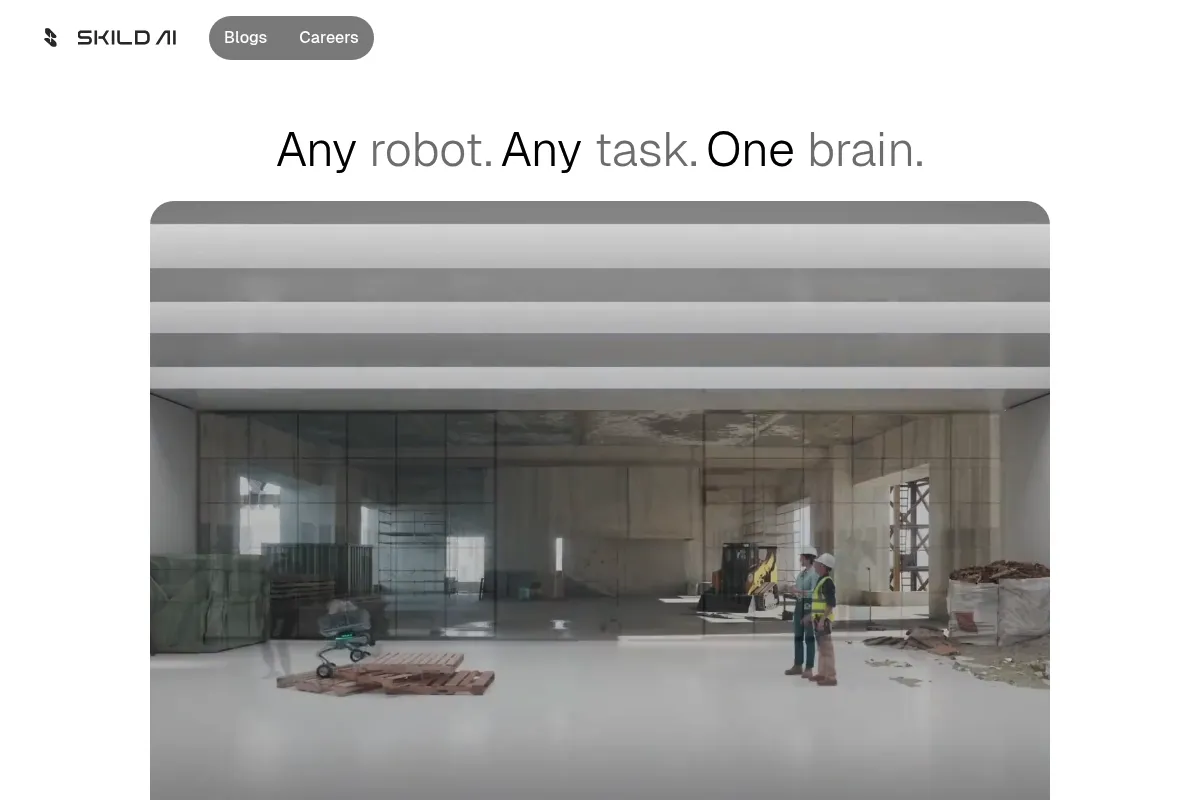
Who Should Use Skild AI?
Typical users
Robotics engineers, hardware manufacturers (OEMs), and industrial automation R&D teams.
Maturity fit
advanced
Choose this if…
- You operate a fleet of diverse hardware (e.g., both quadrupeds and manipulators) and need a unified intelligence layer.
- Your priority is zero-shot adaptation to unstructured environments over rigid, pre-programmed paths.
- You want to leverage a model trained on massive physical datasets rather than collecting your own from scratch.
Skip this if…
- You need a finished, out-of-the-box robot for a specific consumer task.
- Your workflow requires a fully open-source model with local-only execution and no vendor dependency.
- You are a small business looking for low-cost, simple automation scripts.
About Skild AI
Skild AI is a robotics foundation model company founded by former CMU professors and researchers from Meta and Nvidia. It focuses on 'physical intelligence,' creating a scalable model that allows robots to perceive and interact with the world regardless of their mechanical configuration.
Official profiles
What it actually does
The platform provides the 'Skild Brain,' a large-scale neural network that controls robotic movement and task execution. It enables robots to perform complex manipulation and locomotion tasks in real-world settings, such as navigating cluttered warehouses or handling varied industrial materials.
What makes it different
Unlike competitors building proprietary humanoid hardware, Skild is hardware-agnostic. Their model is designed to be 'poured' into any robot—from a one-armed industrial bot to a four-legged walker—leveraging a training dataset significantly larger than standard academic or industry sets.
Key Features
Skild Brain
A foundation model that generalizes physical tasks across different robot morphologies.
Hardware Agnosticism
Support for quadrupeds, bipeds, and industrial manipulators within a single framework.
Unstructured Navigation
Capabilities for robots to operate in messy, real-world environments without manual mapping.
Large-scale Data Engine
A proprietary pipeline for training models on 1,000x more data than typical robotics projects.
General-Purpose Manipulation
Enables robots to pick, place, and interact with objects they haven't encountered during specific training.
Pricing
Enterprise / Developer Access
- Access to Skild Brain foundation model
- Hardware integration support
- Custom fine-tuning capabilities
- Scalable deployment options
Pricing checked 5 months ago
Pricing guidance
- Moving from simulation to real-world hardware deployment
- Scaling from a single robot type to a heterogeneous fleet
- Requiring custom fine-tuning on proprietary industrial data
- Likely requires high-performance edge computing hardware
- API or licensing costs may scale with the number of deployed units
Premium enterprise positioning aimed at the top tier of the robotics and automation market.
Pros & Cons
Strengths
-
Extreme hardware flexibility
The model's ability to run on different mechanical forms prevents vendor lock-in and allows companies to use one intelligence layer for their entire fleet.
-
Reduced training overhead
By using a foundation model, developers spend less time on task-specific reinforcement learning and more on high-level application logic.
-
High-tier research pedigree
Founded by leading experts in computer vision and robotics, ensuring the underlying architecture is at the forefront of the field.
Weaknesses
-
High barrier to entry
As a high-end foundation model, it is likely priced and structured for enterprise-scale R&D rather than small-scale prototyping.
Affects: Startups and independent developers
-
Early-stage ecosystem
The platform is still in a scaling phase with limited public documentation or community-driven troubleshooting resources compared to ROS.
Affects: Implementation teams
-
Proprietary 'Black Box'
Users are dependent on Skild's closed-source model, which may pose risks for industries requiring total transparency in safety-critical logic.
Affects: Safety and compliance officers
Real User Sentiment
The sentiment among robotics researchers and industry insiders is highly optimistic due to the founders' reputations, though end-user feedback is scarce as the tool is not yet in wide release.
Users tend to like
- The hardware-agnostic approach
- The massive scale of the training data
- The pedigree of the founding team
Users commonly complain about
- Lack of public documentation
- Closed-source nature of the 'Brain'
- High capital requirements for implementation
Recurring tradeoffs
- Users trade off full control over low-level motor logic for the speed and generalization of a foundation model.
Happiest users
R&D leads at major logistics or manufacturing firms who need to solve 'impossible' manipulation tasks.
Often frustrated
Hobbyists or small-scale integrators who cannot get access or find the platform too expensive for simple tasks.
Use Cases
Warehouse Automation
Enabling robots to sort and pack items of varying shapes and sizes without custom programming.
Industrial Inspection
Powering quadrupeds to navigate complex, changing environments like oil rigs or construction sites.
Home Robotics
Providing the intelligence for future domestic bots to handle laundry or kitchen tasks.
Research & Development
Using the Skild Brain as a baseline to test new robotic hardware designs.
Last-Mile Delivery
Improving the navigation and obstacle avoidance of autonomous delivery vehicles in urban settings.
Frequently Asked Questions
How much does Skild AI cost?
Pricing is not public. Skild AI operates on a B2B model, requiring direct contact with their sales or partnership teams for custom quotes based on deployment scale and hardware needs.
How does Skild AI compare to Figure or Tesla Optimus?
Figure and Tesla are building both the hardware (humanoid robots) and the software. Skild AI focuses primarily on the software (the 'Brain'), aiming to be the operating system that can run on Figure, Tesla, or any other robot hardware.
Is Skild AI open source?
No, Skild AI is a proprietary foundation model. While the founders have contributed significantly to open-source research in the past, the Skild Brain itself is a commercial product.
What hardware is compatible with Skild AI?
The model is designed to be hardware-agnostic, meaning it can theoretically support any robot with sensors and actuators, including robotic arms, quadrupeds (like Boston Dynamics' Spot), and humanoids.
Does Skild AI require an internet connection to work?
While training happens in the cloud, deployment typically involves 'edge' execution. However, specific details on offline capabilities depend on the integration and hardware used.
What are the main limitations of Skild AI?
The primary limitations are its current 'early access' status and the high computational power required to run large-scale foundation models on the edge, which may increase hardware costs.
Why trust this page?
This evaluation combines product positioning, pricing analysis, traffic and market signals, and public user sentiment into a single decision-support page. Content is generated editorially — not copied from the vendor's website.
Funding & Company
Founded
2023
Stage
Series c
Total Raised
$1.71B
Latest Round
Series C (Jan 2026)
Notable Investors
Skild AI is exceptionally well-capitalized, having raised over $1.7 billion since its founding in 2023. A massive $1.4 billion Series C in January 2026, led by SoftBank at a $14 billion valuation, provides a multi-year runway to pursue its ambitious goal of creating a general-purpose AI for robotics. This significant financial backing from top-tier venture and strategic investors signals strong market confidence and ensures operational stability for the foreseeable future.
Market Signals & Traffic
Estimated visits, global rank, geography, traffic sources, monthly visit trends, and organic search keywords (Similarweb)—on a dedicated page built for depth and search.
- Estimated visits
- 55,290
- Global rank
- #624,338
- Snapshot
- Apr 2026
- Traffic trend
- Falling
Estimated monthly visits
Alternatives to Skild AI
View all alternatives
Similar Tools
Make AI
Automation & Agents, Developer Tools

Visual platform to connect apps and automate workflows without code.
crewAI
Automation & Agents, Developer Tools

Framework for orchestrating collaborative autonomous agents for complex workflows.
Pipedream
Automation & Agents, Developer Tools

Integration platform for developers to build and run event-driven workflows.
MuleSoft Anypoint Platform
Automation & Agents, Developer Tools

Connect applications, data, and devices through APIs and automated workflows.
Pinecone
Developer Tools, Search

Managed vector database for building scalable search and RAG applications
Outlit
Automation, Productivity, Workflow

Automated contract review and negotiation platform for legal teams