

A specialized voice cloning and singing synthesis platform that bridges the gap between professional text-to-speech and hobbyist AI covers, though it lacks the enterprise-grade polish of ElevenLabs.
Excellent for creators making AI singing covers and custom voice memes, weaker for high-stakes commercial narration or long-form audiobook production.
Analysis based on product data, pricing structure, traffic signals, and public user sentiment.
Who Should Use VoiceMy.ai?
Typical users
Solo content creators, meme-makers, and experimental musicians looking to swap vocals or clone specific voices for short-form content.
Maturity fit
beginner to scaling
Choose this if…
- Your primary goal is creating AI-generated singing covers
- You want access to a large community library of pre-trained RVC models
- You need to clone a voice quickly with minimal technical setup
Skip this if…
- You require broadcast-quality long-form narration with deep emotional nuance
- Your workflow depends on API-first integration for high-volume production
- You need a tool with strict, built-in copyright safeguards for enterprise use
About VoiceMy.ai
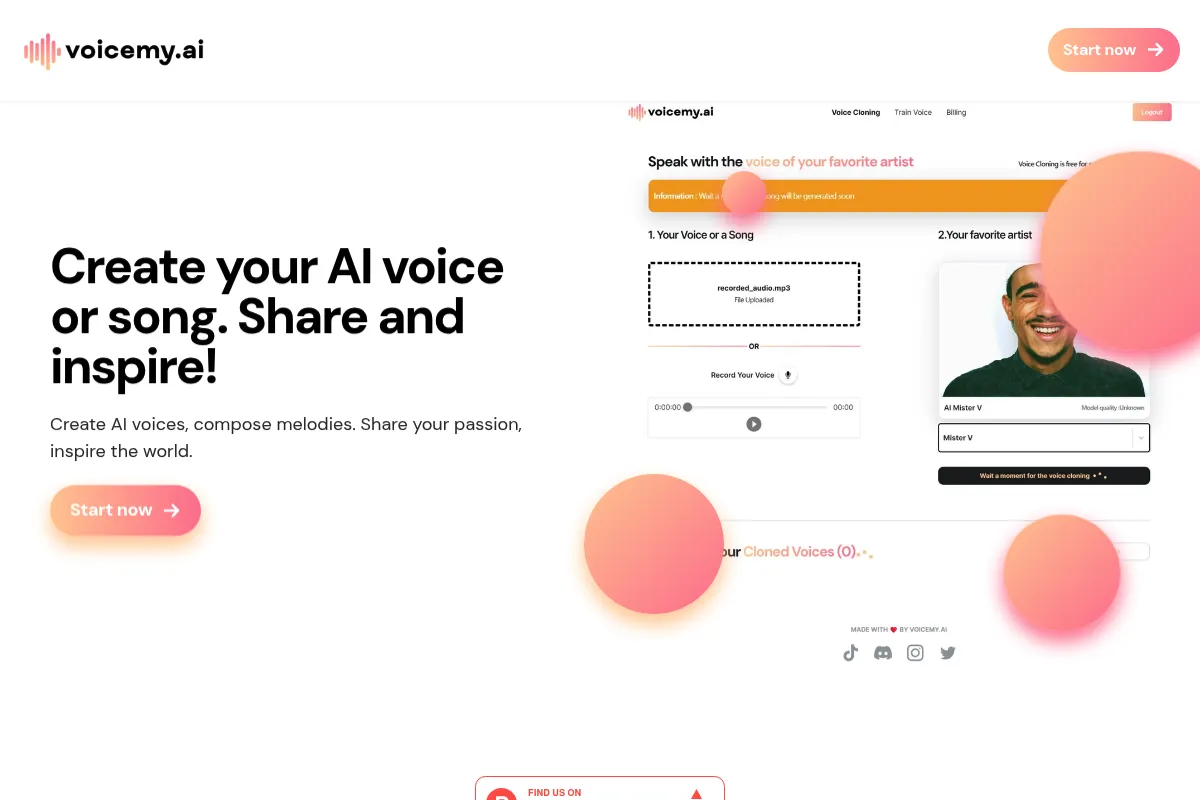
VoiceMy.ai is a web-based audio tool focused on voice cloning and vocal transformation. It primarily serves the niche of 'AI Covers' and custom voiceovers by utilizing RVC (Retrieval-based Voice Conversion) technology.
Official profiles
What it actually does
The platform allows users to upload audio files to swap voices, train custom voice models from 1-10 minutes of data, and generate text-to-speech narrations. It features a community-driven marketplace where users can use public voice models for their own projects.
What makes it different
Unlike general TTS tools that focus on clarity, VoiceMy.ai prioritizes musicality and 'vocal identity.' It is built specifically to handle the pitch and tone shifts required for singing, making it more of a creative instrument than a standard utility.
Ratings across the web

Ratings aggregated from independent review platforms.
Key Features
Voice Training
Create a digital clone by uploading a clean audio sample of any voice.
AI Covers
Upload a song and replace the original singer with a cloned or community voice.
Speech-to-Speech
Change your own voice's identity while maintaining your original delivery and emotion.
Community Library
Access thousands of user-contributed voices ranging from celebrities to fictional characters.
Text-to-Speech
Convert written scripts into audio using cloned voices with adjustable parameters.
Vocal Remover
Extract vocals from background music to prepare tracks for voice swapping.
Model Export
Download trained models for use in local RVC environments.
Pricing
Free
- 10 Credits total
- Access to community voices
- Basic TTS features
- Standard processing speed
Starter
- 100 Credits per month
- Train up to 2 custom voices
- Priority processing
- Commercial usage rights (for custom voices)
Pro
- 300 Credits per month
- Train up to 10 custom voices
- Highest processing priority
- Advanced voice settings
Elite
- 1000 Credits per month
- Unlimited custom voice training
- Early access to new features
- Dedicated support
Pricing checked 6 months ago
Pricing guidance
- When you need to train a custom voice (costs ~50 credits)
- When you exceed 10 minutes of audio generation per month
- When you need faster processing times for long audio files
- Credits typically do not roll over to the next month
- Training a high-quality model often requires multiple attempts, draining credits quickly
- Commercial rights are limited to voices you own/train, not community voices
Mid-range pricing that targets the hobbyist-to-prosumer market, positioned as a cheaper alternative to high-end studio time.
Pros & Cons
Strengths
-
Low barrier to entry for AI singing
Simplifies the complex RVC training process into a few clicks, making it accessible to creators without technical backgrounds.
-
Large community ecosystem
The library of pre-trained voices is extensive, allowing users to experiment with different personas without needing to train their own models.
-
Effective speech-to-speech conversion
Maintains the cadence and inflection of the original speaker better than standard text-to-speech, which is vital for character acting.
Weaknesses
-
Credit-based pricing friction
The credit system can be expensive for users who need to iterate frequently, as failed trainings or generations still consume balance.
Affects: Power users and experimental creators
-
Inconsistent output quality
Quality is heavily dependent on the source audio; poor training data results in metallic or robotic artifacts that require manual cleanup.
Affects: Professional audio engineers
-
Ethical and copyright gray areas
The platform hosts many celebrity and character voices without clear licensing, posing a risk for commercial creators.
Affects: Commercial agencies and brands
Real User Sentiment
Users generally appreciate the ease of use for creating song covers, though there is recurring frustration regarding the credit system and occasional server lag.
Users tend to like
- Speed of voice training
- Quality of singing covers compared to standard TTS
- Ease of using community-made models
Users commonly complain about
- Credits being consumed for poor-quality outputs
- Lack of granular editing tools for the generated audio
- UI can feel cluttered with community content
Recurring tradeoffs
- Ease of use vs. control: It's faster than local RVC but offers fewer technical parameters to tweak.
Happiest users
Social media creators making parody songs or meme content who need quick results without technical overhead.
Often frustrated
Professional voice actors or developers who need high-fidelity API access and predictable pricing.
Use Cases
Parody Music
Swapping a famous singer's voice onto a new track for social media content.
Podcast Intro Branding
Creating a consistent brand voice for intros and outros without hiring talent.
Game Development
Generating placeholder or final character voices for indie games using custom clones.
Content Localization
Using speech-to-speech to maintain a creator's original tone while changing the language.
Meme Generation
Quickly applying recognizable voices to short video clips for viral potential.
Frequently Asked Questions
How many credits does it cost to train a voice?
Training a custom voice model on VoiceMy.ai typically costs 50 credits. This means the Free plan is insufficient for training, and the Starter plan allows for roughly two trainings per month, assuming no other credits are used for generation.
How does VoiceMy.ai compare to ElevenLabs?
ElevenLabs is the industry leader for high-fidelity, natural-sounding text-to-speech narration. VoiceMy.ai is superior for singing and vocal covers because it uses RVC technology, which handles pitch and melody better than ElevenLabs' current models.
Can I use the generated voices for commercial projects?
You generally have commercial rights to the audio generated using voices you have trained yourself on a paid plan. However, using community voices (like celebrity clones) for commercial purposes is a significant legal risk and is usually prohibited by the platform's terms of service.
What audio format is best for training a voice?
For the best results, upload 5-10 minutes of clean, dry audio (no background music or effects) in WAV or high-quality MP3 format. The cleaner the source, the less robotic the final clone will sound.
Does VoiceMy.ai offer an API?
As of now, VoiceMy.ai is primarily a web-based platform for manual use. It does not offer a robust, public API comparable to ElevenLabs or Play.ht, making it less ideal for developers building automated workflows.
Can I download my trained models?
Yes, paid plans typically allow you to download the trained RVC model files (.pth and .index). This is a major advantage as it allows you to use your models in other local RVC software without paying for further generation credits.
Why trust this page?
This evaluation combines product positioning, pricing analysis, traffic and market signals, and public user sentiment into a single decision-support page. Content is generated editorially — not copied from the vendor's website.
Funding & Company
Founded
2023
Stage
Bootstrapped
Total Raised
Bootstrapped
Latest Round
—
Founded in 2023, VoiceMy.ai is a bootstrapped company that has not raised any external venture capital funding. Its operations are funded directly by its own revenue, indicating a focus on product-market fit and profitability from an early stage.
Market Signals & Traffic
Estimated visits, global rank, geography, traffic sources, monthly visit trends, and organic search keywords (Similarweb)—on a dedicated page built for depth and search.
- Estimated visits
- 8,789
- Global rank
- #1,700,531
- Snapshot
- Apr 2026
- Traffic trend
- Falling
Estimated monthly visits
Alternatives to VoiceMy.ai
View all alternativesElevenLabs
Content Creation, AI Assistant

AI-powered platform for realistic speech, voice cloning, and audio generation.
Murf AI
Content Creation, Video Creation

AI voice generator for creating realistic text-to-speech voiceovers.
Resemble AI
Content Creation, AI Assistant
AI-powered voice cloning and speech synthesis platform.
Similar Tools
Weights
Content Creation, Music Generation

Platform for discovering, sharing, and creating custom voice models
Myinstants
Content Creation, Music Generation

Instant soundboard for memes, sound effects, and audio clips.
RVC.AI
Content Creation, Music Generation

Create and use custom voice conversion models for audio projects.
Resemble AI
Content Creation, AI Assistant
AI-powered voice cloning and speech synthesis platform.
DeepBrain AI
Video Creation, Content Creation

AI-powered video creation with customizable avatars and text-to-video.
Rask AI
Video Creation, Communication, Training & Onboarding

Video localization and dubbing platform for global content distribution.