

A managed authentication service for React and Next.js that prioritizes developer speed through pre-built UI components, though costs scale quickly for high-volume B2C apps.
Excellent for B2B SaaS teams needing to ship complex auth and org management in hours, weaker for high-traffic apps with low revenue per user.
Analysis based on product data, pricing structure, traffic signals, and public user sentiment.
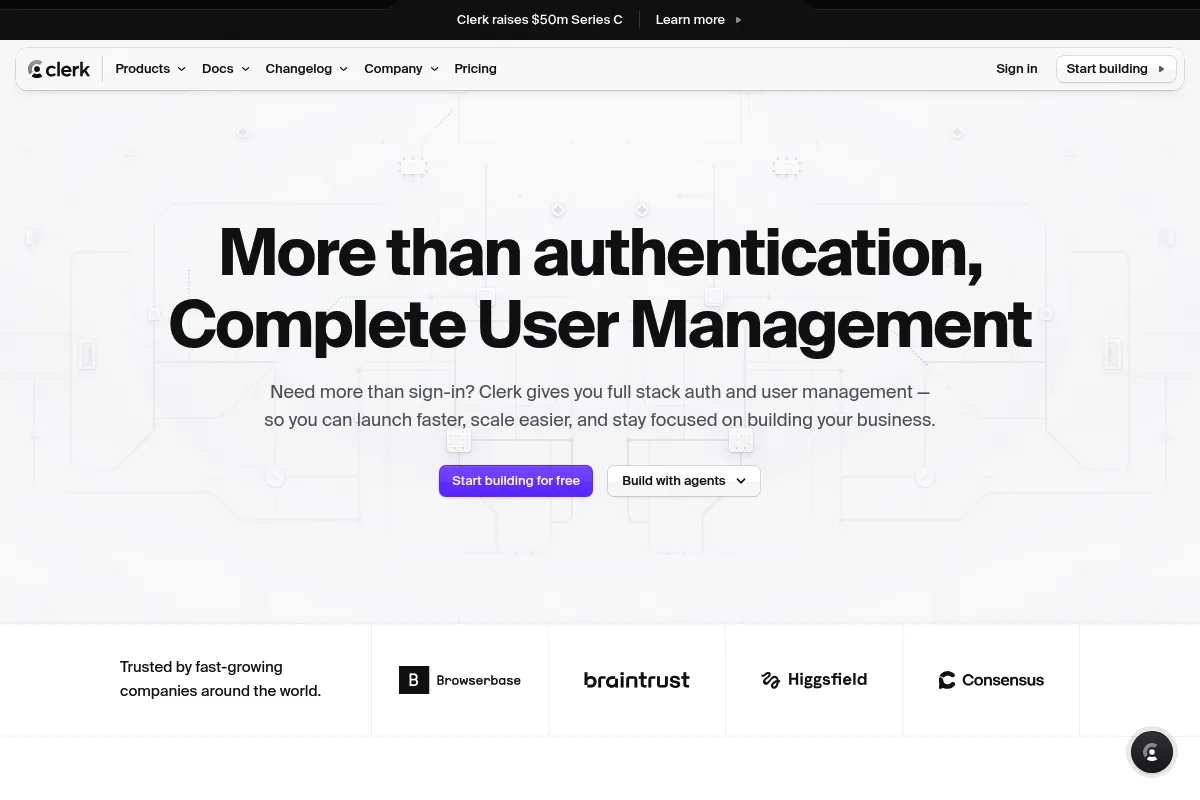
Who Should Use Clerk?
Typical users
Frontend-heavy developers and early-stage startup founders building on the T3 stack or Next.js.
Maturity fit
beginner to scaling
Choose this if…
- You are building with Next.js and want auth running in under 15 minutes
- You need multi-tenancy and organization switching without building complex database schemas
- Your priority is shipping features over maintaining identity infrastructure
- You want pre-built UI components for profiles and sign-in that look professional out of the box
Skip this if…
- You require total control over the authentication database and hosting
- You are building a high-volume consumer app where $0.02 per active user becomes a margin killer
- Your tech stack is primarily non-JavaScript (e.g., Python, Go, or Ruby) without a heavy React frontend
About Clerk
Clerk is a managed identity provider designed specifically for modern JavaScript frameworks. It exists to eliminate the friction of building login flows, session management, and user profiles by providing both the backend API and the frontend UI layer.
Official profiles
What it actually does
It handles user registration, multi-factor authentication, and session persistence through a set of drop-in React components. Beyond basic login, it manages user metadata, organization memberships, and social login integrations through a centralized dashboard.
What makes it different
Unlike API-first competitors like Auth0 or Stytch, Clerk is UI-first. It provides high-level components like <OrganizationSwitcher /> and <UserProfile /> that handle complex logic internally, significantly reducing the amount of frontend code developers must write and maintain.
Ratings across the web



Ratings aggregated from independent review platforms.
Key Features
Next.js Middleware Integration
Protects routes and handles redirects at the edge before the page even renders.
Organization Management
Allows users to create, join, and switch between accounts for B2B SaaS use cases.
Pre-built UI Components
Drop-in sign-in and sign-up forms that handle MFA and error states automatically.
Clerk Elements
A lower-level primitive library for building custom UI while keeping Clerk's logic.
Device Management
Lets users see and revoke active sessions from their profile page.
Social Connection Toggles
Enables OAuth providers like Google, GitHub, and Apple with a single click in the dashboard.
User Impersonation
Allows admins to sign in as a user to debug issues directly in the production environment.
Pricing
Free
- Up to 10,000 Monthly Active Users
- Unlimited logins and sign-ups
- Social login providers
- Organization management (B2B)
- Community support
Pro
- Everything in Free
- 10,000 MAU included ($0.02/extra MAU)
- Custom domains
- Remove 'Powered by Clerk' branding
- Advanced MFA options (SMS)
- Priority support
Enterprise
- SAML/SSO integration
- Custom session durations
- Dedicated success manager
- SLA guarantees
- Advanced security auditing
Pricing checked 5 months ago
Pricing guidance
- When you need to use a custom domain (e.g., auth.yourdomain.com)
- When you need to remove the Clerk branding
- When you require SMS-based MFA (which incurs extra costs)
- When you need SAML SSO for enterprise customers
- SMS MFA is not included in the base price and is billed per message
- The Pro plan still charges $0.02 per MAU after the first 10k
- Advanced features like SAML are locked behind the Enterprise tier
Affordable for early startups, but shifts to a premium usage-based model as you scale.
Pros & Cons
Strengths
-
Unmatched speed to market
The pre-built components handle edge cases like password resets and MFA that usually take weeks to build manually.
-
Deep Next.js optimization
Native support for Server Components and Middleware makes it the most integrated auth choice for the Vercel ecosystem.
-
Generous free tier
10,000 Monthly Active Users (MAU) for free is significantly higher than many competitors, making it ideal for MVPs.
-
Built-in B2B primitives
Handling 'Organizations' out of the box saves developers from building complex relational logic for team-based apps.
Weaknesses
-
Styling limitations
While customizable via a 'CSS-in-JS' object, making Clerk components perfectly match a highly unique design system can be frustrating.
Affects: Design-heavy brands
-
Aggressive pricing at scale
Once you exceed the free tier, the per-MAU cost can become a significant line item compared to self-hosted or lower-level alternatives.
Affects: High-growth consumer apps
-
Vendor lock-in
Because you rely on their specific UI components and hooks, migrating away to another provider requires a significant frontend rewrite.
Affects: Long-term engineering strategy
Real User Sentiment
Users generally praise the speed of implementation and the quality of the pre-built UI, though there is recurring anxiety regarding long-term pricing.
Users tend to like
- The 'it just works' experience with Next.js
- The quality of the documentation
- The ease of setting up social logins
- The built-in organization/multi-tenancy logic
Users commonly complain about
- Difficulty in deep CSS customization of components
- High cost per MAU for B2C apps
- Occasional latency in the Clerk dashboard
Recurring tradeoffs
- Trading UI flexibility for implementation speed
- Trading lower infrastructure costs for reduced maintenance burden
Happiest users
B2B SaaS developers who need to ship a professional dashboard with team management in a few days.
Often frustrated
Developers building high-traffic, low-ARPU apps (like social networks) who find the MAU pricing prohibitive.
Use Cases
B2B SaaS
Using the Organizations feature to manage team invites and role-based access.
Internal Tools
Quickly adding auth to a company-wide dashboard using Google Workspace SSO.
E-commerce
Handling customer accounts and profiles without building a custom backend.
Content Platforms
Protecting premium content with easy-to-implement paywalls and user sessions.
AI Apps
Managing user credits and API access through Clerk's user metadata fields.
Frequently Asked Questions
Is Clerk's free plan actually enough for a production app?
Yes, for many. The 10,000 Monthly Active User (MAU) limit is quite generous compared to competitors like Auth0 (which limits to 7,500). Most early-stage startups will stay on the free tier for months or even years before needing to upgrade for custom domains or higher limits.
How does Clerk compare to Auth0?
Auth0 is an enterprise-grade, API-first identity provider that works with any language but requires significant work to build the UI. Clerk is UI-first and optimized specifically for React/Next.js. Choose Clerk for speed in JS environments; choose Auth0 for complex, polyglot enterprise requirements.
Can I use my own UI instead of Clerk's components?
Yes. While Clerk is famous for its pre-built components, they offer 'Clerk Elements' and a set of headless hooks (like useAuth and useUser) that allow you to build a completely custom UI while Clerk handles the backend logic.
Does Clerk support social logins like Google and GitHub?
Yes, Clerk supports over 20 social identity providers. On the Free and Pro plans, you can enable these with a toggle in the dashboard. It handles the OAuth flow and profile data syncing automatically.
What happens if I want to leave Clerk later?
You can export your user data, but because your frontend is likely tightly coupled with Clerk's components and hooks, migrating to another provider like Supabase or Firebase will require a significant rewrite of your authentication UI and logic.
Does Clerk work with databases like Supabase or Prisma?
Yes. Clerk is often used alongside Supabase (for the database) and Prisma (as the ORM). You typically use webhooks to sync Clerk user data into your own database so you can associate users with your application's specific data.
Why trust this page?
This evaluation combines product positioning, pricing analysis, traffic and market signals, and public user sentiment into a single decision-support page. Content is generated editorially — not copied from the vendor's website.
Funding & Company
Founded
2019
Stage
Series c
Total Raised
$105.2M
Latest Round
Series C (Oct 2025)
Notable Investors
Clerk has raised a total of $105.2M across five funding rounds, including a recent $50M Series C in October 2025. This consistent and significant backing from top-tier investors like Andreessen Horowitz, CRV, and Stripe indicates strong market confidence and provides a substantial runway for product development and expansion.
Market Signals & Traffic
Estimated visits, global rank, geography, traffic sources, monthly visit trends, and organic search keywords (Similarweb)—on a dedicated page built for depth and search.
- Estimated visits
- 1,582,496
- Global rank
- #25,029
- Snapshot
- Apr 2026
- Traffic trend
- Surging
Estimated monthly visits
Alternatives to Clerk
View all alternativesSimilar Tools
Auth0
Developer Tools, Privacy & Compliance

Identity management platform for secure application authentication and authorization.
Ollama
Developer Tools, Privacy & Compliance

Run large language models locally on your machine.
LocalAI
Developer Tools, Privacy & Compliance

Self-hosted, open-source alternative to OpenAI for running models locally.
Arthur
Developer Tools, Privacy & Compliance

Observability and governance platform for machine learning models.
Patronus AI
Developer Tools, Privacy & Compliance

Automated evaluation and security platform for large language models
Giskard
Developer Tools, Privacy & Compliance

Testing and quality assurance framework for LLM applications