

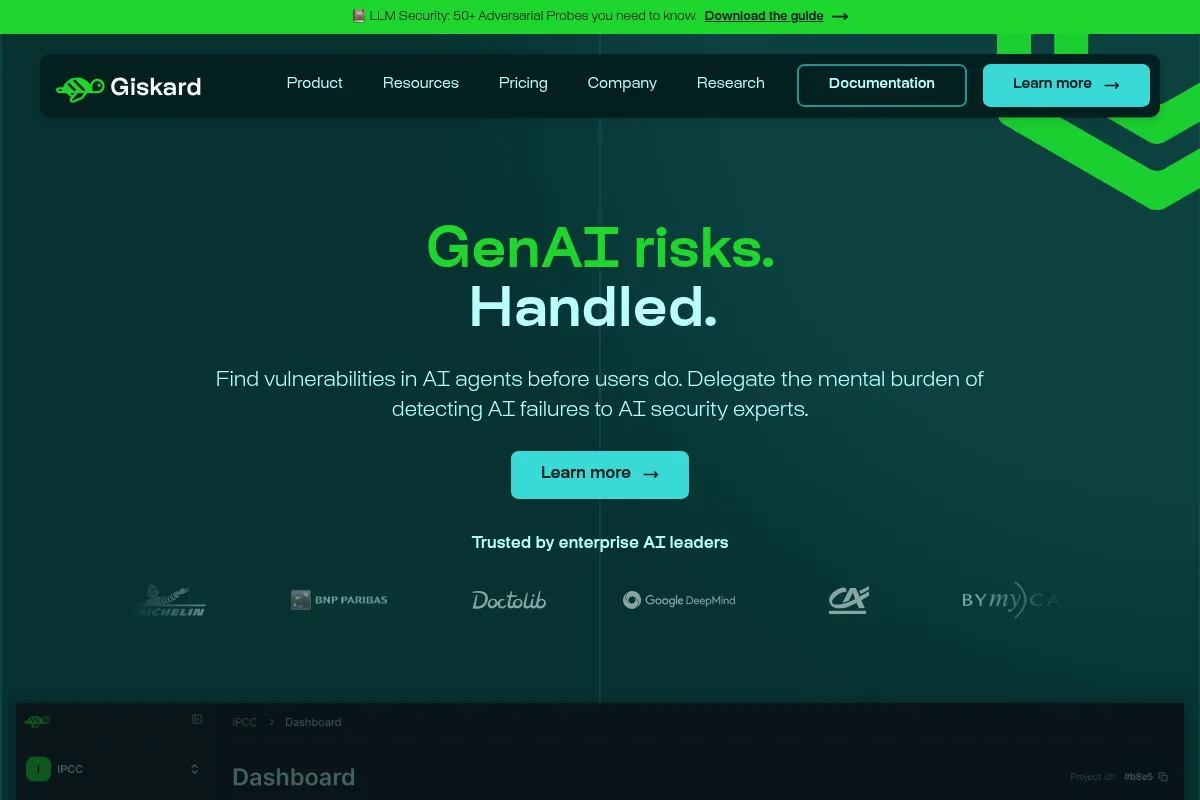
Giskard
An open-source testing framework that automates the detection of hallucinations, biases, and security vulnerabilities in LLM applications through adversarial scanning and RAG-specific evaluation.
Excellent for engineering teams needing automated vulnerability scanning and RAG benchmarking, weaker for teams seeking a pure no-code observability platform.
Analysis based on product data, pricing structure, traffic signals, and public user sentiment.
Who Should Use Giskard?
Typical users
ML engineers, LLM developers, and QA teams building RAG systems or agentic workflows who need to move beyond manual 'vibe checks'.
Maturity fit
beginner to scaling
Choose this if…
- You want to automate the generation of adversarial test cases without writing them manually
- Your priority is catching prompt injections and hallucinations before they reach production
- You need a testing framework that integrates directly into Python-based CI/CD pipelines
- You are building a RAG system and need to evaluate retrieval quality versus generation quality
Skip this if…
- You need a plug-and-play 'no-code' solution for non-technical stakeholders
- Your primary requirement is real-time production monitoring and tracing rather than pre-deployment testing
- You are not using Python for your LLM orchestration or testing suite
About Giskard
Giskard is a Python-based testing framework designed to bring rigor to LLM development. It exists to solve the 'black box' problem of AI by providing automated tools to scan for risks like misinformation, harmful content, and data leakage. It is primarily used to validate models during the development and staging phases.
What it actually does
Giskard runs automated 'scans' on LLM models or RAG pipelines to identify hidden failure modes. It generates synthetic test sets, calculates performance metrics using LLM-as-a-judge, and provides a collaborative interface for teams to debug and compare model versions.
What makes it different
Unlike many observability tools that focus on logging production data, Giskard is built as a proactive testing library. Its 'Scan' feature is unique in its ability to automatically generate adversarial inputs designed to break the model, effectively acting as an automated red-teaming tool.
Key Features
Automated Scan
Detects hallucinations, prompt injections, and off-topic answers without manual test writing.
RAGET
Automatically generates a diverse test suite from your own documents to evaluate RAG performance.
Giskard Hub
A centralized UI where developers and domain experts can collaborate on model debugging.
Pytest Integration
Allows AI quality tests to be executed as part of standard software testing workflows.
Adversarial Input Generation
Uses an internal LLM to create 'tricky' prompts that test the model's guardrails.
Custom Domain Metrics
Enables the creation of specific business logic tests beyond generic accuracy scores.
Data Leakage Detection
Scans for instances where the model might reveal sensitive information from the training or retrieval set.
Pricing
Open Source
- Python library access
- Automated vulnerability scan
- RAGET (RAG Evaluation Toolkit)
- Local execution
- Community support
Enterprise / Cloud
- Managed Giskard Hub
- Team collaboration tools
- SSO and RBAC
- Priority support
- Advanced security features
Pricing checked 4 months ago
Pricing guidance
- When you need a shared UI for non-technical stakeholders to review and approve model performance
- When you require enterprise security features like SSO
- When you need centralized management for multiple AI projects across a large team
- The open-source version lacks collaborative features
- You must provide your own LLM API keys for evaluation, which incurs external costs
Developer-friendly open-core model with a premium tier focused on enterprise collaboration and security.
Pros & Cons
Strengths
-
Proactive risk detection
The automated scan finds edge cases like prompt injections that developers often miss during manual testing, reducing the risk of public model failures.
-
RAG-specific diagnostics
It distinguishes between failures in the retrieval step and failures in the generation step, which is critical for debugging complex RAG pipelines.
-
Open-source flexibility
The core library is free and runs locally, making it accessible for developers who are sensitive about data privacy or have limited budgets.
-
Developer-centric workflow
By integrating with Pytest and GitHub Actions, it treats LLM testing like standard software engineering rather than a separate, manual process.
Weaknesses
-
Inference cost overhead
Using the 'LLM-as-a-judge' or automated scanning features requires many API calls to powerful models (like GPT-4), which can become expensive during large test runs.
Affects: Teams with tight API budgets or high-frequency testing needs
-
Setup and configuration complexity
While the basic scan is easy, configuring the framework for complex, multi-step agentic workflows requires significant Python expertise.
Affects: Junior developers or non-technical product managers
-
UI performance
The Giskard Hub can experience latency when handling very large datasets or high volumes of test results.
Affects: Enterprise teams with massive evaluation benchmarks
Real User Sentiment
Users generally view Giskard as a robust, engineering-first tool that provides more depth than basic evaluation scripts.
Users tend to like
- The automated scan's ability to find prompt injections
- Seamless integration with the existing Python ecosystem
- The specific focus on RAG metrics (faithfulness, relevancy)
- Open-source transparency
Users commonly complain about
- Documentation can be difficult to navigate for advanced use cases
- High token consumption when running full scans
- Initial setup of the Hub can be finicky
Recurring tradeoffs
- You trade ease of use (no-code) for deep, customizable testing capabilities.
Happiest users
ML engineers in regulated industries who need documented proof of model safety and reliability.
Often frustrated
Product managers looking for a simple dashboard without needing to touch a Python environment.
Use Cases
RAG Benchmarking
Verifying that a customer support bot retrieves accurate data from a knowledge base.
Security Auditing
Testing a public-facing LLM for prompt injection and jailbreak vulnerabilities.
Regression Testing
Ensuring that updating a model from GPT-3.5 to GPT-4 doesn't introduce new hallucinations.
Bias Detection
Scanning a recruitment AI for gender or racial bias in its responses.
Red Teaming
Automatically generating adversarial prompts to stress-test a model's safety guardrails.
Frequently Asked Questions
How does Giskard compare to Ragas?
Ragas is highly specialized for RAG metrics (like faithfulness and answer relevance). Giskard is a broader framework that includes RAG evaluation but also adds automated security scanning, bias detection, and a collaborative UI (Hub) for non-technical users.
Is Giskard free to use?
Yes, the core Python library is open-source and free. However, you will still need to pay for the LLM API calls (e.g., OpenAI) used by the framework to evaluate your models. There is also a paid Enterprise version for team collaboration.
Does Giskard support LangChain and LlamaIndex?
Yes, Giskard has native integrations for both LangChain and LlamaIndex, allowing you to wrap your existing chains or indexes for testing with minimal code changes.
Can I run Giskard offline?
The core library can run locally in your environment. However, if you use 'LLM-as-a-judge' features, you will need access to an LLM provider (either cloud-based like OpenAI or a locally hosted model via Ollama/vLLM).
What are the main limitations of Giskard?
The main limitations are its reliance on Python (not ideal for JS/TS teams) and the potential for high costs when running automated scans on large datasets due to the volume of LLM evaluations required.
Does Giskard provide real-time production monitoring?
Giskard is primarily a testing and QA framework for pre-deployment. While it can be used to analyze production logs, it is not a real-time observability tool like Arize Phoenix or WhyLabs.
Why trust this page?
This evaluation combines product positioning, pricing analysis, traffic and market signals, and public user sentiment into a single decision-support page. Content is generated editorially — not copied from the vendor's website.
Funding & Company
Founded
2021
Stage
Seed
Total Raised
$8.06M
Latest Round
Grant (Jan 2024)
Notable Investors
Giskard has raised a total of $8.06 million, primarily through a seed round and significant grants from European institutions. This funding from both private VCs and public bodies indicates confidence in their approach to AI quality and safety, suggesting a stable foundation for product development and longevity.
Market Signals & Traffic
Estimated visits, global rank, geography, traffic sources, monthly visit trends, and organic search keywords (Similarweb)—on a dedicated page built for depth and search.
- Estimated visits
- 52,389
- Global rank
- #655,455
- Snapshot
- Apr 2026
- Traffic trend
- Steady
Estimated monthly visits
Alternatives to Giskard
View all alternatives
Similar Tools
Ollama
Developer Tools, Privacy & Compliance

Run large language models locally on your machine.
Clerk
Developer Tools, Privacy & Compliance

Complete authentication and user management solution for modern web applications.
Patronus AI
Developer Tools, Privacy & Compliance
Automated evaluation and security platform for large language models
Attest
Developer Tools, Privacy & Compliance

Evaluation and testing platform for large language model applications
Auth0
Developer Tools, Privacy & Compliance

Identity management platform for secure application authentication and authorization.
LocalAI
Developer Tools, Privacy & Compliance

Self-hosted, open-source alternative to OpenAI for running models locally.