

Induced AI
Induced AI offers autonomous browser agents that execute tasks described in natural language, aiming to simplify web automation for businesses and individuals.
Best for automating repetitive browser tasks with natural language commands, weaker for complex, multi-step workflows on frequently changing sites.
Analysis based on product data, pricing structure, traffic signals, and public user sentiment.
Who Should Use Induced AI?
Typical users
Businesses and individuals looking to automate repetitive web-based tasks without coding. This includes roles in sales, operations, and data collection.
Maturity fit
beginner to scaling
Choose this if…
- You need to automate browser tasks without writing code.
- Your primary need is data extraction or form filling from websites.
- You want to monitor competitor activity across multiple sites.
- You need to automate cross-platform web workflows.
Skip this if…
- You require automation for desktop applications.
- Your workflows involve highly dynamic or frequently changing websites.
- You need advanced conditional logic or complex branching in your automations.
- You are looking for a tool that integrates deeply with a wide range of enterprise software.
About Induced AI
Induced AI is an AI-powered platform that automates browser-based workflows using natural language instructions. It aims to make advanced automation accessible by allowing users to describe tasks in plain English, which the AI then executes in cloud-hosted browser instances. The platform is designed for businesses and individuals seeking to streamline repetitive web tasks.
Official profiles
What it actually does
Induced AI allows users to define web automation tasks using natural language. The AI agent then navigates websites, fills forms, clicks buttons, and extracts information autonomously. It operates in cloud-hosted browser instances, providing visual records of actions for transparency and debugging.
What makes it different
Induced AI differentiates itself by focusing on natural language task definition, eliminating the need for traditional coding or scripting. It also emphasizes human-like reasoning for non-deterministic workflows and operates on a purpose-built, cloud-first browser infrastructure designed for automated workflows.
Key Features
Natural Language Task Definition
Allows users to describe desired actions in plain English, removing the need for coding or scripting.
Autonomous Browser Agents
AI-powered agents that navigate websites, interact with elements, and perform tasks independently.
Cloud-First Infrastructure
All automated tasks run in the background on cloud-hosted browser instances, not affecting the user's local computer.
Visual Recordings
Provides a visual record of every action taken by the agent, aiding in transparency and debugging.
API Access
Enables programmatic control and integration of Induced AI's capabilities into other applications and workflows.
CAPTCHA Handling
Capable of detecting and solving various types of CAPTCHAs, including text, number, and ReCaptcha.
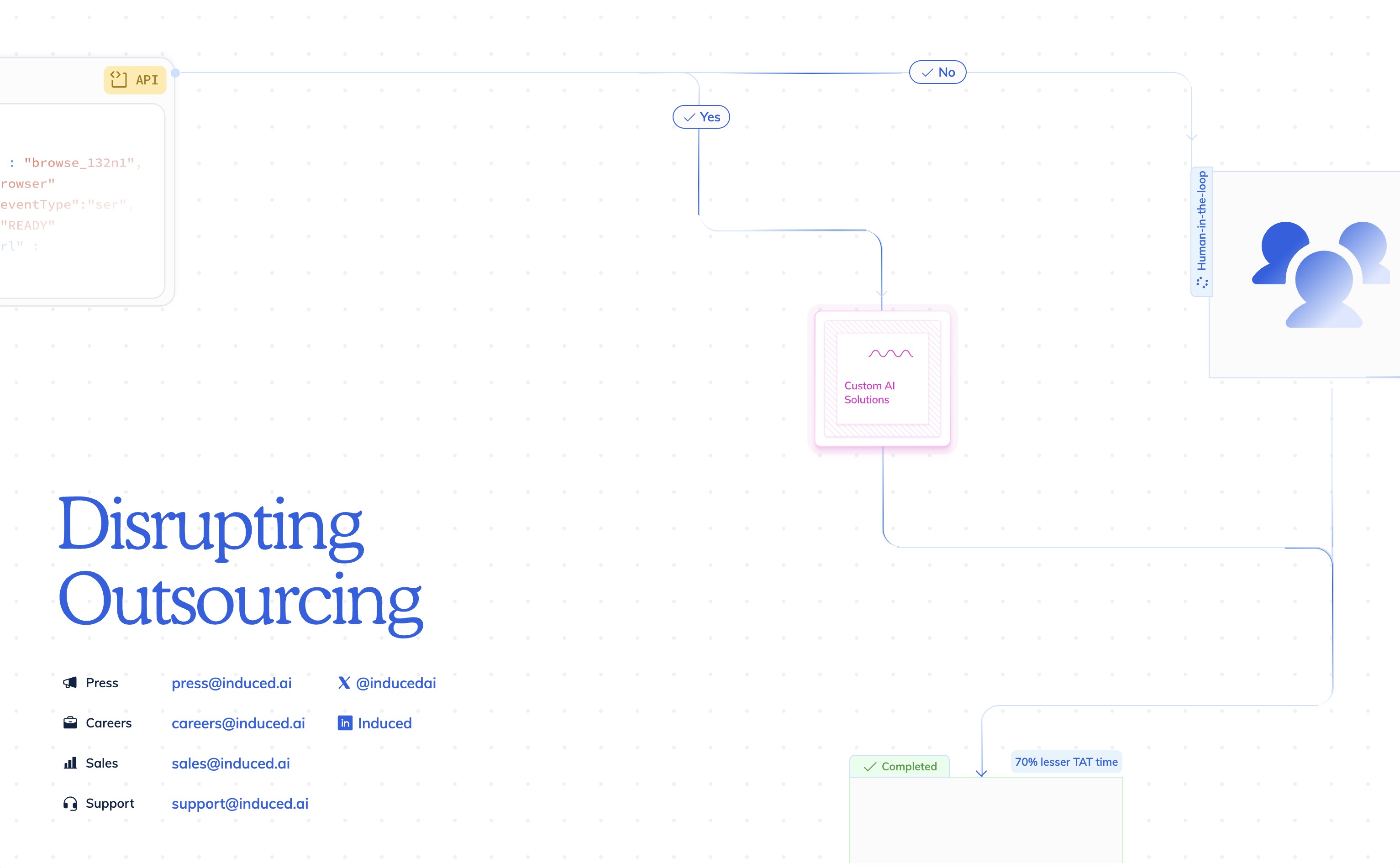
Human-in-the-Loop Workflows
Combines AI automation with human oversight for tasks requiring verification or approval.
Pricing
Free
- Basic features
- Limited usage
- Community support
Pricing checked 6 months ago
Pricing guidance
- When you exceed the usage limits of the free tier.
- When you require priority support for your automated workflows.
- When you need access to advanced features for team collaboration or more complex tasks.
- Usage limits on the free tier (specifics not detailed).
- Potential for future introduction of paid tiers and associated feature restrictions.
- Support is limited to community support on the free tier.
Currently positioned as a free tool for all users, with potential for future paid tiers as features expand.
Pros & Cons
Strengths
-
No-code automation
Users can define complex web tasks using natural language, making automation accessible to non-technical users.
-
Visual debugging and transparency
The ability to watch agents work in real-time or review recordings simplifies troubleshooting and builds trust in automated processes.
-
Handles complex web interactions
Can manage tasks involving authentication, form filling, and even CAPTCHAs, which are common hurdles in web automation.
-
Cloud-based operation
Tasks run in the cloud, freeing up local computing resources and allowing for background execution without user intervention.
Weaknesses
-
Browser-based automation limitations
Browser automation is inherently slower than API-based solutions, which can impact efficiency for high-volume tasks.
Affects: Users requiring high-speed, large-scale data processing.
-
Reliability on dynamic websites
Complex, multi-step workflows may become unreliable on websites that change their structure frequently.
Affects: Users automating tasks on frequently updated or complex web applications.
-
Limited free tier
While a free tier is available, it has usage limitations, which may not be sufficient for extensive testing or production use.
Affects: Users evaluating the tool for significant or ongoing automation needs.
-
Web-based tasks only
The platform is designed for web-based tasks and cannot automate desktop applications.
Affects: Users needing to automate processes that extend beyond web browsers.
Real User Sentiment
Generally positive, with users appreciating its natural language capabilities and ease of use for basic automation.
Users tend to like
- Natural language task definition
- Visual recordings for debugging
- Handles complex web interactions
- Cloud infrastructure
- Works on any website without pre-configuration
Users commonly complain about
- Browser-based automation is slower than API calls
- Complex workflows can be unreliable on frequently changing sites
- Limited free tier for evaluation
- Cannot handle desktop applications
Recurring tradeoffs
- Ease of use for simple tasks vs. potential unreliability for complex, dynamic workflows.
- No-code approach vs. inherent speed limitations of browser automation.
Happiest users
Individuals and small teams looking to automate straightforward web tasks without technical expertise.
Often frustrated
Users attempting to automate complex, multi-step processes on highly dynamic websites or those requiring desktop application integration.
Use Cases
Automating data collection from websites without APIs
Filling out web forms and applications at scale
Competitive monitoring across multiple websites
Cross-platform web workflows that span multiple sites
Automating repetitive browser-based tasks
Enhancing operational efficiency in sales and internal processes
Creating and managing automated workflows using natural language instructions
Frequently Asked Questions
What is Induced AI?
Induced AI is an AI-powered automation platform that allows users to automate browser-based workflows using natural language instructions. It uses autonomous browser agents to interact with websites, fill forms, and extract information, operating in cloud-hosted browser instances. The goal is to make advanced automation accessible without requiring coding or scripting knowledge.
Is Induced AI free?
Induced AI currently offers a completely free plan with basic features and limited usage. While this allows users to explore its capabilities, pricing models can change, and future paid tiers may be introduced as the platform expands its features and support. Users should check the terms of service for any usage limitations or potential future costs.
What are the main limitations of Induced AI?
Induced AI's primary limitations include the inherent slowness of browser-based automation compared to API calls, potential unreliability of complex workflows on frequently changing websites, and its inability to automate desktop applications. The free tier also has usage limitations, which may not be sufficient for extensive use.
How does Induced AI compare to other browser automation tools like BrowserFlow or Bardeen AI?
Induced AI's key differentiator is its focus on natural language task definition and its cloud-first, purpose-built browser infrastructure. Tools like BrowserFlow and Bardeen AI also offer no-code or low-code browser automation, often through browser extensions or APIs. Induced AI emphasizes human-like reasoning for non-deterministic workflows and provides visual recordings for debugging, which may differ in implementation from competitors. Pricing and specific feature sets also vary, making direct comparison important based on user needs.
Does Induced AI integrate with other tools or platforms?
Yes, Induced AI offers API integration, allowing users to programmatically control its autonomous agents and incorporate them into existing workflows or applications. While specific direct integrations with popular CRMs or other enterprise software are not extensively detailed, the API provides a pathway for custom integrations.
What kind of tasks can Induced AI automate?
Induced AI can automate a wide range of browser-based tasks, including data collection from websites, filling out forms and applications, competitive monitoring, executing sales operations, compliance checks, and other internal processes that typically require human interaction with web interfaces. It is designed for repetitive tasks that can be described in natural language.
What are the pricing plans for Induced AI?
Currently, Induced AI offers a free plan with basic features and limited usage. There is no publicly listed information on paid tiers or specific pricing structures, suggesting that the platform may be in an early stage of monetization or offering custom pricing for enterprise solutions. Users are advised to contact the sales team for detailed pricing information if needed.
Why trust this page?
This evaluation combines product positioning, pricing analysis, traffic and market signals, and public user sentiment into a single decision-support page. Content is generated editorially — not copied from the vendor's website.
Funding & Company
Founded
2023
Stage
Seed
Total Raised
$2.3M
Latest Round
Seed (Oct 2023)
Notable Investors
Induced AI has raised a single Seed round of $2.3 million, announced in October 2023. The round was led by prominent investors including OpenAI CEO Sam Altman and Peak XV (formerly Sequoia India & SEA), signaling strong early confidence in the team and technology. This initial funding provides the capital to build out their core AI-powered browser automation platform.
Market Signals & Traffic
Estimated visits, global rank, geography, traffic sources, monthly visit trends, and organic search keywords (Similarweb)—on a dedicated page built for depth and search.
- Estimated visits
- 8,279
- Global rank
- #2,590,522
- Snapshot
- Apr 2026
- Traffic trend
- Surging
Estimated monthly visits
Alternatives to Induced AI
View all alternatives
Similar Tools
Skyvern
Automation, Automation & Agents, Productivity

AI-powered browser automation for complex web workflows.
Obviously AI
Automation, Developer Tools, Research

No-code platform for building and deploying predictive machine learning models.
Krea AI
Content Creation, Design, Video Creation

AI creative suite for generating, enhancing, and animating images and videos.
Geordie
Sales, Automation & Agents, AI Assistant

Autonomous sales representative for prospecting and personalized multi-channel outreach.
DSPy
Developer Tools, Research, Automation

Framework for programming and optimizing language model pipelines.
Durable
Productivity, Content Creation, Automation & Agents

AI-powered platform for building websites and managing businesses.