

An ambient AI scribe that turns patient conversations into structured clinical notes in seconds, designed to eliminate manual charting for outpatient clinicians.
Excellent for high-volume outpatient clinics needing fast SOAP notes, weaker for complex inpatient workflows requiring deep longitudinal data synthesis.
Analysis based on product data, pricing structure, traffic signals, and public user sentiment.
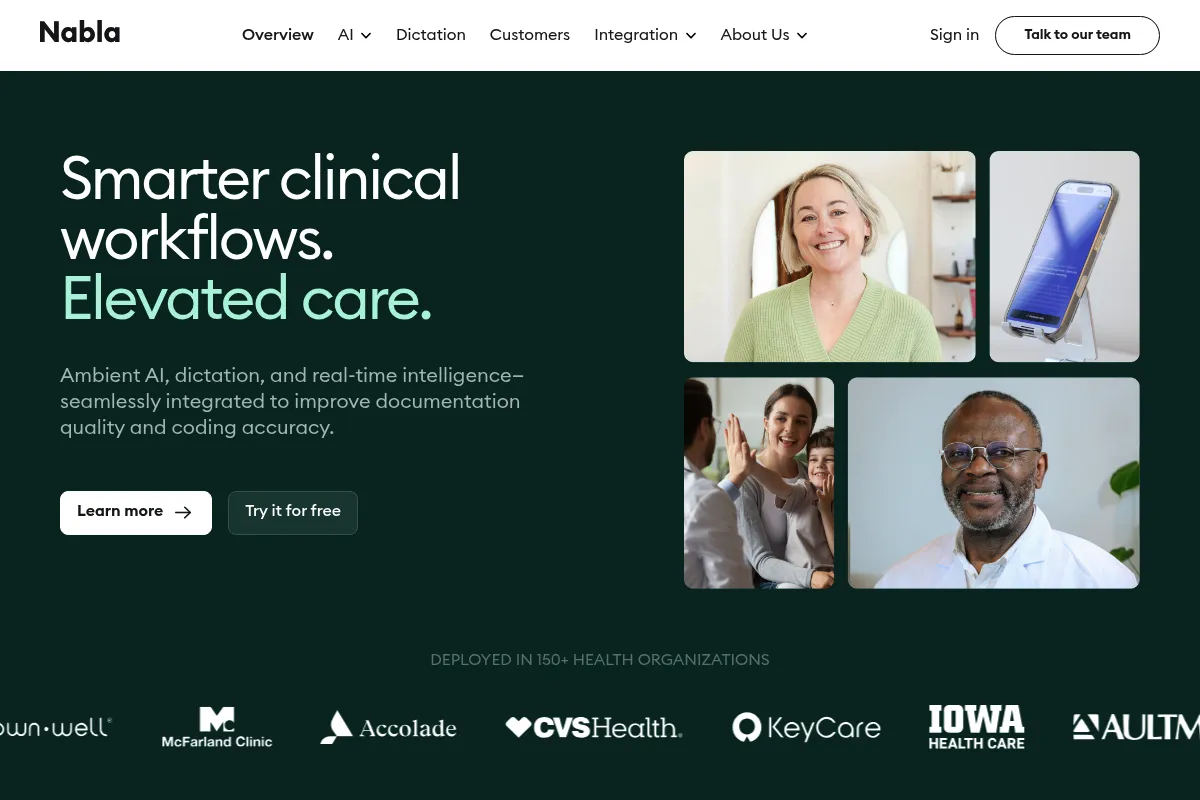
Who Should Use Nabla?
Typical users
Individual practitioners, small to mid-sized medical clinics, and large health systems looking to reduce physician administrative burden.
Maturity fit
scaling to advanced
Choose this if…
- You want clinical notes generated immediately after the visit ends
- Your priority is a privacy-first tool that does not store audio recordings
- You need a tool that integrates with major EHRs like Epic or Cerner via browser extensions
Skip this if…
- You require human-in-the-loop verification for 100% note accuracy
- Your workflow relies on a legacy EHR that does not support modern browser extensions or APIs
- You need a tool that manages full medical billing and coding end-to-end
About Nabla
Nabla is an ambient clinical assistant that uses large language models to automate medical documentation. It captures natural patient-provider dialogue and converts it into structured medical records, aiming to eliminate the hours clinicians spend on documentation after hours.
Official profiles
What it actually does
It listens to patient encounters via a mobile or desktop app and generates structured clinical notes, such as SOAP or HPI, within seconds. It also provides patient instructions, referral letters, and suggested ICD-10 codes based on the conversation.
What makes it different
Nabla is fully automated and delivers notes almost instantly, whereas many competitors rely on human editors or take hours to process. Its privacy-by-design approach, which deletes audio immediately after processing, simplifies compliance for risk-averse health systems.
Ratings across the web

Ratings aggregated from independent review platforms.
Key Features
Instant Note Generation
Delivers structured clinical summaries within seconds of ending a visit.
EHR Extensions
Browser-based integration allows notes to be pushed directly into Epic or Cerner without switching tabs.
Customizable Templates
Allows clinicians to adjust the structure and tone of notes to match their specific specialty.
Patient Instructions
Automatically generates plain-language summaries for patients to take home.
Privacy-First Architecture
Audio is never stored on servers, reducing data liability and HIPAA concerns.
Multi-Speaker Identification
Distinguishes between the clinician, patient, and family members in the room.
Referral Letter Drafting
Uses the encounter data to pre-write referral letters for specialists.
Pricing
Free
- 30 consultations per month
- Standard note templates
- Mobile and desktop app access
- Basic support
Pro
- Unlimited consultations
- EHR integration (Epic, Cerner, etc.)
- Advanced custom templates
- Priority support
- Medical coding suggestions
Enterprise
- SSO and advanced security
- Dedicated account management
- API access
- Custom legal agreements
- Bulk seat discounts
Pricing checked 5 months ago
Pricing guidance
- When you exceed 30 patient visits per month
- When you need to sync notes directly into your EHR
- When you require custom templates for specific specialties
- EHR integration may require coordination with your IT department
- The Free plan does not include the browser extension for direct EHR data entry
Competitive and transparent pricing that undercuts legacy human-scribe services.
Pros & Cons
Strengths
-
Extreme speed of delivery
Notes are ready almost immediately, allowing clinicians to review and sign off before the next patient enters the room.
-
Minimal training required
The interface is cleaner and more intuitive than traditional medical software, leading to high adoption rates among non-technical staff.
-
Strong privacy posture
The refusal to store audio recordings is a significant advantage for compliance officers concerned about long-term data liability.
-
Transparent pricing
Unlike many enterprise medical tools, Nabla offers a clear per-user price that is accessible to solo practitioners.
Weaknesses
-
Occasional AI hallucinations
Like all LLM-based tools, it can occasionally misinterpret technical terms or invent details, requiring clinicians to proofread every note.
Affects: Clinicians in highly technical or niche specialties
-
Limited longitudinal context
It excels at the current encounter but does not automatically pull in a patient's full medical history from previous years unless manually prompted.
Affects: Primary care providers managing chronic, multi-year conditions
-
Integration friction with legacy EHRs
While it works well with modern web-based EHRs, it can be clunky to use with older, on-premise desktop medical software.
Affects: Practices using older, non-web-based systems
Real User Sentiment
Users generally report high satisfaction, specifically citing the significant reduction in time spent on documentation.
Users tend to like
- The speed of note generation
- The accuracy of the medical summaries
- The ease of the 'copy-paste' or extension workflow
- The ability to focus on the patient instead of a screen
Users commonly complain about
- Occasional errors in medication dosages
- Difficulty capturing clear audio in noisy environments
- The need to manually correct AI-generated formatting
Recurring tradeoffs
- Users trade the 100% accuracy of a human scribe for the 95% accuracy and 100x speed of AI.
Happiest users
Outpatient primary care physicians and specialists with high daily patient volumes.
Often frustrated
Clinicians using legacy, non-web-based EHRs that make the integration feel disjointed.
Use Cases
Primary Care
Automating SOAP notes for 20+ daily patient visits.
Telehealth
Capturing audio from virtual calls to generate instant summaries.
Specialist Consultations
Using custom templates for orthopedics, cardiology, or psychiatry.
Patient Education
Generating take-home instructions in plain language automatically.
Medical Coding
Speeding up the billing process with AI-suggested ICD-10 codes.
Frequently Asked Questions
Is Nabla HIPAA compliant?
Yes, Nabla is HIPAA compliant and signs Business Associate Agreements (BAAs) with its users. A key part of its compliance strategy is its privacy-by-design approach, where audio recordings are processed in real-time and deleted immediately after the note is generated, ensuring no sensitive audio data is stored long-term.
How does Nabla compare to Suki or DAX?
Nabla is generally faster and more affordable than Nuance DAX, which often has a human-in-the-loop component. Compared to Suki, Nabla is often praised for its cleaner UI and 'ambient' focus, whereas Suki has historically leaned more into voice-command features, though both now compete heavily in the ambient space.
Does Nabla work with Epic and Cerner?
Yes, Nabla integrates with major EHRs like Epic, Cerner, and Athenahealth. For many users, this is achieved through a browser extension that allows the clinician to 'push' the generated note directly into the correct field in the EHR without manual copying and pasting.
Can I use Nabla for free?
Nabla offers a free tier that includes up to 30 consultations per month. This is ideal for testing the tool or for very low-volume practitioners. However, to get unlimited consultations and EHR integration features, you must upgrade to the Pro plan at $119/month.
What happens if the AI makes a mistake in a note?
Clinicians are legally responsible for the accuracy of their medical records. Nabla is designed as an assistant, not a replacement; clinicians must review, edit, and approve every note before it is finalized in the EHR. The tool includes an editor interface specifically for this purpose.
Does it support languages other than English?
Yes, Nabla supports multiple languages and can even handle encounters where the patient speaks one language and the clinician speaks another, though the final note is typically generated in the clinician's preferred language (usually English).
Why trust this page?
This evaluation combines product positioning, pricing analysis, traffic and market signals, and public user sentiment into a single decision-support page. Content is generated editorially — not copied from the vendor's website.
Funding & Company
Founded
2018
Stage
Series c
Total Raised
$120M
Latest Round
Series C (Jun 2025)
Notable Investors
Nabla has raised a total of $120 million across three funding rounds, culminating in a $70 million Series C in mid-2025. This substantial funding from notable investors provides the company with a strong financial foundation to continue its growth and product development in the competitive AI-powered clinical documentation market.
Market Signals & Traffic
Estimated visits, global rank, geography, traffic sources, monthly visit trends, and organic search keywords (Similarweb)—on a dedicated page built for depth and search.
- Estimated visits
- 0
- Global rank
- —
- Snapshot
- May 2026
- Traffic trend
- —
Alternatives to Nabla
View all alternativesAbridge
Health & Wellness, Documentation, Workflow

Ambient clinical documentation for healthcare providers and medical systems.
Sunoh.ai
Health & Wellness, Documentation, AI Assistant

Ambient medical scribe for automated clinical documentation and SOAP notes
Similar Tools
Notion AI
AI Assistant, Content Creation

AI assistant integrated into Notion for content creation and task automation.
Mithril Security
Privacy & Compliance, Developer Tools

Secure deployment platform for private and compliant language models.
Durable
Productivity, Content Creation, Automation & Agents

AI-powered platform for building websites and managing businesses.
Msty
AI Assistant, Productivity, Developer Tools

Unified interface for local and cloud-based language models
Adam.ai
AI Assistant, Productivity, Communication

Comprehensive platform for managing meeting agendas, notes, and action items.
Semantic Scholar
Productivity, Data Extraction, Developer Tools

AI-powered research tool for scientific literature discovery and analysis.