

Positron
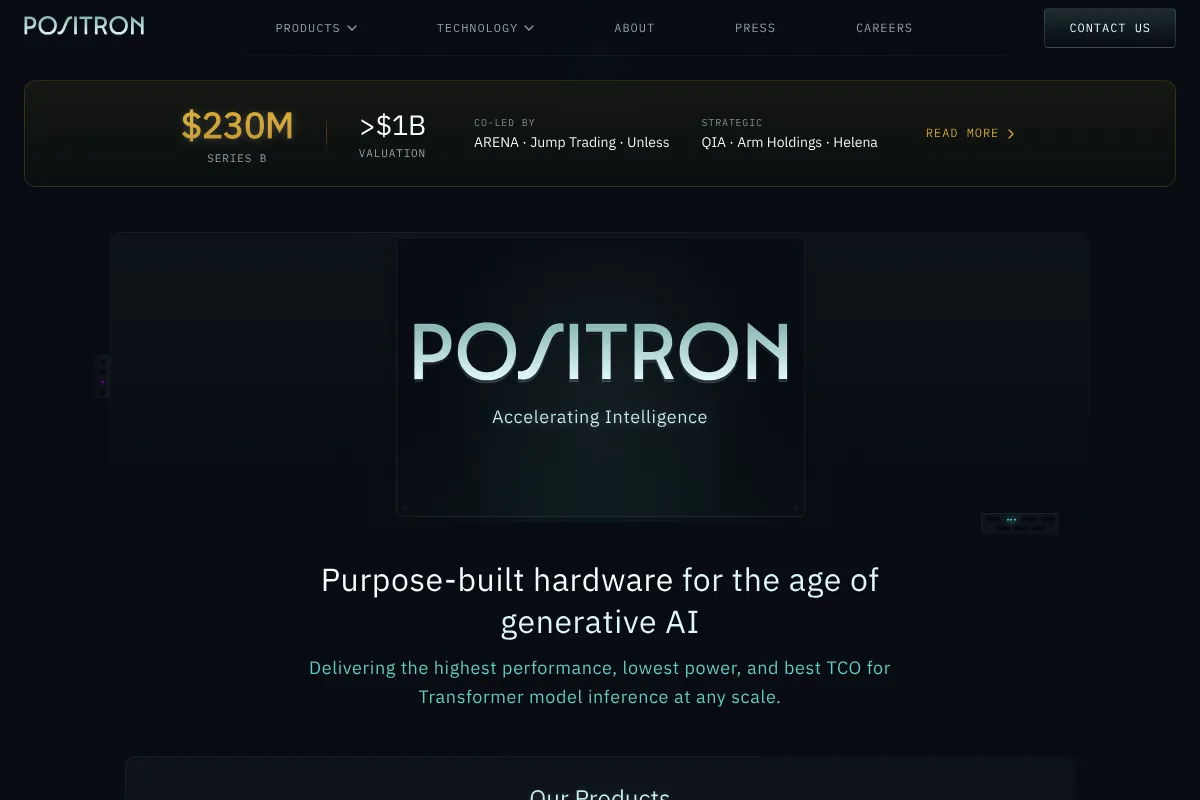
A specialized hardware-software stack that trades general-purpose GPU flexibility for extreme efficiency in transformer model inference, prioritizing memory bandwidth over raw compute.
Excellent for high-volume LLM inference where power and TCO are bottlenecks, but carries the risk of early-stage hardware and a less mature software ecosystem than NVIDIA.
Analysis based on product data, pricing structure, traffic signals, and public user sentiment.
Who Should Use Positron?
Typical users
Infrastructure engineers at AI-native companies, cloud service providers (CSPs), and high-frequency trading firms scaling massive transformer workloads.
Maturity fit
advanced
Choose this if…
- Your primary bottleneck is memory bandwidth or power consumption rather than raw FLOPs.
- You are scaling production LLMs and need to reduce TCO compared to NVIDIA H100/H200 clusters.
- You want to deploy Hugging Face models with minimal code changes via an OpenAI-compatible API.
- Your workload is exclusively based on transformer architectures.
Skip this if…
- You require the versatility of the CUDA ecosystem for custom kernels or non-transformer models.
- You are in the early R&D phase and need the safety of widely available, general-purpose hardware.
- Your team lacks the capacity to manage specialized hardware appliances or early-stage vendor risk.
About Positron
Positron develops purpose-built hardware designed to solve the 'memory wall' in AI inference. Founded by veterans from Groq and Lambda, the company focuses on delivering high-throughput, low-power execution for generative AI models. It exists to provide a viable alternative to general-purpose GPUs for enterprises scaling production-level intelligence.
Official profiles
What it actually does
Positron provides the Atlas inference appliance, a server-grade system packed with specialized accelerators that run transformer models with significantly lower power draw than traditional GPUs. It also offers a managed API endpoint that allows developers to point their existing OpenAI-compatible applications to Positron's hardware for immediate performance gains.
What makes it different
Unlike GPUs that optimize for peak floating-point operations (FLOPs), Positron's architecture is 'memory-first,' achieving over 90% memory bandwidth utilization compared to the 10-30% typical of NVIDIA hardware. It ingests Hugging Face model files directly, bypassing the need for complex custom compilers that often plague other specialized AI chips.
Key Features
Atlas Appliance
A production-ready 2kW server housing eight specialized accelerators for high-density inference.
Asimov Silicon
Next-generation ASIC (coming 2027) designed with 2TB of memory per chip to handle multi-trillion parameter models.
Model Manager
A drag-and-drop interface to upload and deploy .pt or .safetensors files directly to hardware.
TransWarp Engine
A reconfigurable systolic array that dynamically optimizes for different transformer layers (FFN vs Attention).
Streaming Vector Acceleration
Dedicated hardware for activation functions like Softmax and RoPE to eliminate CPU stalls.
US-Based Manufacturing
Chips are fabricated at TSMC Arizona and assembled in the U.S. for supply chain security.
Pricing
API Access
- OpenAI-compatible endpoint
- Managed infrastructure
- Support for popular open-source models
- Usage-based billing
Atlas Appliance
- 8x Archer accelerators
- Supports up to 500B parameter models
- 2kW power envelope
- On-premise deployment
Pricing checked 4 months ago
Pricing guidance
- When cloud GPU costs exceed the CAPEX of an on-premise appliance
- When data center power limits prevent further scaling with GPUs
- When sub-millisecond latency becomes a competitive requirement
- Hardware lead times can be significant for physical appliances
- Support for new model architectures may lag behind software-only updates
- Minimum commitment likely required for API access
Premium infrastructure positioning focused on long-term TCO and energy savings for high-scale operators.
Pros & Cons
Strengths
-
Extreme power efficiency
Claims to deliver comparable inference performance to an H200 while consuming only 33% of the power, which is critical for data centers with strict energy caps.
-
Superior memory utilization
By focusing on the memory-bound nature of transformers, it achieves nearly 3x the effective bandwidth of general-purpose GPUs on real-world workloads.
-
Low-friction deployment
The ability to ingest raw model files and provide an OpenAI-compatible API reduces the engineering overhead typically associated with switching hardware.
-
Predictable performance
Deterministic architecture ensures consistent latency for real-time applications like high-frequency trading or interactive voice AI.
Weaknesses
-
Transformer-only limitation
The hardware is hard-coded for transformer architectures; it cannot run CNNs, RNNs, or other non-transformer neural networks efficiently.
Affects: Teams running diverse AI model portfolios
-
Early-stage ecosystem
Lacks the decade-long software maturity, community support, and library depth of NVIDIA's CUDA platform.
Affects: Developers needing deep low-level customization
-
First-gen ASIC risk
As with any new silicon, there is inherent risk regarding long-term reliability, driver stability, and hardware availability compared to incumbents.
Affects: Enterprise procurement and risk management teams
Real User Sentiment
Cautious optimism from the hardware community, with significant interest in the 'memory-first' architecture claims.
Users tend to like
- High tokens-per-watt efficiency
- Ease of model migration via Hugging Face integration
- Deterministic latency for real-time use cases
- US-based manufacturing and supply chain
Users commonly complain about
- Lack of public benchmarks for a wider variety of models
- Skepticism about software stack maturity vs CUDA
- Limited availability for smaller teams
Recurring tradeoffs
- Users trade the flexibility of running any AI model for extreme performance on transformers.
Happiest users
Infrastructure leads at scale-ups who have hit a 'power wall' in their data centers.
Often frustrated
Research scientists who need to experiment with novel, non-transformer architectures.
Use Cases
High-Frequency Trading
Using deterministic low latency for real-time market signal processing.
Cloud Service Providers
Offering cost-efficient LLM inference as a service to compete with hyperscalers.
Enterprise Content Moderation
Running high-volume text analysis at a fraction of the power cost of GPUs.
Real-time Voice AI
Minimizing time-to-first-token for natural-sounding conversational agents.
Sovereign AI Initiatives
Deploying US-made hardware for sensitive government or national infrastructure projects.
Frequently Asked Questions
How does Positron compare to Groq?
Both focus on inference, but their architectures differ. Groq uses a Tensor Streaming Processor (TSP) focused on ultra-low latency via SRAM, while Positron uses a memory-first architecture designed to maximize bandwidth for larger models. Positron claims better performance per watt and easier model ingestion from Hugging Face without complex recompilation.
Is this the same as the Positron IDE?
No. Positron (positron.ai) is a hardware company building AI chips. The Positron IDE is a data science tool from Posit (formerly RStudio) built on VS Code. They are entirely separate entities.
What models are supported?
Positron supports any model based on the Transformer architecture, including Llama, Mistral, and GPT-style models. It specifically targets models from the Hugging Face Transformers library, allowing for 'drag-and-drop' deployment.
Can I use Positron for training models?
No. Positron is an inference-only accelerator. While GPUs are designed for both training (compute-bound) and inference (memory-bound), Positron strips away the training-specific hardware to maximize efficiency for serving models in production.
Does it support CUDA?
No, Positron does not use CUDA. It provides an OpenAI-compatible API and a custom software stack designed to ingest models directly. This means you don't need to write CUDA kernels, but you also can't use existing ones.
What is the pricing for the Atlas server?
Pricing is not public and requires a custom quote. As a high-end hardware appliance, it is intended for enterprise-scale deployments where the CAPEX is offset by significant savings in operational power and cooling costs.
Why trust this page?
This evaluation combines product positioning, pricing analysis, traffic and market signals, and public user sentiment into a single decision-support page. Content is generated editorially — not copied from the vendor's website.
Funding & Company
Founded
2023
Stage
Series b
Total Raised
$305.1M
Latest Round
Series B (Feb 2026)
Notable Investors
Positron AI has raised over $305 million in total, culminating in a $230 million Series B in February 2026 that valued the company at over $1 billion. This substantial backing from strategic and financial investors like Arm, Jump Trading, and Valor Equity Partners is aimed at scaling production of its energy-efficient AI inference hardware.
Market Signals & Traffic
Estimated visits, global rank, geography, traffic sources, monthly visit trends, and organic search keywords (Similarweb)—on a dedicated page built for depth and search.
- Estimated visits
- 12,881
- Global rank
- #1,888,148
- Snapshot
- Apr 2026
- Traffic trend
- Falling
Estimated monthly visits
Alternatives to Positron
View all alternativesGroq
Developer Tools, AI Assistant

AI inference acceleration platform with specialized LPU chips.
SambaNova
Developer Tools, Automation & Agents

Full-stack platform for high-speed AI inference and model deployment.
Tenstorrent
Developer Tools, Research

RISC-V based hardware and software for scalable AI computing.
Similar Tools
Amazon CodeWhisperer
Developer Tools

AI-powered coding companion that generates code recommendations.
Nebius
Developer Tools

Cloud infrastructure for training and deploying machine learning models.
Hyperbolic
Developer Tools

Decentralized cloud platform for GPU resources and AI model inference.
Tabnine
Developer Tools
AI code assistant for faster, more accurate software development.
Modular
Developer Tools

Unified platform for high-performance AI development and deployment.
AskCodi
Developer Tools
AI coding assistant and unified LLM API gateway for developers.