

A comprehensive sales engagement suite that prioritizes workflow automation and pipeline visibility for mid-to-large teams, though it carries a premium price tag and high configuration overhead.
Excellent for enterprise teams needing tight Salesforce integration and AI-driven task prioritization, weaker for small startups seeking a low-cost, plug-and-play sequencer.
Analysis based on product data, pricing structure, traffic signals, and public user sentiment.
Who Should Use Salesloft?
Typical users
B2B sales organizations with dedicated SDR and AE teams, typically mid-market to enterprise level.
Maturity fit
scaling to advanced
Choose this if…
- Your priority is a unified workflow for email, phone, and social touches.
- You want AI to prioritize rep tasks based on buyer intent signals.
- Your team relies heavily on Salesforce or Microsoft Dynamics as a source of truth.
- You need to consolidate conversation intelligence and pipeline management into one tool.
Skip this if…
- You have a sales team of fewer than 5 people.
- You need a low-cost tool primarily for cold email automation.
- Your workflow doesn't require a heavy CRM integration.
- You lack the operations resources to manage complex platform configurations.
About Salesloft
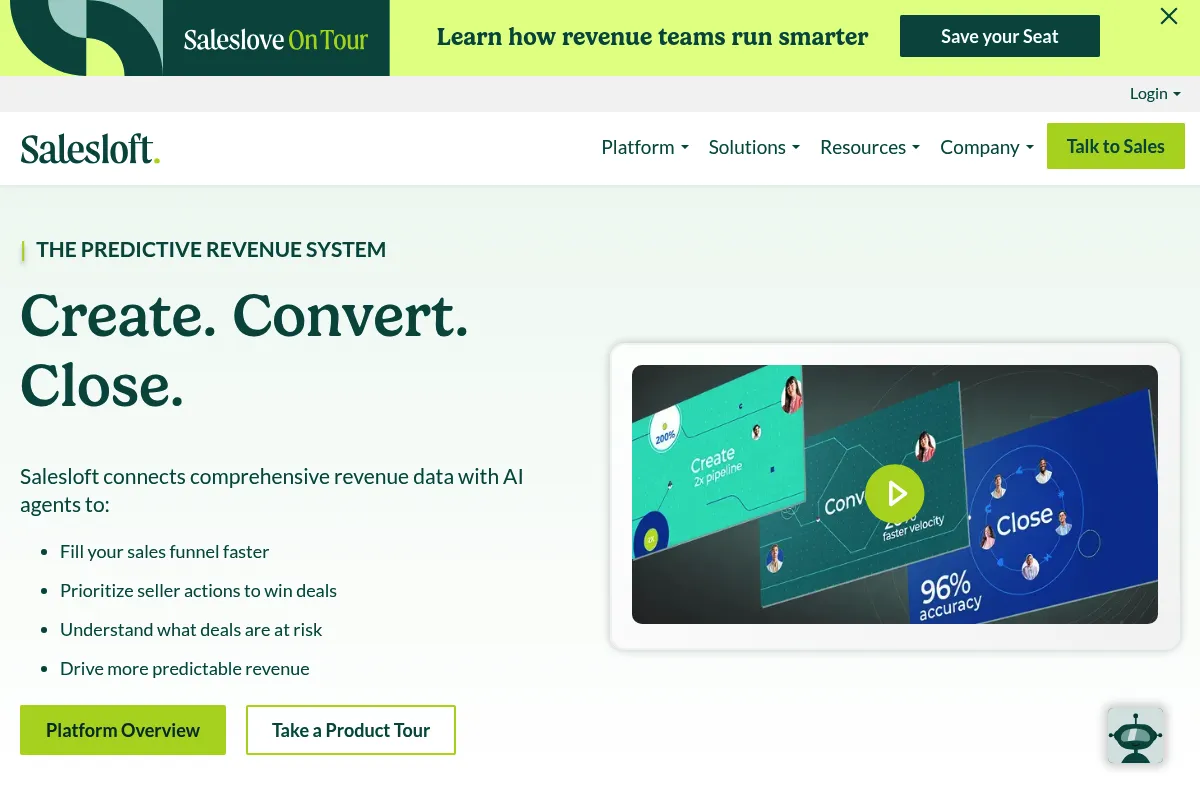
Salesloft is a revenue orchestration platform designed to centralize sales activities and pipeline management. It bridges the gap between the CRM and the actual work of selling by providing a single interface for outreach, call recording, and forecasting.
Official profiles
What it actually does
The platform automates multi-channel outreach sequences, records and transcribes sales calls, and tracks deal health. It uses an AI engine to rank daily tasks for reps, ensuring they focus on the leads most likely to convert.
What makes it different
Salesloft stands out through its 'Rhythm' engine, which uses a signal-based approach to prioritize tasks rather than just chronological sequences. Its deep integration with Drift (following acquisition) allows it to trigger sales plays based on real-time website visitor behavior, a capability most sequencers lack.
Ratings across the web
Ratings aggregated from independent review platforms.
Key Features
Cadences
Automates multi-step outreach across email, phone, and LinkedIn to maintain consistency.
Rhythm
An AI-powered workflow that prioritizes a rep's daily tasks based on buyer engagement signals.
Conversations
Records and analyzes sales calls to identify coaching opportunities and buyer sentiment.
Deals
Provides a visual overview of the pipeline to help managers identify at-risk opportunities.
Forecast
Uses historical data and current pipeline signals to predict quarterly revenue attainment.
Messenger
Enables 1:1 SMS communication with prospects directly from the platform.
Drift Integration
Triggers immediate sales follow-ups based on website chat interactions.
Pricing
Essentials
- Automated Cadences
- Email tracking
- Salesforce/Dynamics integration
- Basic reporting
Advanced
- Everything in Essentials
- Conversation Intelligence
- Deals pipeline management
- Priority support
Premier
- Everything in Advanced
- Revenue Forecasting
- Advanced analytics
- Strategic account management
Pricing checked 6 months ago
Pricing guidance
- When you need to record and analyze calls for coaching (Essentials to Advanced)
- When you need formal revenue forecasting within the platform (Advanced to Premier)
- When your team size grows and requires more sophisticated governance
- Dialer minutes and SMS are often billed as add-ons
- Strict seat minimums usually apply
- Multi-year contracts are standard
Premium positioning justified by feature depth and enterprise-grade support.
Pros & Cons
Strengths
-
Superior UI/UX for reps
The interface is generally considered more intuitive than its primary competitor, Outreach, which reduces the time it takes for new hires to become productive.
-
Tight CRM synchronization
Bi-directional sync with Salesforce is highly reliable, ensuring that activity data is captured without manual entry by reps.
-
Signal-based prioritization
Rhythm helps reps ignore low-value tasks and focus on prospects showing high intent, such as those visiting pricing pages or opening emails multiple times.
-
Consolidated tech stack
By including conversation intelligence and forecasting, it eliminates the need for separate tools like Gong or Clari for many mid-market teams.
Weaknesses
-
High total cost of ownership
Between seat costs, dialer credits, and the need for a dedicated admin, the platform is a significant financial commitment.
Affects: Small teams and startups
-
Steep administrative learning curve
Setting up complex cadences, governance rules, and custom fields requires significant time and technical expertise.
Affects: Sales Operations managers
-
Occasional dialer latency
Users frequently report minor lag or connection issues with the built-in dialer, which can disrupt the flow of high-volume cold calling.
Affects: High-volume SDR teams
Real User Sentiment
Generally positive, with users praising the workflow efficiency while expressing frustration over pricing and occasional technical glitches.
Users tend to like
- Intuitive task management interface
- Reliable Salesforce integration
- The 'Rhythm' prioritized to-do list
- Quality of customer success managers
Users commonly complain about
- Expensive compared to newer entrants like Apollo
- Dialer connectivity issues
- Reporting can be rigid and difficult to customize
- Occasional lag when syncing large amounts of data
Recurring tradeoffs
- You trade simplicity for power; it takes longer to set up than basic tools but offers much more control.
Happiest users
Sales leaders at mid-market companies who want a single pane of glass for their reps' activities.
Often frustrated
Small business owners or solo founders who find the platform too complex and expensive for basic cold outreach.
Use Cases
SDR Outreach
Standardizing how reps follow up with inbound leads across multiple channels.
AE Deal Management
Helping Account Executives track deal health and record meetings for later review.
Sales Coaching
Managers using call recordings to identify why certain reps are underperforming.
Revenue Forecasting
Leadership teams using platform data to predict end-of-quarter results.
Inbound Response
Using the Drift integration to instantly alert reps when a high-value prospect is on the website.
Frequently Asked Questions
How much does Salesloft cost per user?
Salesloft does not publish pricing, but industry benchmarks suggest it ranges from $125 to $160 per user per month, typically billed annually. There are often seat minimums (e.g., 5 or 10 seats) and additional costs for dialer minutes.
How does Salesloft compare to Outreach?
Salesloft is often praised for having a cleaner, more user-friendly interface and better customer support. Outreach is sometimes seen as more flexible for highly complex, enterprise-wide logic but has a steeper learning curve for reps.
Does Salesloft work with Gmail and Outlook?
Yes, Salesloft has native integrations and browser extensions for both Gmail and Outlook, allowing reps to send tracked emails and execute cadences directly from their inbox.
What are the main limitations of Salesloft?
The main limitations include its high price point, the complexity of its administrative backend, and occasional stability issues with its built-in dialer. It also lacks a built-in B2B database, meaning you still need a tool like ZoomInfo or Apollo for lead sourcing.
Can I use Salesloft without a CRM?
Technically yes, but it is not recommended. The platform's value is heavily tied to its ability to sync data with CRMs like Salesforce, HubSpot, or Microsoft Dynamics. Using it standalone results in significant manual data entry.
Does Salesloft include a dialer?
Yes, Salesloft includes a built-in VOIP dialer that supports one-click dialing, call recording, and local presence (showing a local area code to the prospect). Dialer minutes are typically a separate cost.
Why trust this page?
This evaluation combines product positioning, pricing analysis, traffic and market signals, and public user sentiment into a single decision-support page. Content is generated editorially — not copied from the vendor's website.
Funding & Company
Founded
2011
Stage
Acquired
Total Raised
$246.22M
Latest Round
Undisclosed (May 2022)
Notable Investors
Salesloft has raised a total of over $245 million across multiple funding rounds, culminating in a majority stake acquisition by Vista Equity Partners in late 2021, which valued the company at $2.3 billion. [18, 23] This significant financial backing from prominent investors like Insight Partners and Emergence Capital highlights strong market confidence in its revenue orchestration platform.
Market Signals & Traffic
Estimated visits, global rank, geography, traffic sources, monthly visit trends, and organic search keywords (Similarweb)—on a dedicated page built for depth and search.
- Estimated visits
- 1,220,461
- Global rank
- #28,590
- Snapshot
- Apr 2026
- Traffic trend
- Steady
Estimated monthly visits
Alternatives to Salesloft
View all alternatives
Similar Tools
Dust
AI Assistant, Automation & Agents, Productivity

Custom assistants that connect internal company data to language models.
Taskade AI
AI Assistant, Productivity

AI-powered workspace for project management, collaboration, and automation.
AgentSmyth
AI Assistant, Research, Automation & Agents

Autonomous agents for financial research and investment analysis.
Vapi
AI Assistant, Automation & Agents, Developer Tools

Developer platform for building and deploying voice AI agents.
Replo
Developer Tools, Content Creation

A visual, no-code platform for building high-performance landing pages on Shopify.
MindOS
AI Assistant, Automation & Agents, Productivity

Create and deploy autonomous agents for professional and personal tasks.