

A high-scale cross-channel orchestration engine that excels at handling massive data volumes for B2C brands, though it requires significant technical resources to master.
Excellent for high-growth B2C companies with complex data needs, weaker for small teams looking for a plug-and-play email tool.
Analysis based on product data, pricing structure, traffic signals, and public user sentiment.
Who Should Use Iterable?
Typical users
Growth marketers and product teams at mid-market to enterprise B2C companies with high message volumes.
Maturity fit
advanced
Choose this if…
- You need to trigger messages based on real-time user behavior across mobile and web
- Your priority is data flexibility and the ability to ingest custom data schemas
- You have a dedicated data or engineering team to manage the initial integration
Skip this if…
- You are a solo founder or a small team with limited technical bandwidth
- Your primary need is a simple newsletter tool or basic email automation
- You do not have a centralized data source or warehouse to feed the platform
About Iterable
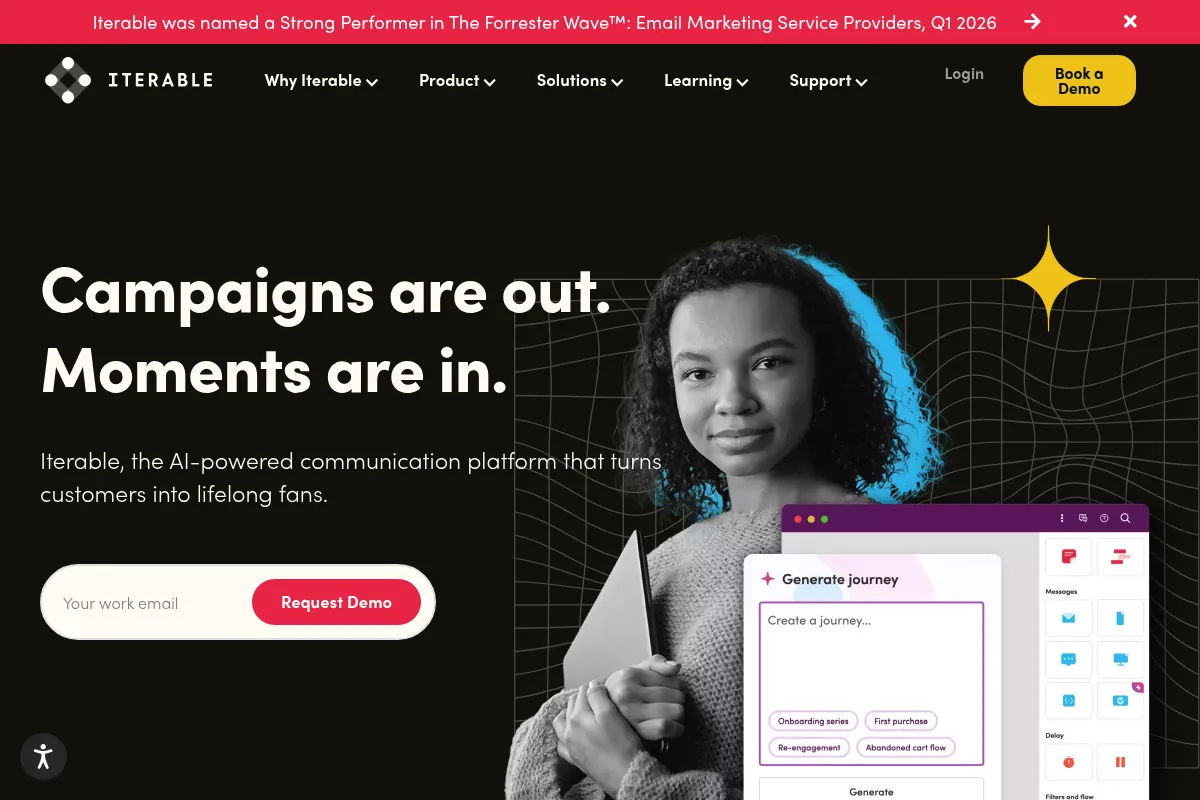
Iterable is a growth marketing platform designed to unify customer data and automate messaging across email, mobile, and web. It was built to solve the data rigidity issues found in legacy enterprise marketing clouds, allowing for more flexible event-based triggering.
Official profiles
What it actually does
It ingests user events and attributes to trigger automated journeys across email, SMS, push notifications, and in-app messages. Marketers use a visual canvas to build logic-heavy campaigns that update in real-time based on user actions.
What makes it different
The platform's 'Catalog' feature distinguishes it by allowing users to store and reference non-user data—like product inventory, store locations, or weather—directly within templates. This avoids the need for complex API calls at the moment of send, which is a common bottleneck in older systems.
Ratings across the web


Ratings aggregated from independent review platforms.
Key Features
Workflow Studio
A visual drag-and-drop builder for mapping complex, multi-step customer lifecycles.
Catalog
Ingests external data sets to personalize messages with real-time metadata like local inventory.
Handlebars Logic
Enables deep conditional logic within templates to change content based on user attributes.
Iterable AI
Predicts user behavior and automates the selection of the best channel for each recipient.
Snippets
Reusable content blocks that allow global updates across thousands of templates simultaneously.
Data Feeds
Pulls content from external APIs at the time of send to ensure message relevance.
In-App Messaging
Delivers custom-designed overlays and notifications directly within mobile applications.
Pricing
Custom
- Full cross-channel orchestration
- Predictive AI capabilities
- Advanced segmentation
- Dedicated account management
Pricing checked 6 months ago
Pricing guidance
- When you exceed your Monthly Tracked User (MTU) limit
- When you add additional channels like SMS or WhatsApp
- When you require advanced AI optimization features
- SMS and WhatsApp carry additional per-message costs
- Data retention limits may apply to historical event data
- Support response times vary by contract tier
Premium positioning justified by high-scale reliability and data flexibility.
Pros & Cons
Strengths
-
Superior data flexibility
Unlike competitors with rigid schemas, Iterable allows you to send almost any JSON data and use it immediately for segmentation or personalization.
-
Unified cross-channel view
Managing push, email, and SMS in a single workflow prevents channel fatigue and ensures a consistent user experience.
-
High-performance API
The platform is built for scale, making it a reliable choice for companies sending millions of triggered messages per hour.
Weaknesses
-
Steep learning curve
The use of Handlebars for logic and the complexity of the workflow builder require a more technical marketing team.
Affects: Non-technical marketers
-
Fragmented UI experience
Some users report that the interface feels like a mix of old and new designs, making navigation inconsistent.
Affects: Daily power users
-
Premium pricing
The cost of entry is high, and the pricing model can scale aggressively as your user base grows.
Affects: Early-stage startups and mid-market companies on tight budgets
Real User Sentiment
Generally positive, with high marks for technical capability and significant criticism regarding the complexity of the UI.
Users tend to like
- The flexibility of the Catalog feature
- Robustness of the API
- Ability to handle complex logic within workflows
- Responsive customer success teams for high-tier accounts
Users commonly complain about
- The template editor can be buggy and frustrating
- Handlebars syntax is difficult for non-developers
- Reporting and analytics can feel limited compared to dedicated BI tools
Recurring tradeoffs
- You trade ease-of-use for extreme customization and data power.
Happiest users
Technical growth marketers at companies like DoorDash or SeatGeek who need to coordinate millions of personalized touchpoints.
Often frustrated
Marketers at smaller companies who find the platform over-engineered for their simple email needs.
Use Cases
Onboarding Sequences
Delivering a mix of push and email based on specific app actions taken in the first 24 hours.
Cart Abandonment
Using Catalog data to show the exact items left in a cart with real-time stock levels.
Re-engagement Campaigns
Using AI to predict which users are likely to churn and sending a targeted SMS discount.
Transactional Updates
Sending high-priority order confirmations and shipping updates via a reliable API.
Localized Promotions
Triggering messages based on a user's proximity to a physical store using geo-fencing data.
Frequently Asked Questions
How much does Iterable cost?
Iterable does not publish pricing. It is custom-quoted based on your number of Monthly Tracked Users (MTUs) and message volume. Most contracts start at $30,000 to $50,000 per year, making it a significant investment for smaller teams.
How does Iterable compare to Braze?
Iterable is often praised for its data flexibility and the 'Catalog' feature, while Braze is frequently cited as having a more polished mobile SDK and a slightly more intuitive UI for marketers. Both are top-tier enterprise solutions.
Does Iterable have a free trial?
No, Iterable does not offer a self-serve free trial. You must go through a sales process and a guided demo to evaluate the platform.
What are the main limitations of Iterable?
The primary limitations are the steep learning curve for non-technical users and a template editor that many users find less intuitive than those of competitors like Klaviyo or Mailchimp.
What integrations does Iterable support?
Iterable has deep integrations with data platforms like Segment, mParticle, and Snowflake, as well as various analytics tools and attribution platforms like AppsFlyer and Branch.
Why trust this page?
This evaluation combines product positioning, pricing analysis, traffic and market signals, and public user sentiment into a single decision-support page. Content is generated editorially — not copied from the vendor's website.
Funding & Company
Founded
2013
Stage
—
Total Raised
$342.2M
Latest Round
Series E (Jun 2021)
Notable Investors
Iterable has raised a total of $342.2 million, culminating in a significant $200 million Series E round in June 2021 which valued the company at $2 billion. This substantial late-stage funding from prominent investors like Silver Lake and Viking Global Investors indicates strong market confidence and provides a long operational runway.
Market Signals & Traffic
Estimated visits, global rank, geography, traffic sources, monthly visit trends, and organic search keywords (Similarweb)—on a dedicated page built for depth and search.
- Estimated visits
- 1,712,049
- Global rank
- #25,226
- Snapshot
- Apr 2026
- Traffic trend
- Surging
Estimated monthly visits
Alternatives to Iterable
View all alternatives
Similar Tools
Setmore
Productivity, Automation, Communication

Online appointment scheduling and booking management for businesses.
Day
Automation, Productivity, Workflow

Automated CRM that captures interactions and updates records automatically.
Manus
AI Assistant, Automation & Agents, Productivity

Autonomous general-purpose agent for executing complex digital tasks and workflows.
Ironclad
Workflow, Privacy & Compliance, Automation

Digital contracting platform for managing and automating legal workflows.
Morphic
AI Assistant, Productivity, Developer Tools

Open-source search engine providing real-time answers with source citations.
Emergence
Automation & Agents, Developer Tools, Workflow

Platform for building and deploying autonomous agentic AI workflows.