

An open-source AI answer engine that provides a clean, cited search experience—best for users who want a transparent, self-hostable alternative to Perplexity without the subscription fee.
Excellent for developers and researchers who prioritize transparency and cost-control, but weaker for those needing a polished mobile app or social discovery features.
Analysis based on product data, pricing structure, traffic signals, and public user sentiment.
Who Should Use Morphic?
Typical users
Developers, technical researchers, and privacy-conscious power users who want an AI search tool they can inspect or self-host.
Maturity fit
beginner to advanced
Choose this if…
- You want a transparent search tool where you can see the source code and RAG logic.
- You prefer a minimal, ad-free interface over the feature-heavy UI of Perplexity.
- You want to use your own API keys (OpenAI, Anthropic, Groq) to control costs.
- You need to self-host your search engine for privacy or internal team use.
Skip this if…
- You require a dedicated mobile app with native features like voice-to-search.
- You want 'social' search features like public feeds, collections, or 'Pages'.
- You need a highly polished, bug-free experience (the hosted version is often in beta).
- You aren't comfortable managing API keys or Docker for the best experience.
About Morphic
Morphic is an open-source AI-powered search engine designed to compete with proprietary 'answer engines' like Perplexity. It was built to provide a fast, transparent, and customizable way to get cited answers from the web. The project is highly popular on GitHub and serves as a foundation for many developers building their own RAG-based search tools.
What it actually does
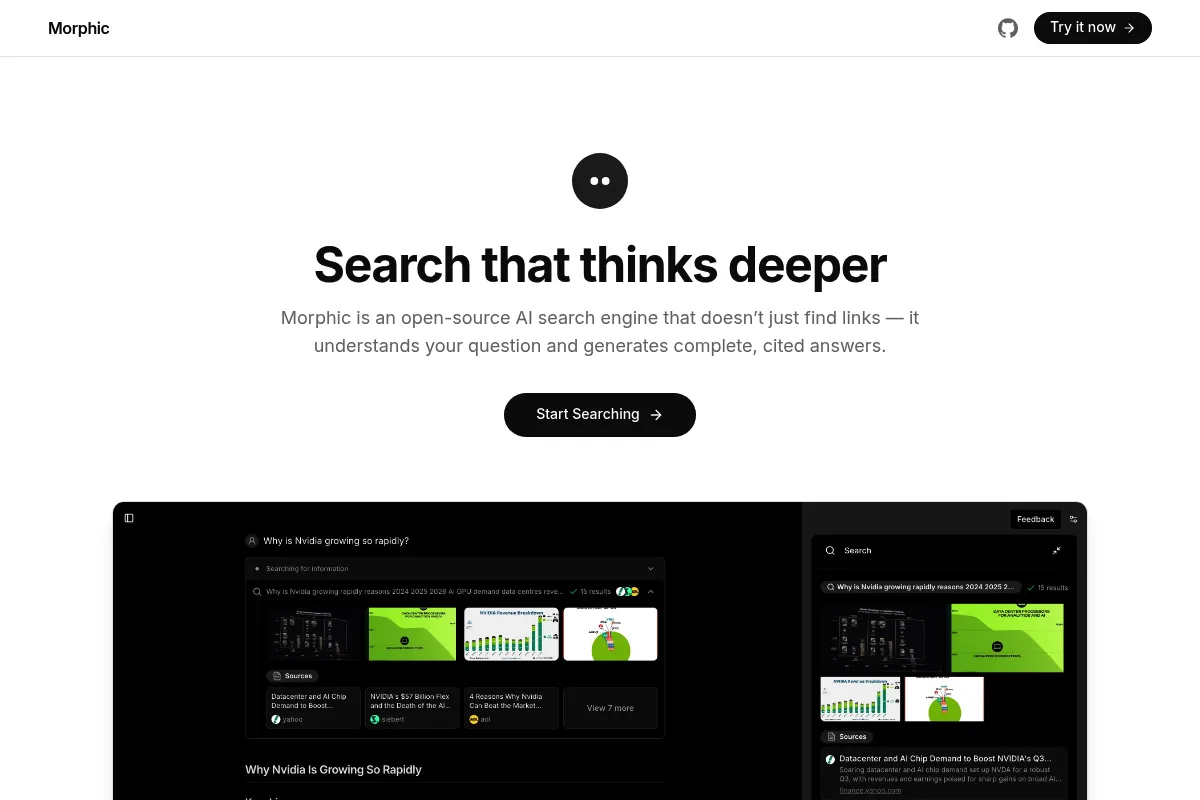
Morphic takes natural language queries, searches the live web using providers like Tavily or SearXNG, and synthesizes the results into a cited response. It uses a 'Generative UI' approach, meaning it can render interactive components like charts, tables, and maps directly in the chat interface based on the data found.
What makes it different
Unlike closed-source competitors, Morphic is fully open-source (Apache-2.0 license), allowing anyone to audit the code or deploy it on their own infrastructure. It uniquely supports a wide range of LLM providers out of the box, including local models via Ollama, making it the most flexible option for privacy-focused users.
Ratings across the web


Ratings aggregated from independent review platforms.
Key Features
Adaptive Search Mode
Performs multiple recursive searches to answer complex, multi-part questions.
Model Selector
Allows users to toggle between different LLMs like GPT-4o and Claude 3.5 Sonnet within the same session.
Generative UI
Renders data as interactive widgets (e.g., stock charts or weather maps) instead of plain text.
Open Source Pedigree
The entire stack is available on GitHub, ensuring no hidden tracking or proprietary bias.
Tavily Integration
Uses a search engine optimized specifically for AI agents to ensure high-quality, relevant sources.
Docker Support
Enables one-command deployment for users who want to run their own private instance.
Citations
Every claim is backed by a numbered source link, reducing the risk of unchecked hallucinations.
Shareable Results
Generates unique URLs for search results to facilitate collaboration without requiring an account.
Pricing
Hosted (morphic.sh)
- Web search and citations
- Basic model selection
- Chat history
- Result sharing
Self-Hosted
- Full source code access
- Bring Your Own Key (BYOK)
- Local model support (Ollama)
- No usage limits (subject to your API keys)
Pricing checked 6 months ago
Pricing guidance
- When you want to use local models for privacy
- When you want to customize the search logic
- When you hit rate limits on the public hosted version
- Hosted version may have daily query caps during peak times
- Self-hosting requires your own Tavily and OpenAI/Anthropic API keys
- No enterprise-grade SLA for the hosted version
Disruptive pricing model that offers a 'Pro' experience for free by leveraging open-source contributions.
Pros & Cons
Strengths
-
High Transparency
Because it is open-source, users can verify exactly how the tool handles data and which sources it prioritizes, which is impossible with Perplexity.
-
Cost Efficiency
The hosted version is currently free, and self-hosters only pay for the raw API tokens they consume, often making it cheaper than a $20/month subscription.
-
Clean, Minimalist UI
Focuses entirely on the search and answer experience without the 'Pro Discovery' feeds or social clutter found in mainstream alternatives.
-
Flexible Model Support
Users aren't locked into one provider; they can switch to Groq for speed or Claude for nuanced writing as needed.
Weaknesses
-
Lacks Mobile Polish
There is no official iOS or Android app, and the web interface, while responsive, lacks the fluid feel of native mobile search tools.
Affects: Mobile-first users
-
Beta Stability Issues
The hosted version at morphic.sh can occasionally be slow or experience downtime as it is primarily a showcase for the open-source project.
Affects: Users requiring 100% uptime
-
Limited 'Extra' Features
Does not have advanced features like Perplexity's 'Pages' (for creating articles) or deep integration with social media platforms.
Affects: Content creators and power researchers
Real User Sentiment
Users generally view Morphic as the 'clean' and 'honest' alternative to Perplexity, praising its speed and open nature.
Users tend to like
- The lack of 'bloat' in the UI
- Speed of the Groq integration
- The ability to self-host via Docker
- Accurate citations
Users commonly complain about
- Lack of a mobile app
- Occasional UI bugs in the beta
- Requires technical knowledge to self-host
Recurring tradeoffs
- You trade the 'ecosystem' features of Perplexity for transparency and lower cost.
Happiest users
Developers and technical hobbyists who enjoy 'rolling their own' tools and avoiding monthly subscriptions.
Often frustrated
Non-technical users who want a 'just works' mobile experience with 24/7 support.
Use Cases
Technical Research
Finding specific documentation or library comparisons with cited sources.
Fact-Checking
Verifying claims in real-time by seeing the exact websites the AI is reading.
Developer Prototyping
Using the Morphic codebase as a template to build custom internal search tools.
Privacy-First Search
Running Morphic locally with Ollama to search and summarize without sending data to a cloud provider.
Quick Comparisons
Using the 'Adaptive' mode to compare products or services across multiple websites simultaneously.
Frequently Asked Questions
Is Morphic.sh free to use?
Yes, the hosted version at morphic.sh is currently free to use in its beta state. However, for unlimited usage or to use specific high-end models without restrictions, most power users choose to self-host the project using their own API keys.
How does Morphic compare to Perplexity?
Morphic is more minimal and fully open-source. While Perplexity offers a more 'consumer-ready' experience with a mobile app and social features, Morphic allows for greater customization and transparency. Perplexity costs $20/month for Pro, whereas Morphic can be run for the cost of your API tokens.
Can I run Morphic locally?
Yes, Morphic is designed to be self-hosted. You can clone the repository from GitHub and use Docker Compose to get it running on your own machine in minutes. This allows you to use local models like Llama 3 via Ollama.
What search engine does Morphic use?
Morphic primarily uses Tavily AI, a search engine built specifically for AI agents and RAG. It also supports SearXNG, Brave Search, and Exa, giving users flexibility in how they retrieve web data.
Does Morphic have a mobile app?
No, Morphic does not currently have an official app on the Apple App Store or Google Play Store. The website is mobile-responsive, but users looking for a native app experience may find it lacking compared to Perplexity.
What AI models can I use with Morphic?
Morphic supports a wide range of models including OpenAI's GPT-4o, Anthropic's Claude 3.5 Sonnet, and various models via Groq. If you self-host, you can connect it to almost any model provider that has an OpenAI-compatible API.
Why trust this page?
This evaluation combines product positioning, pricing analysis, traffic and market signals, and public user sentiment into a single decision-support page. Content is generated editorially — not copied from the vendor's website.
Funding & Company
Founded
—
Stage
Bootstrapped
Total Raised
Bootstrapped
Latest Round
—
Morphic has no publicly disclosed venture capital funding and appears to be self-funded by its founder, Polygon co-founder Jaynti Kanani. [1, 12] The company has announced a $1 million Creator's Fund, which is a grant program to support creators on its platform, not a corporate funding round. [11, 15]
Market Signals & Traffic
Estimated visits, global rank, geography, traffic sources, monthly visit trends, and organic search keywords (Similarweb)—on a dedicated page built for depth and search.
- Estimated visits
- 25,009
- Global rank
- #1,066,079
- Snapshot
- Apr 2026
- Traffic trend
- Cooling
Estimated monthly visits
Alternatives to Morphic
View all alternativesPerplexity
AI Assistant, Content Creation

AI-powered conversational search engine providing cited, comprehensive answers.
Gemini
AI Assistant, Content Creation

An experimental AI-powered conversational chatbot from Google.
Copilot
AI Assistant, Content Creation

AI-powered assistant for productivity, creativity, and collaboration.
Similar Tools
Msty
AI Assistant, Productivity, Developer Tools

Unified interface for local and cloud-based language models
Mistral AI
AI Assistant, Developer Tools

Efficient large language models for developers and enterprise applications.
MarketMuse
Content Creation, Productivity

AI-powered platform for content strategy, planning, and optimization.
OpenClaw
AI Assistant, Automation, Developer Tools

Open-source AI agent that automates tasks via messaging platforms.
Applio
Music Generation, Content Creation, Developer Tools

Open-source platform for voice cloning and retrieval-based voice conversion
AuraScape
Privacy & Compliance, Developer Tools

Real-time security and governance platform for generative applications.