

Spider
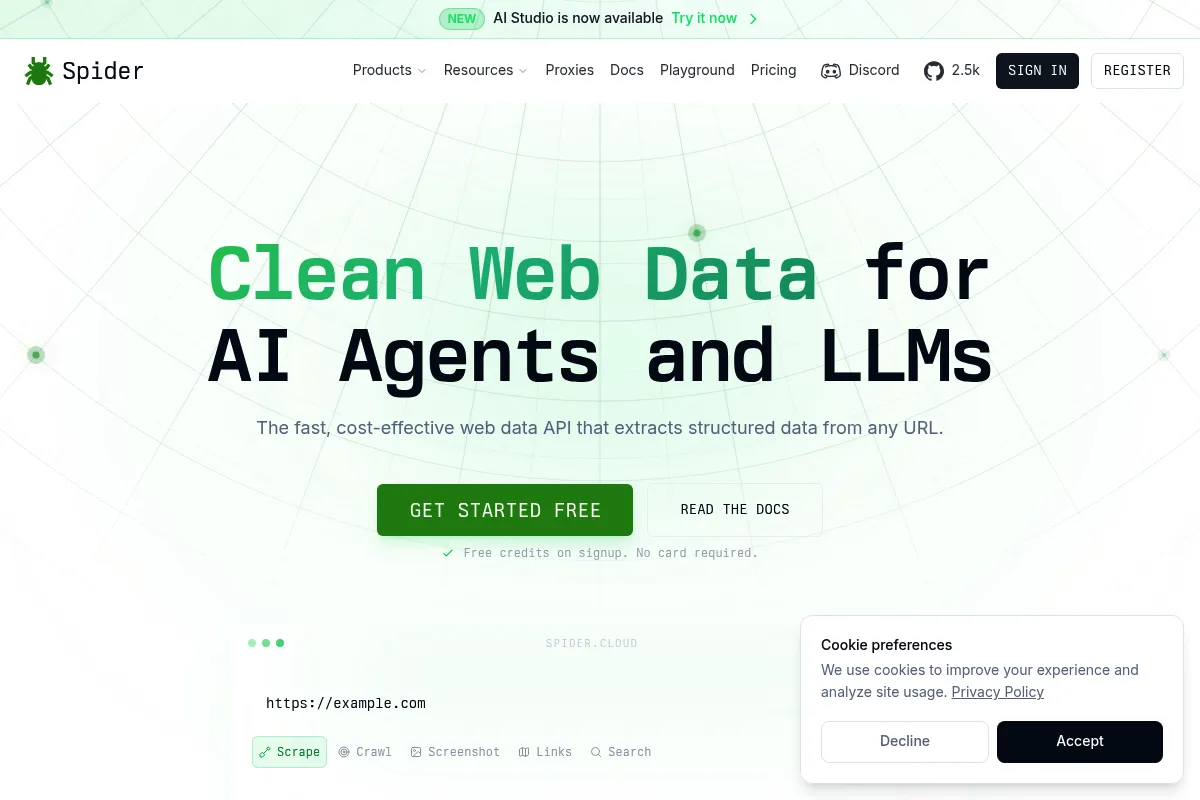
A high-speed, Rust-based crawler designed to turn the web into LLM-ready markdown with significantly better cost-efficiency than mainstream competitors.
Excellent for developers building RAG pipelines at scale, weaker for non-technical users who need a visual point-and-click scraper.
Analysis based on product data, pricing structure, traffic signals, and public user sentiment.
Who Should Use Spider?
Typical users
AI engineers, data scientists, and backend developers building RAG systems or training LLMs on fresh web data.
Maturity fit
scaling to advanced
Choose this if…
- Your priority is raw crawling speed and markdown quality over a visual UI.
- You find Firecrawl or Apify too expensive for high-volume data ingestion.
- You need to bypass sophisticated anti-bot protections without managing your own proxy infrastructure.
Skip this if…
- You are a non-technical user looking for a no-code browser extension.
- Your workflow requires complex, multi-step browser interactions like filling out forms or solving CAPTCHAs manually.
- You only need to scrape a handful of pages once a month.
About Spider
Spider is a performance-focused web crawler built in Rust, specifically optimized for the AI era. It bridges the gap between raw HTTP requests and full browser rendering to deliver clean, structured data for LLM applications.
Official profiles
What it actually does
It crawls entire domains or specific URLs, bypasses bot detection, and converts HTML into clean markdown or JSON. It handles JavaScript execution and proxy rotation automatically through a single API call.
What makes it different
Unlike many Python-based scrapers, Spider is built on a high-concurrency Rust engine, making it significantly faster and more resource-efficient. It positions itself as a direct, more affordable alternative to Firecrawl with a focus on 'LLM-native' output.
Key Features
Rust-based Engine
Delivers sub-second crawl speeds and handles massive concurrency without memory leaks.
Markdown Conversion
Strips headers, footers, and nav menus to provide clean text for LLM context windows.
Smart Proxy Management
Automatically switches between data center and residential proxies to avoid IP bans.
JavaScript Rendering
Executes client-side code to capture content from SPAs built with React or Vue.
Crawl Budget Controls
Allows users to set limits on depth and page counts to prevent runaway costs.
API-First Design
Simple REST endpoints that integrate directly into LangChain or LlamaIndex workflows.
Pricing
Free
- 1,000 credits
- Basic crawling
- Markdown output
- Community support
Basic
- 50,000 credits
- JavaScript rendering
- Anti-bot bypass
- Priority support
Pro
- 250,000 credits
- Residential proxies
- Higher concurrency
- Dedicated support
Scale
- 1,500,000 credits
- Custom limits
- Enterprise-grade reliability
- SLA
Pricing checked 5 months ago
Pricing guidance
- When you need to scrape sites that require JavaScript execution
- When you hit the 1,000-page limit on the free tier
- When you require residential proxies to bypass strict geo-blocking
- JS rendering costs 10 credits per page
- Premium/Residential proxies cost 25 credits per page
- Concurrency limits apply based on the tier
Aggressively priced to undercut established scraping APIs while targeting the high-growth AI developer market.
Pros & Cons
Strengths
-
Superior cost-to-performance ratio
Compared to competitors like Firecrawl, Spider offers significantly more page credits per dollar, making it the better choice for large-scale data ingestion.
-
Built for LLM context windows
The markdown output is highly optimized, removing noise that usually confuses models or wastes token counts.
-
Extreme speed
The Rust core allows it to process thousands of pages per minute, which is critical for time-sensitive RAG applications.
Weaknesses
-
Steep credit multipliers for JS rendering
While the base price is low, enabling JavaScript rendering or premium proxies consumes credits 10x to 25x faster, which can surprise users on the Basic plan.
Affects: Users scraping modern, heavy web apps
-
Developer-centric interface
There is no visual 'select and click' tool for defining custom extraction rules; you must rely on selectors or LLM-based extraction.
Affects: Non-technical researchers
-
Documentation can be sparse
Advanced configurations for the open-source version or specific API edge cases aren't always thoroughly documented compared to more mature platforms.
Affects: Teams self-hosting or doing complex custom implementations
Real User Sentiment
Users generally view Spider as a faster, cheaper, and more 'hardcore' alternative to mainstream LLM scrapers.
Users tend to like
- Blazing fast crawl speeds
- Clean markdown conversion
- Generous credit limits on paid plans
- Ease of API integration
Users commonly complain about
- Credit burn rate when using JS/Proxies
- Lack of a visual dashboard for data management
- Occasional issues with complex CAPTCHAs
Recurring tradeoffs
- You trade a user-friendly UI for raw performance and lower costs.
Happiest users
Engineers who need to ingest thousands of documentation pages or blog posts into a vector database daily.
Often frustrated
Marketing analysts who want to export data to a CSV without writing any code.
Use Cases
RAG Pipeline Ingestion
Crawling documentation sites to keep an AI agent's knowledge base up to date.
LLM Training Sets
Collecting massive amounts of clean text data from specific niches for fine-tuning.
Competitor Monitoring
Tracking price changes or product updates across thousands of e-commerce pages.
Search Engine Building
Indexing specific corners of the web for custom search applications.
Content Aggregation
Pulling news or blog posts into a centralized feed in a structured format.
Frequently Asked Questions
How does Spider compare to Firecrawl?
Spider is built in Rust and generally offers higher performance and lower pricing. While Firecrawl has a more established brand in the AI space, Spider provides more credits per dollar and focuses on raw speed for large-scale crawls.
Is there a free plan available?
Yes, Spider offers a free tier with 1,000 credits per month. However, keep in mind that using advanced features like JavaScript rendering (10 credits) or premium proxies (25 credits) will deplete this limit very quickly.
Can Spider bypass Cloudflare and other anti-bot measures?
Yes, Spider includes built-in anti-bot bypass and proxy rotation. For the most difficult sites, you will need to use the Pro plan or higher to access residential proxies, which are more effective at mimicking real user behavior.
What format does the data come back in?
Spider primarily returns data in Markdown or JSON. The Markdown is specifically cleaned to be 'LLM-ready,' meaning it removes boilerplate like navigation bars and footers to focus on the core content.
Does Spider support JavaScript rendering?
Yes, it uses a headless Chrome instance to render JavaScript. This is essential for scraping modern web apps (React, Vue, etc.), but it costs 10 credits per page compared to 1 credit for a standard HTTP request.
Can I self-host Spider?
Yes, Spider has an open-source version available on GitHub. However, the managed cloud version (spider.cloud) is recommended for users who don't want to manage their own proxy pools and browser infrastructure.
Why trust this page?
This evaluation combines product positioning, pricing analysis, traffic and market signals, and public user sentiment into a single decision-support page. Content is generated editorially — not copied from the vendor's website.
Funding & Company
Founded
2024
Stage
Bootstrapped
Total Raised
Bootstrapped
Latest Round
—
Spider appears to be a bootstrapped company with no publicly disclosed external funding. The company's revenue is generated through a usage-based model for its cloud services.
Market Signals & Traffic
Estimated visits, global rank, geography, traffic sources, monthly visit trends, and organic search keywords (Similarweb)—on a dedicated page built for depth and search.
- Estimated visits
- 22,245
- Global rank
- #1,009,845
- Snapshot
- Apr 2026
- Traffic trend
- Surging
Estimated monthly visits
Alternatives to Spider
View all alternatives
Similar Tools
Nomic
Developer Tools, Research, Search

Tools for visualizing unstructured data and running local language models.
Bolt.new
Developer Tools, Automation, Website Builder

AI-powered platform to build websites and apps from natural language prompts.
HyperWrite
AI Assistant, Content Creation

AI-powered writing assistant for content creation, research, and task automation.
Hasty
Developer Tools, Automation, Workflow
Data-centric vision platform for labeling, training, and deploying models.
Bittensor
Developer Tools, Research

Decentralized marketplace for peer-to-peer machine intelligence and model training.
Claude
AI Assistant

A conversational AI assistant for writing, analysis, coding, and more.