

A vertically integrated publishing platform that trades technical flexibility and margin efficiency for built-in growth and extreme ease of use.
Excellent for solo writers prioritizing audience growth via network effects, weaker for established brands requiring custom design or advanced marketing automation.
Analysis based on product data, pricing structure, traffic signals, and public user sentiment.
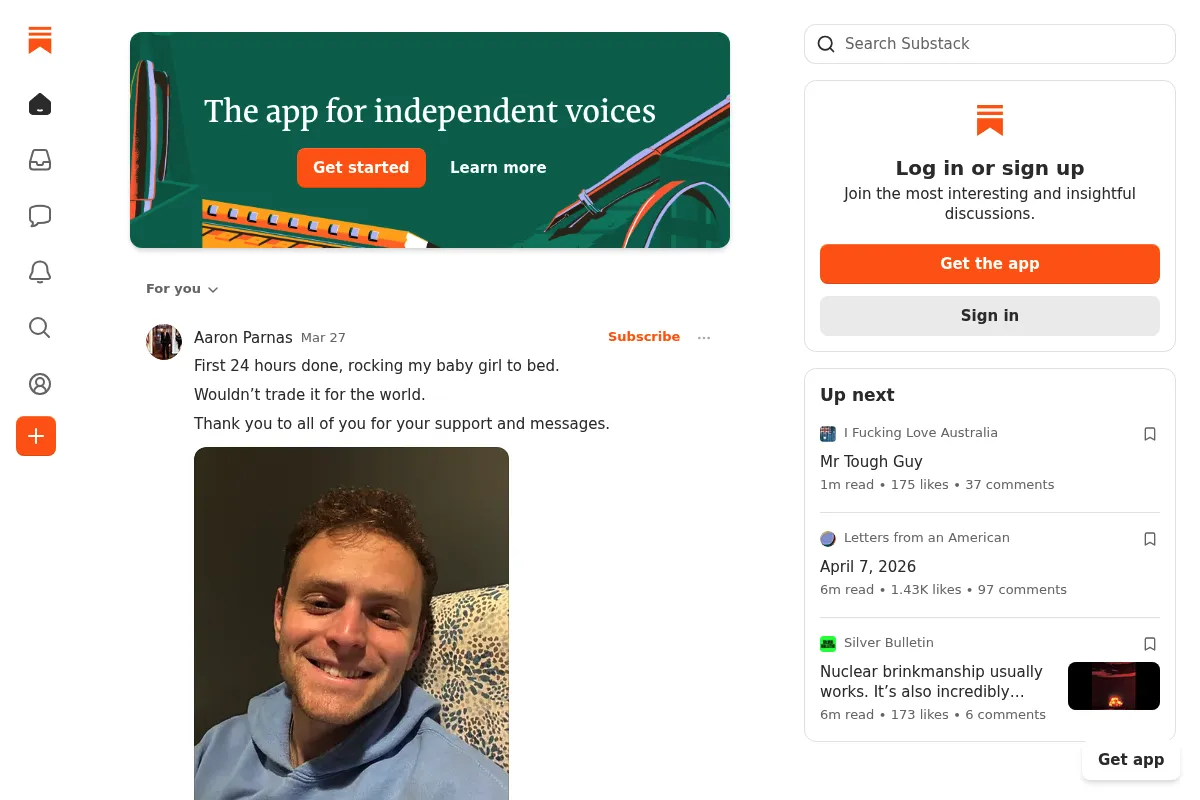
Who Should Use Substack?
Typical users
Independent journalists, niche subject matter experts, and solo creators building a direct-to-fan subscription business.
Maturity fit
beginner to scaling
Choose this if…
- You want to focus entirely on writing without managing a tech stack
- Your primary growth strategy relies on recommendations from other writers
- You want to start for free and only pay when you generate revenue
- You need integrated podcast and video hosting alongside your newsletter
Skip this if…
- You require custom CSS or unique website layouts
- You need complex email automation, branching logic, or advanced segmentation
- Your revenue is high enough that a 10% platform fee exceeds the cost of a flat-fee competitor
- You need deep integration with a third-party CRM or external marketing tools
About Substack
Substack is a publishing ecosystem that combines a simplified CMS, email distribution, and payment processing. It was built to help writers monetize their work through direct subscriptions while bypassing the traditional ad-supported media model.
What it actually does
It hosts your content on a dedicated web publication and simultaneously delivers it as an email newsletter to your subscribers. The platform handles the entire subscription lifecycle, including sign-up forms, paywalls, and recurring billing via Stripe.
What makes it different
The 'Substack Network' is its primary differentiator. Unlike traditional email tools that operate in a vacuum, Substack functions as a social graph where writers recommend each other, driving roughly 40% of all new subscriptions and 25% of paid subscriptions through internal discovery.
Ratings across the web


Ratings aggregated from independent review platforms.
Key Features
Recommendations
Automatically suggests your publication to readers of similar newsletters in the network.
Substack Notes
A short-form social feed that allows writers to interact and drive traffic to their long-form posts.
One-click Subscriptions
Enables existing Substack users to subscribe to your publication without re-entering payment details.
Private Podcasts
Allows you to offer audio content exclusively to your paying subscribers.
Referral Program
A built-in system that rewards readers with subscription credit for sharing your work.
Flexible Paywalls
Lets you lock specific posts, sections, or even individual comments behind a subscription.
Subscriber Chat
A private space for writers to host discussions with their community inside the Substack app.
Pricing
Free
- Unlimited subscribers
- Unlimited email sends
- Full access to CMS and Notes
- Podcast and video hosting
Paid Subscriptions
- All Free features
- Payment processing via Stripe
- Paid-only posts and podcasts
- Founding member tier support
Pricing checked 6 months ago
Pricing guidance
- When you want to turn on paid subscriptions
- When you want to use a custom domain (requires a $50 one-time fee)
- 10% platform fee does not include Stripe's credit card processing fees (typically 2.9% + $0.30)
- Custom domain setup requires a one-time $50 payment to Substack
- No API access for standard users to build custom integrations
Highly affordable for beginners, but becomes one of the most expensive options on the market as revenue scales.
Pros & Cons
Strengths
-
Built-in discovery engine
The recommendation feature is the most effective organic growth tool in the newsletter space, significantly reducing the need for external marketing.
-
Zero upfront cost
There are no monthly subscription fees; the platform is free to use until you decide to charge your readers, making it low-risk for new creators.
-
Frictionless payments
By using a shared ecosystem, readers who have a credit card saved on any Substack can subscribe to yours with a single click.
-
Audience and content portability
You retain full ownership of your email list and content, with the ability to export both if you choose to leave the platform.
Weaknesses
-
High long-term cost
The 10% revenue cut is significantly more expensive than flat-fee competitors like Ghost or Beehiiv once you reach a substantial subscriber base.
Affects: High-earning creators making over $1,000/month
-
Rigid design constraints
Every Substack publication looks nearly identical. You cannot use custom themes, modify CSS, or add third-party tracking scripts easily.
Affects: Brands and creators who need a unique visual identity
-
Primitive automation
The platform lacks the ability to create welcome sequences, conditional triggers, or behavioral-based email flows found in dedicated ESPs.
Affects: Marketers running complex lead-nurturing campaigns
Real User Sentiment
Users generally praise the platform for its simplicity and the growth it provides via the network, but express frustration over the high fees and lack of customization.
Users tend to like
- The ease of the writing interface
- The 'Recommendations' feature for organic growth
- The mobile app experience for readers
- The lack of technical maintenance required
Users commonly complain about
- The 10% platform fee at scale
- Limited SEO settings and metadata control
- Inability to customize the website layout
- Lack of advanced email segmentation
Recurring tradeoffs
- You trade design and margin for growth and simplicity.
Happiest users
Solo writers who want to focus on content and community without touching code or managing complex marketing stacks.
Often frustrated
Professional marketers and established media brands who find the platform's lack of data and design control too restrictive.
Use Cases
Independent Journalism
Launching a niche news outlet with a paid subscription model.
Thought Leadership
Building an audience around specific industry expertise using the recommendation network.
Community Building
Using the Chat and Notes features to foster a private space for dedicated fans.
Podcast Monetization
Hosting a podcast and offering bonus episodes to paid subscribers via a private RSS feed.
Author Platform
Fiction or non-fiction writers building a direct relationship with readers before a book launch.
Frequently Asked Questions
Is Substack actually free?
Yes, Substack is free to use for unlimited subscribers and emails. They only make money when you charge for subscriptions, at which point they take a 10% cut of your revenue. Note that Stripe also charges a separate processing fee of roughly 2.9% + $0.30 per transaction.
Substack vs. Ghost: Which is better?
Substack is better for beginners who want built-in growth and zero upfront costs. Ghost is better for established creators who want full design control, better SEO, and a flat monthly fee that doesn't scale with their revenue.
Can I use my own domain name on Substack?
Yes, you can use a custom domain (e.g., yourname.com instead of yourname.substack.com). However, Substack charges a one-time $50 fee to enable this feature, and you must purchase the domain separately from a registrar like Namecheap or Cloudflare.
Who owns my email list on Substack?
You do. Substack allows you to export your subscriber list (emails) and your content (posts) at any time. This makes it easy to move to another platform like Beehiiv or Ghost if you outgrow Substack's features.
Does Substack help with SEO?
Substack provides basic SEO, but it is not as robust as WordPress or Ghost. You have limited control over meta tags, and because many Substacks share similar structures, it can be harder to rank for competitive keywords compared to a fully optimized site.
Can I send automated welcome emails?
Substack allows you to set a single welcome email that goes out to all new subscribers. However, it does not support multi-day 'drip' sequences or complex automation based on subscriber behavior.
Why trust this page?
This evaluation combines product positioning, pricing analysis, traffic and market signals, and public user sentiment into a single decision-support page. Content is generated editorially — not copied from the vendor's website.
Funding & Company
Founded
2017
Stage
Series b
Total Raised
$86.22M
Latest Round
Undisclosed (Mar 2023)
Notable Investors
Substack has raised over $86 million, with significant Series A and B rounds led by Andreessen Horowitz. This funding has enabled the platform to attract high-profile writers and expand its product offerings, signaling strong investor confidence in the creator economy and subscription-based content models.
Market Signals & Traffic
Estimated visits, global rank, geography, traffic sources, monthly visit trends, and organic search keywords (Similarweb)—on a dedicated page built for depth and search.
- Estimated visits
- 0
- Global rank
- —
- Snapshot
- May 2026
- Traffic trend
- Rising
Estimated monthly visits
Alternatives to Substack
View all alternativesbeehiiv
Email Marketing, Content Creation

An all-in-one platform for creating, growing, and monetizing newsletters.
MailerLite
Email Marketing, Marketing Automation, Website Builder

Email marketing and automation platform for creators and businesses.
Similar Tools
Malva AI
AI Assistant, Content Creation, Productivity

Curated directory and toolkit for free content creation tools.
Myinstants
Content Creation, Music Generation

Instant soundboard for memes, sound effects, and audio clips.
Lovo AI
Content Creation, AI Assistant

AI voice generator and text-to-speech platform with video editing.
Lumen5
Content Creation, Video Creation

AI-powered platform to create engaging videos from text content.
Fliki
Content Creation, Video Creation

AI-powered text-to-video and text-to-speech creator.
DeepSeek
AI Assistant, Developer Tools, Productivity

Advanced AI models for coding, content creation, and business automation.