

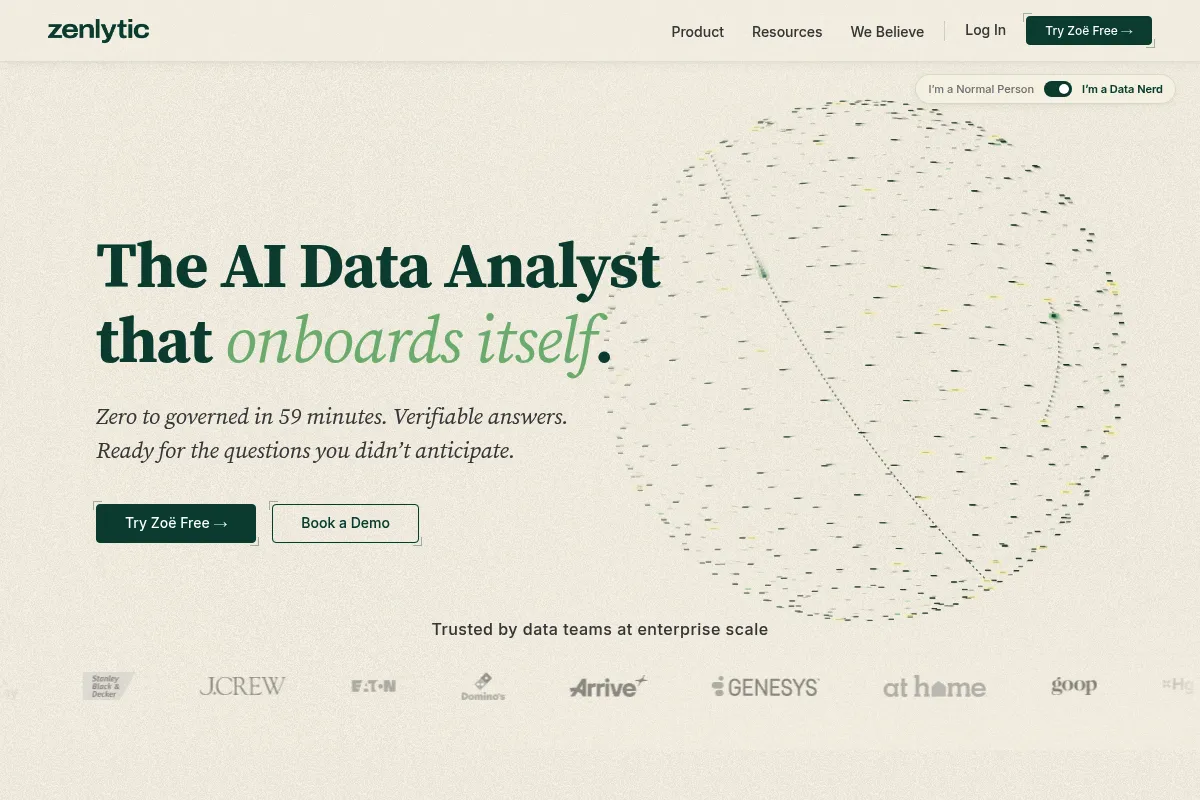
Zenlytic is a conversational business intelligence platform that uses a governed semantic layer to ensure AI-generated data answers are accurate and consistent across an organization.
Excellent for scaling companies needing accurate self-service data exploration, weaker for teams without a centralized cloud data warehouse.
Analysis based on product data, pricing structure, traffic signals, and public user sentiment.
Who Should Use Zenlytic?
Typical users
Mid-market to enterprise organizations with centralized data in Snowflake or BigQuery and business teams bottlenecked by data requests.
Maturity fit
scaling to advanced
Choose this if…
- You want non-technical users to ask complex data questions in plain English
- Your priority is data accuracy and consistency over quick, ungoverned visualizations
- You need a single source of truth for metrics that the AI cannot hallucinate
- Your data team is overwhelmed by repetitive ad-hoc reporting requests
Skip this if…
- You do not have a centralized cloud data warehouse like Snowflake or BigQuery
- Your data is scattered across disconnected spreadsheets and legacy on-premise databases
- You prefer manual SQL development and pixel-perfect dashboard design over conversational interfaces
About Zenlytic
Zenlytic is an AI-native BI platform designed to replace static dashboards with a conversational analyst named Zoë. It bridges the gap between natural language and data correctness by using a built-in semantic layer that governs how metrics are calculated.
What it actually does
It connects to your data warehouse, allows you to model business logic in a YAML-based layer, and enables any user to ask questions via chat. The system generates SQL, executes it, and returns visualizations or written reports with a full audit trail of the logic used.
What makes it different
Unlike standard text-to-SQL tools that guess table relationships, Zenlytic uses a 'Cognitive Layer' that ensures metrics like 'Net Revenue' are calculated identically every time. It features 'Memories' to store business-specific context and 'Citations' to show the exact SQL and source tables for every answer.
Ratings across the web
Ratings aggregated from independent review platforms.
Key Features
Zoë AI Analyst
Acts as an on-call data analyst for non-technical users to explore data through chat.
Clarity Engine
Maps natural language to a governed semantic layer to prevent AI hallucinations.
Citations
Provides a transparent audit trail showing the exact logic and SQL for every generated number.
Memories
Stores organizational context and custom definitions so the AI learns your specific business rules.
ZenML
A code-first modeling language for defining metrics, relationships, and dimensions.
Artifacts
Generates interactive apps, slide decks, and spreadsheets directly from conversational queries.
Proactive Agents
Runs scheduled analyses to surface insights before a user even asks a question.
Pricing
Contact Sales
- Full access to Zoë AI Analyst
- ZenML Semantic Layer
- Git integration and version control
- Unlimited data warehouse connections
- SSO and advanced security controls
- Dedicated customer success manager
Pricing checked 4 months ago
Pricing guidance
- When moving from a pilot phase to a full-organization rollout
- When requiring SSO/SAML for security compliance
- When needing to embed analytics into external customer-facing products
- Query-based API limits may apply on certain custom tiers
- Seat-based licensing typically scales with the number of business users
Premium enterprise positioning justified by the depth of its governance and AI explainability features.
Pros & Cons
Strengths
-
Governance-first AI architecture
By forcing the AI to use a defined semantic layer, it eliminates the risk of different users getting different answers for the same metric.
-
High logic transparency
Every answer includes the underlying SQL and reasoning, which allows data teams to trust and verify the AI's work easily.
-
Reduced data team backlog
Automates the 'simple' ad-hoc requests that usually take up 60-80% of an analyst's time, allowing them to focus on strategic modeling.
-
Git-integrated workflow
Data teams can manage the semantic layer using standard engineering practices like pull requests and version control.
Weaknesses
-
Upfront modeling overhead
You must invest time in defining your metrics and relationships in ZenML before the AI can provide reliable answers.
Affects: Data Engineers and Analysts
-
Opaque enterprise pricing
The lack of public pricing tiers makes it difficult for smaller teams to evaluate the tool without a formal sales process.
Affects: Budget-conscious small teams
-
Warehouse dependency
The platform is built specifically for modern cloud warehouses; it is not a fit for companies still relying on local files or legacy SQL Server setups.
Affects: Organizations with legacy infrastructure
Real User Sentiment
Users generally praise the accuracy of the AI and the responsiveness of the Zenlytic team during implementation.
Users tend to like
- Accuracy of answers compared to raw GPT-to-SQL tools
- The 'Citations' feature that builds trust with skeptical executives
- Ease of use for non-technical marketing and sales leads
- Speed of the conversational interface
Users commonly complain about
- Initial learning curve for ZenML modeling
- Lack of transparent pricing on the website
- Requirement for a clean data warehouse to see full value
Recurring tradeoffs
- Users trade immediate 'plug-and-play' setup for long-term accuracy through the semantic layer.
Happiest users
Heads of Data at scaling startups and Marketing/Ops leads at mid-market firms who are tired of waiting for reports.
Often frustrated
Small teams looking for a cheap, zero-setup visualization tool for basic spreadsheets.
Use Cases
Marketing Attribution
Asking Zoë which channels drove the most revenue last month without writing a single join.
Executive Reporting
Generating a board-ready slide deck on quarterly performance via a simple chat prompt.
Sales Operations
Identifying which regions are falling behind quota in real-time and investigating the root cause.
Data Team Efficiency
Offloading repetitive 'how many X did we do' questions to the AI agent to focus on complex modeling.
Root Cause Analysis
Investigating why a specific metric dropped suddenly by asking follow-up questions to the AI.
Frequently Asked Questions
How much does Zenlytic cost?
Zenlytic does not publish its pricing publicly. It uses a custom enterprise model based on the number of user seats, data integrations, and deployment scale. You must book a demo to receive a quote.
How does Zenlytic compare to Looker?
Zenlytic is often described as 'Looker for the AI era.' While Looker requires heavy LookML modeling and centers on dashboards, Zenlytic uses a simpler YAML-based layer (ZenML) and focuses on a conversational AI interface (Zoë) for self-service.
Does Zenlytic hallucinate data?
Zenlytic minimizes hallucinations through its Clarity Engine. Instead of the AI guessing the SQL, it is forced to use the governed metrics and relationships defined in your semantic layer, ensuring the logic is always correct.
What data warehouses does it support?
Zenlytic connects directly to major cloud data warehouses including Snowflake, Google BigQuery, Amazon Redshift, and Databricks.
Is there a free version of Zenlytic?
No, there is no permanent free version. Zenlytic is an enterprise-grade platform, though they typically offer guided pilots for qualified organizations to test the tool with their own data.
How long does it take to set up?
Basic connectivity can happen in minutes, but building a reliable semantic layer for an entire organization typically takes a few days to a few weeks, depending on the complexity of your data.
Why trust this page?
This evaluation combines product positioning, pricing analysis, traffic and market signals, and public user sentiment into a single decision-support page. Content is generated editorially — not copied from the vendor's website.
Funding & Company
Founded
2018
Stage
Series a
Total Raised
$15.4M
Latest Round
Series A (Sep 2024)
Notable Investors
Zenlytic has raised a total of $15.4 million over three rounds, culminating in a $9 million Series A in late 2024. This consistent backing from venture capital firms like M13 and Bain Capital Ventures indicates strong investor confidence in its AI-driven approach to business intelligence.
Market Signals & Traffic
Estimated visits, global rank, geography, traffic sources, monthly visit trends, and organic search keywords (Similarweb)—on a dedicated page built for depth and search.
- Estimated visits
- 7,958
- Global rank
- #2,544,694
- Snapshot
- Apr 2026
- Traffic trend
- Surging
Estimated monthly visits
Similar Tools
iMini
AI Assistant, Automation & Agents, Productivity

Create and use intelligent agents through a modular interface.
Manus
AI Assistant, Automation & Agents, Productivity

Autonomous general-purpose agent for executing complex digital tasks and workflows.
MindOS
AI Assistant, Automation & Agents, Productivity

Create and deploy autonomous agents for professional and personal tasks.
Dust
AI Assistant, Automation & Agents, Productivity
Custom assistants that connect internal company data to language models.
Minion
AI Assistant, Automation & Agents, Productivity

Autonomous browser agent that completes complex web tasks for users.
DeepJudge
Search, Productivity, Research

Semantic search engine for legal documents and internal knowledge.