

iMini
A mobile-first agent platform that packages LLMs into modular mini-apps, making it easier to deploy specialized personal assistants than standard chat interfaces but lacking the depth for complex enterprise workflows.
Excellent for individuals who need custom AI utilities on mobile, weaker for teams requiring multi-step business process automation.
Analysis based on product data, pricing structure, traffic signals, and public user sentiment.
Who Should Use iMini?
Typical users
Solo productivity hackers, mobile-heavy professionals, and casual AI experimenters who find the standard ChatGPT interface too broad.
Maturity fit
beginner to scaling
Choose this if…
- You want a dedicated mobile app for your custom AI agents
- Your priority is quick access to specialized tools over deep technical configuration
- You prefer a modular 'app-like' UI over a continuous chat thread
Skip this if…
- You need to build complex, multi-agent autonomous workflows with conditional logic
- Your workflow requires deep integration with enterprise software like Salesforce or Jira
- You are looking for a developer-centric tool with extensive API documentation
About iMini
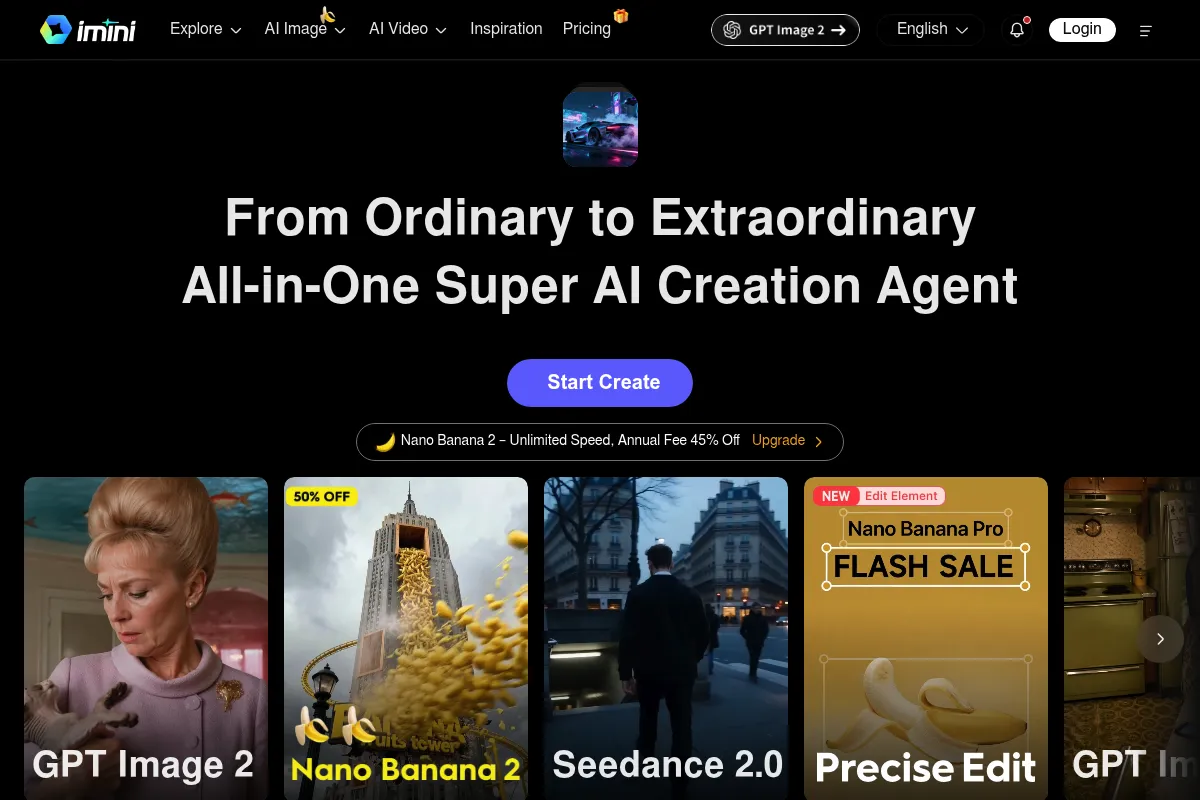
iMini is an AI-native platform for building and using 'iMinis'—specialized agents designed for specific tasks. It bridges the gap between simple chatbots and complex agent frameworks by providing a modular, cross-device interface for personal automation.
Official profiles
What it actually does
Users can create custom agents by selecting underlying models and attaching specific tools like web search or image generation. These agents are then accessible via a mobile-optimized interface or a web dashboard, allowing for task-specific interactions without re-prompting.
What makes it different
Unlike Poe or ChatGPT, which focus on the conversation, iMini treats agents as modular apps. The interface emphasizes the 'tooling' aspect, allowing users to switch between specialized mini-apps that feel more like standalone utilities than a single generic assistant.
Key Features
Modular Agent Builder
Allows users to toggle specific capabilities like 'Web Search' or 'Image Gen' on a per-agent basis.
iMini Store
A repository of user-generated agents for specific tasks like legal drafting or fitness planning.
Cross-Platform Sync
Ensures that agents built on the web are immediately functional on the mobile app.
File Interaction
Upload and query documents directly within a specific agent's context.
Model Switching
Choose between different LLM providers depending on the task's complexity or cost.
Prompt Templates
Pre-built structures to help users define agent behavior without starting from scratch.
Pricing
Free
- Limited daily messages
- Access to basic models
- Public agent marketplace access
- Standard response speed
Pro
- Increased daily message limits
- Access to GPT-4 and Claude 3
- Priority processing
- Create private agents
Max
- Highest message limits
- Early access to new models
- Advanced file analysis limits
- Premium support
Pricing checked 4 months ago
Pricing guidance
- When you hit daily message caps on the free tier
- When you need the reasoning capabilities of GPT-4 or Claude 3 Opus
- When you want to keep your custom agents private
- Message limits are often reset daily rather than monthly
- File upload sizes are capped on lower tiers
- Some 'advanced' models may consume more credits per message
Aggressively priced to undercut direct LLM subscriptions while offering a more specialized UI.
Pros & Cons
Strengths
-
Superior mobile experience
The interface is designed for mobile first, making it more practical for on-the-go use than most web-based agent builders.
-
Low barrier to entry
Creating a specialized agent requires no coding knowledge, relying instead on a structured, modular setup process.
-
Centralized agent management
Keeps specialized tools organized in a single dashboard rather than forcing users to manage a long list of disparate chat threads.
Weaknesses
-
Limited logic branching
You cannot build complex 'if-this-then-that' sequences between multiple agents; it is largely one agent per task.
Affects: Power users and automation engineers
-
Marketplace quality variance
Many community-created agents are just simple prompt wrappers with little unique value, requiring manual filtering.
Affects: New users looking for immediate utility
-
Credit-based restrictions
Access to top-tier models is gated behind a credit system that can feel restrictive during heavy usage periods.
Affects: High-volume users
Real User Sentiment
Users generally appreciate the clean UI and the ease of switching between specialized agents, though power users find the lack of API access frustrating.
Users tend to like
- The intuitive mobile app design
- Ability to use multiple LLMs in one place
- The 'mini-app' concept for organization
Users commonly complain about
- Daily message limits can be confusing
- Lack of deep integrations with third-party apps
- Occasional slow response times for advanced models
Recurring tradeoffs
- You trade deep customization and logic for ease of use and mobile accessibility.
Happiest users
Individuals who want a 'Swiss Army Knife' of AI tools on their phone without managing multiple subscriptions.
Often frustrated
Developers who want to build complex automated pipelines or integrate agents into their own software.
Use Cases
Content Creation
Creating an agent with specific brand voice instructions for social media posts.
Language Learning
Using a dedicated tutor agent that only speaks in a target language and corrects grammar.
Legal/Document Summary
Building an agent specifically to extract key clauses from contracts.
Personal Coaching
Setting up a fitness or nutrition agent with your specific health data and goals.
Code Snippet Generation
A specialized agent that only outputs clean, documented Python code.
Frequently Asked Questions
How does iMini compare to Poe?
Poe is more chat-centric and focuses on a wide variety of bots in a feed. iMini focuses on a 'modular app' feel, where each agent feels like a standalone tool with specific toggles for search or vision, and it places a heavier emphasis on the mobile application experience.
Is iMini free to use?
Yes, iMini offers a free tier with a set number of daily messages. However, access to more advanced models like GPT-4 or Claude 3 Opus typically requires a Pro or Max subscription starting at $9.90/month.
Can I build my own agents on iMini?
Yes, the platform is designed for users to create 'iMinis' by providing custom instructions, choosing a base model, and enabling specific tools. You can keep these agents private or share them in the public store.
Does iMini support GPT-4?
Yes, iMini supports GPT-4 and other high-end models like Claude 3. These are usually available on the paid tiers (Pro and Max) due to the higher inference costs associated with these models.
What are the limitations of the free plan?
The free plan is limited by the number of messages you can send per day and generally restricts you to 'standard' models. You also may not be able to create an unlimited number of private agents without upgrading.
Does iMini integrate with Zapier or Slack?
Currently, iMini is primarily a standalone platform. It lacks the deep third-party integrations found in enterprise-grade tools like Relevance AI or Zapier Central, focusing instead on the direct user-to-agent interaction.
Why trust this page?
This evaluation combines product positioning, pricing analysis, traffic and market signals, and public user sentiment into a single decision-support page. Content is generated editorially — not copied from the vendor's website.
Funding & Company
Founded
—
Stage
Bootstrapped
Total Raised
Bootstrapped
Latest Round
—
There is no public record of iMini.ai having raised any external venture capital or seed funding. The company appears to be bootstrapped, relying on its own revenue for growth and operations.
Market Signals & Traffic
Estimated visits, global rank, geography, traffic sources, monthly visit trends, and organic search keywords (Similarweb)—on a dedicated page built for depth and search.
- Estimated visits
- 24,356
- Global rank
- #986,962
- Snapshot
- Apr 2026
- Traffic trend
- Falling
Estimated monthly visits
Alternatives to iMini
View all alternativesMake AI
Automation & Agents, Developer Tools

Visual platform to connect apps and automate workflows without code.
n8n
Automation, Automation & Agents, Developer Tools

Workflow automation platform for connecting apps and building complex sequences.
Lindy
AI Assistant, Automation, Productivity

No-code AI agent builder for automating business workflows.
Similar Tools
MindOS
AI Assistant, Automation & Agents, Productivity

Create and deploy autonomous agents for professional and personal tasks.
Dust
AI Assistant, Automation & Agents, Productivity

Custom assistants that connect internal company data to language models.
Manus
AI Assistant, Automation & Agents, Productivity

Autonomous general-purpose agent for executing complex digital tasks and workflows.
Zenlytic
AI Assistant, Automation & Agents, Productivity

Conversational business intelligence platform for self-service data analysis
Minion
AI Assistant, Automation & Agents, Productivity

Autonomous browser agent that completes complex web tasks for users.
Windsurf
Developer Tools, Productivity, Content Creation

AI-powered IDE and coding assistant for developers.