

ChatGPT is a versatile AI assistant for text generation, brainstorming, and task assistance, but its limitations in real-time data, nuanced understanding, and potential for inaccuracies require careful user oversight.
Best for content creation and general assistance, but not for critical, real-time data analysis.
Analysis based on product data, pricing structure, traffic signals, and public user sentiment.
Who Should Use ChatGPT?
Typical users
Individuals, students, content creators, developers, and small to medium-sized businesses looking for an AI assistant for writing, coding, brainstorming, and general information retrieval.
Maturity fit
beginner to scaling
Choose this if…
- You need to generate text for various purposes like articles, emails, or creative writing.
- You require assistance with coding, debugging, or understanding technical concepts.
- You want a tool for brainstorming ideas or summarizing information.
- You need a conversational AI for general knowledge or quick answers.
Skip this if…
- You require access to real-time, up-to-the-minute information.
- Your work demands absolute factual accuracy without verification.
- You need to process highly sensitive or confidential data without robust security measures.
- You require deep, nuanced understanding of complex emotional or satirical content.
About ChatGPT
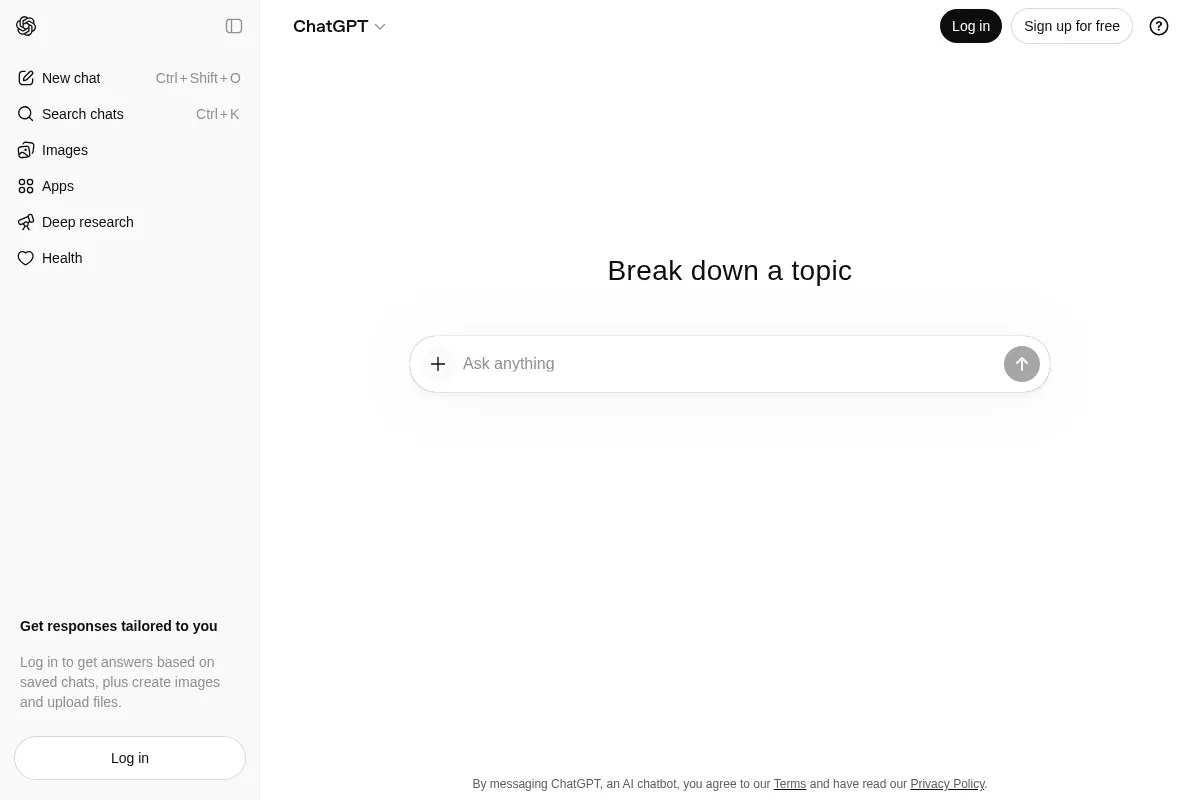
ChatGPT is a conversational AI chatbot developed by OpenAI that generates human-like text for a wide range of tasks. It serves as a versatile assistant for content creation, coding, research, and general knowledge, aiming to enhance productivity and creativity for individuals and businesses.
What it actually does
ChatGPT engages in natural language conversations, answers questions, generates various text formats (articles, code, emails), summarizes information, and assists with brainstorming. It can also perform tasks like translation and basic data analysis.
What makes it different
ChatGPT's differentiation lies in its advanced conversational capabilities, its ability to maintain context over longer interactions, and its continuous development with newer models like GPT-4o. Its extensive training data allows for a broad range of responses, and its integration capabilities through APIs and custom GPTs extend its utility.
Ratings across the web



Ratings aggregated from independent review platforms.
Key Features
Conversational AI
Engages in human-like dialogue, allowing for follow-up questions and context retention.
Text Generation
Creates diverse written content, from creative stories to professional emails and code.
Web Browsing (Plus/Enterprise)
Accesses current information from the internet for more up-to-date responses.
Data Analysis
Can process and analyze data from uploaded files (CSV, spreadsheets) to identify trends and insights.
Image Generation (DALL-E 3)
Creates images from text prompts, integrated within the ChatGPT interface for Plus users.
Custom GPTs
Allows users to create specialized versions of ChatGPT tailored to specific tasks or knowledge domains.
Memory Feature
Remembers user preferences and details across conversations for a more personalized experience.
Plugins (Deprecated, replaced by GPTs)
Previously extended functionality by connecting to third-party services.
Pricing
Free
- GPT-4o (limited messages)
- GPT-4o mini (fallback)
- Web browsing
- Data analysis
- Image generation (limited)
- GPTs
Plus
- Priority access to GPT-4o
- Faster response times
- Access to DALL-E 3
- Advanced data analysis
- Web browsing
- GPTs
- Memory
Team
- Higher message caps
- Shared workspace
- Admin console
- Data privacy (not used for training by default)
- Custom GPTs for teams
Pro
- Unlimited access to top models (o1, o1 Pro)
- Higher limits on advanced tools (Sora, deep research)
- Priority access
Enterprise
- Unlimited high-speed access
- Advanced security and compliance (SOC 2)
- Larger document processing
- Admin controls
- Dedicated support
Pricing checked 6 months ago
Pricing guidance
- When you consistently hit message limits on the free tier.
- When you need faster response times and priority access during peak hours.
- When you require access to advanced features like DALL-E 3 image generation or enhanced data analysis.
- When you need to process larger documents or conduct more complex research.
- Free tier GPT-4o access is metered and can switch to GPT-4o mini without explicit notification.
- Image generation on the free tier has a hard daily cap.
- Enterprise plans have 'virtually unlimited' usage subject to fair-use policies, which can lead to throttling.
- API usage is token-based and can incur significant costs beyond subscription fees.
A freemium model with a capable free tier, offering progressively more power, speed, and features through tiered paid plans for individuals and businesses.
Pros & Cons
Strengths
-
Versatile Text Generation
Can produce a wide array of written content, from creative writing to technical documentation, significantly speeding up content creation processes.
-
Coding Assistance
Capable of writing, debugging, and explaining code in various programming languages, aiding developers in their tasks.
-
Brainstorming and Ideation
Excellent for generating ideas, exploring different angles, and overcoming creative blocks, making it a valuable tool for strategists and creators.
-
Accessibility and Ease of Use
The free tier is readily available, and the interface is intuitive, making advanced AI capabilities accessible to a broad audience.
-
Continuous Improvement
OpenAI regularly updates models, improving accuracy, capabilities, and expanding features, ensuring the tool remains competitive.
Weaknesses
-
Factual Inaccuracies and Hallucinations
Can generate incorrect or fabricated information that sounds plausible, requiring users to fact-check critical outputs.
Affects: Users requiring high factual accuracy for research, legal, or medical applications.
-
Limited Real-time Information Access
The free version lacks direct internet access, and even paid versions may not always provide the most current information, making it unsuitable for time-sensitive data.
Affects: Users needing up-to-the-minute data for financial, news, or market analysis.
-
Contextual Limitations
In very long or complex conversations, ChatGPT can lose track of earlier instructions or context, leading to repetitive or irrelevant responses.
Affects: Users working on extensive projects or multi-stage tasks that require sustained context.
-
Potential for Bias
Training data can reflect societal biases, leading to biased or unfair outputs, which requires careful review and mitigation.
Affects: Users in sensitive fields like HR, policy-making, or any application where fairness is paramount.
-
Usage Limits
Free and even some paid tiers have message limits, which can interrupt workflows for heavy users.
Affects: Power users and teams with high-volume usage needs.
Real User Sentiment
Generally positive, with users appreciating its versatility and capabilities, though common criticisms revolve around accuracy and limitations.
Users tend to like
- Impressive text generation and creative writing abilities.
- Helpfulness in coding and technical problem-solving.
- Speed and efficiency for quick tasks.
- The ability to brainstorm and generate ideas.
- The continuous improvement and new features rolled out by OpenAI.
Users commonly complain about
- Factual inaccuracies and 'hallucinations'.
- Limited understanding of nuance, sarcasm, or complex emotions.
- Usage limits on free and even some paid tiers.
- Concerns about data privacy and potential bias in responses.
- Lack of real-time information access in the free tier.
Recurring tradeoffs
- Accuracy vs. Speed: Faster responses can sometimes come at the cost of factual accuracy.
- Versatility vs. Specificity: While broadly capable, it may not excel in highly specialized or niche domains without fine-tuning.
- Ease of Use vs. Control: The user-friendly interface simplifies access but offers less granular control over the AI's behavior compared to developer-focused tools.
Happiest users
Content creators, developers, students, and casual users who leverage its generative capabilities for a wide range of tasks and appreciate its accessibility.
Often frustrated
Users who rely on absolute factual accuracy for critical decisions, those needing real-time data, or individuals who frequently hit usage caps on lower tiers.
Use Cases
Drafting blog posts and articles
Quickly generate outlines, drafts, or full articles on various topics.
Writing marketing copy and social media posts
Create engaging content for promotional campaigns and social platforms.
Generating code snippets and debugging
Assist developers by writing code, identifying errors, and explaining programming concepts.
Summarizing long documents and research papers
Condense lengthy texts into concise summaries for faster comprehension.
Brainstorming business ideas and strategies
Generate new concepts, explore market opportunities, and refine business plans.
Answering complex questions and explaining concepts
Obtain detailed explanations on a wide range of subjects.
Translating text between languages
Facilitate communication across different linguistic barriers.
Frequently Asked Questions
What are the main limitations of ChatGPT?
ChatGPT's primary limitations include potential factual inaccuracies and 'hallucinations' (generating plausible but incorrect information), a lack of true understanding of nuance and emotion, limited real-time internet access (especially in the free tier), potential biases inherited from training data, and usage caps on message frequency. It also struggles with maintaining context in very long conversations and cannot ask clarifying questions on its own without specific prompting. Users must always verify critical information and be aware of these constraints.
How does ChatGPT compare to Google Gemini (formerly Bard)?
ChatGPT, powered by OpenAI's GPT models, excels at text generation, creative writing, and coding assistance. Google Gemini (formerly Bard), powered by Google's models, is generally better for research due to its real-time internet access and ability to cite sources. Gemini also offers deeper integration with Google Workspace. ChatGPT's free tier has usage limits, while Gemini's free tier is more generous with real-time data access. ChatGPT is often preferred for its advanced reasoning and customization through GPTs, while Gemini is favored for up-to-date information and Google ecosystem integration.
Is the free version of ChatGPT sufficient for most users?
The free version of ChatGPT is sufficient for casual users who need occasional assistance with basic tasks like drafting short texts, answering general questions, or brainstorming simple ideas. It provides access to GPT-4o with metered usage, meaning you might be switched to the GPT-4o mini model after reaching a certain number of messages within a five-hour window. For users who require faster responses, priority access, advanced features like image generation (DALL-E 3), or more extensive data analysis capabilities, upgrading to ChatGPT Plus is recommended.
What are the pricing tiers for ChatGPT?
ChatGPT offers several pricing tiers: Free ($0/month) for basic access with usage limits; Plus ($20/month) for individuals with priority access, faster responses, and advanced features; Team ($25-30/user/month) for collaborative workspaces and admin controls; Pro ($200/month) for individuals needing unlimited access to top models; and Enterprise (custom pricing) for large organizations with advanced security and support needs.
Does ChatGPT have access to the internet?
ChatGPT's ability to access the internet depends on the subscription tier. The free version does not have direct internet access, relying on its training data which has a knowledge cut-off. ChatGPT Plus and higher tiers offer web browsing capabilities, allowing them to access current information from the internet and provide more up-to-date responses. This feature is crucial for tasks requiring real-time data.
What are the main integrations available for ChatGPT?
ChatGPT can be integrated into various workflows and applications through its API, allowing developers to embed its capabilities into their own software. Additionally, OpenAI offers custom GPTs, which are specialized versions of ChatGPT that can be tailored for specific tasks or industries. Platforms like Zapier also facilitate integrations with thousands of other apps, enabling automation of tasks such as generating email drafts from new Gmail messages or creating Slack assistants. Major integrations include Microsoft 365 Copilot, Slack, Notion, and Salesforce Einstein GPT, among others.
Can ChatGPT be used for sensitive or confidential data?
While ChatGPT can process uploaded files and data, users should exercise caution when inputting sensitive or confidential information. OpenAI states that data submitted through their API is not used for training their models by default, and Enterprise plans offer enhanced security and compliance features. However, for highly sensitive data, it is advisable to consult OpenAI's data usage policies and consider on-premises solutions or specialized enterprise-grade AI tools with stricter data governance.
How does ChatGPT handle different languages?
ChatGPT can generate text in over 80 languages, making it a versatile tool for translation and multilingual content creation. However, its proficiency can vary depending on the language, with less commonly spoken languages potentially yielding lower quality responses due to less extensive training data. When switching between languages within a conversation, the model may take a moment to adapt, and comprehension can sometimes be affected.
Why trust this page?
This evaluation combines product positioning, pricing analysis, traffic and market signals, and public user sentiment into a single decision-support page. Content is generated editorially — not copied from the vendor's website.
Funding & Company
Founded
2015
Stage
Late stage
Total Raised
$193.33B
Latest Round
Series G (Mar 2026)
Notable Investors
OpenAI has raised an astronomical amount of capital, estimated to be over $190 billion, from a consortium of technology giants and top-tier venture firms. This immense financial backing, particularly from strategic partners like Microsoft and Amazon, provides unparalleled resources for computing power and research, ensuring its position as a market leader for the foreseeable future.
Market Signals & Traffic
Estimated visits, global rank, geography, traffic sources, monthly visit trends, and organic search keywords (Similarweb)—on a dedicated page built for depth and search.
- Estimated visits
- 0
- Global rank
- —
- Snapshot
- May 2026
- Traffic trend
- Falling
Estimated monthly visits
Alternatives to ChatGPT
View all alternativesGemini
AI Assistant, Content Creation

An experimental AI-powered conversational chatbot from Google.
Claude
AI Assistant

A conversational AI assistant for writing, analysis, coding, and more.
Copilot
AI Assistant, Content Creation

AI-powered assistant for productivity, creativity, and collaboration.
Similar Tools
You.com
AI Assistant, Content Creation

AI-powered search engine and productivity platform for research and creation.
Wordtune
AI Assistant, Content Creation

AI-powered writing assistant for rewriting, refining, and improving text.
Gemini
AI Assistant, Content Creation
An experimental AI-powered conversational chatbot from Google.
Character AI
AI Assistant, Content Creation
Create and chat with AI characters for entertainment and storytelling.
Copilot
AI Assistant, Content Creation
AI-powered assistant for productivity, creativity, and collaboration.
Poe
AI Assistant, Content Creation
A platform to chat with and create AI bots, accessing multiple models in one place.