

Fashable
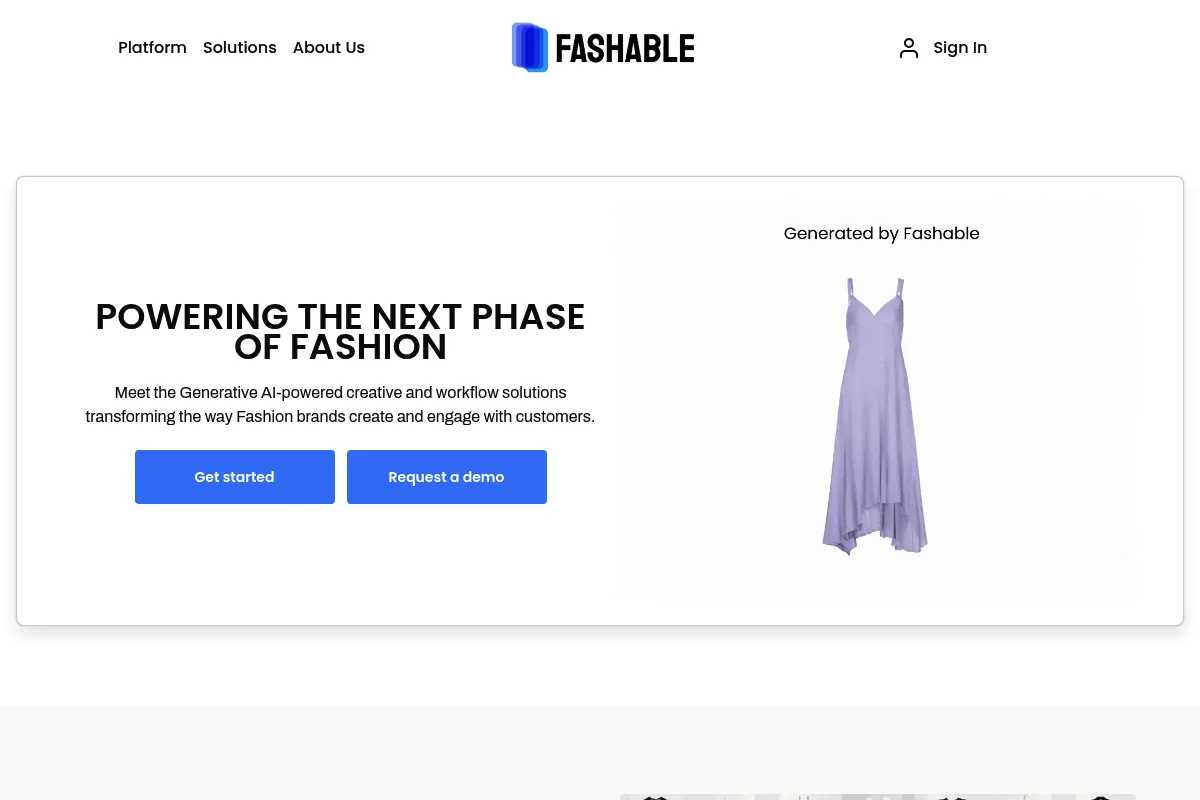
A specialized generative AI tool for fashion designers and retailers that creates original garment concepts and marketing imagery to bypass physical prototyping.
Excellent for rapid fashion ideation and catalog expansion, weaker for technical garment construction or pattern making.
Analysis based on product data, pricing structure, traffic signals, and public user sentiment.
Who Should Use Fashable?
Typical users
Fashion designers, creative directors at mid-to-large retail brands, and e-commerce marketing teams.
Maturity fit
scaling to advanced
Choose this if…
- Your priority is reducing the cost of physical samples and photoshoots
- You need to generate high volumes of original design concepts quickly
- You want to test consumer demand for designs before manufacturing
Skip this if…
- You require production-ready technical patterns or CAD files
- You are a solo hobbyist looking for a low-cost image generator
- Your workflow depends on precise fabric physics and 3D draping simulations
About Fashable
Fashable is a generative design platform built specifically for the fashion industry. It uses proprietary AI models to generate original clothing designs and photorealistic marketing content, aiming to solve the waste problem in fast fashion by digitizing the concept-to-campaign pipeline.
What it actually does
The platform generates unique garment designs based on text prompts or reference images and places them on photorealistic AI models. It allows brands to create entire digital lookbooks and social media content without sewing a single physical sample.
What makes it different
Unlike general-purpose tools like Midjourney, Fashable is trained on fashion-specific datasets to ensure garment coherence and commercial viability. It focuses on 'originality'—ensuring generated designs aren't direct copies of existing copyrighted works, which is a critical legal requirement for retail brands.
Key Features
Originality Engine
Ensures generated designs are unique to avoid copyright infringement issues common in general AI.
AI Model Casting
Generates diverse, photorealistic human models to showcase designs without hiring talent or studios.
Style Transfer
Applies specific textures, prints, or brand aesthetics to new garment silhouettes.
Batch Generation
Produces hundreds of design variations from a single concept to fill out seasonal collections.
Digital Prototyping
Creates high-fidelity visual representations of clothes for internal stakeholder approval.
Content Export
Outputs high-resolution imagery suitable for e-commerce listings and marketing campaigns.
Pricing
Enterprise
- Full access to generative design tools
- Unlimited AI model generation
- High-resolution exports
- API access for e-commerce integration
- Dedicated account support
Pricing checked 4 months ago
Pricing guidance
- When moving from design ideation to full-scale digital catalog creation
- When requiring API access to automate e-commerce imagery updates
- Usage limits on the number of high-res generations may apply depending on the contract
- Custom model training on brand-specific DNA often requires additional professional service fees
Premium enterprise positioning aimed at established fashion houses and high-volume retailers.
Pros & Cons
Strengths
-
Significant reduction in sample waste
By visualizing designs digitally first, brands can kill underperforming concepts before spending money on physical prototypes and shipping.
-
Fashion-specific output quality
The AI understands garment structure better than general models, resulting in fewer 'impossible' clothes that can't actually be manufactured.
-
Accelerated speed-to-market
Marketing teams can start creating campaign imagery and testing social media engagement while the physical product is still in the factory.
Weaknesses
-
Lack of technical specifications
The tool generates images, not tech packs. You still need a human designer to translate the AI image into a pattern and measurement sheet.
Affects: Production teams and manufacturers
-
Opaque pricing and access
There is no self-serve sign-up; the 'Contact Sales' barrier makes it difficult for smaller brands to experiment or budget quickly.
Affects: Small businesses and independent designers
-
Hardware/Connectivity requirements
As a high-fidelity visual tool, it requires significant bandwidth and can be resource-heavy during batch generations.
Affects: Remote teams with limited infrastructure
Real User Sentiment
Generally positive among industry professionals who view it as a productivity tool rather than a replacement for designers.
Users tend to like
- Speed of generating mood boards
- Quality of the AI-generated human models
- Ability to visualize prints on different silhouettes instantly
Users commonly complain about
- Difficulty in getting a response from sales for smaller projects
- Occasional 'AI hallucinations' in garment seams or buttons
- Lack of integration with 3D design software like CLO3D
Recurring tradeoffs
- Users trade technical precision (patterns) for creative volume and speed.
Happiest users
Creative directors at fast-fashion brands who need to churn through hundreds of concepts weekly.
Often frustrated
Technical designers who expect the tool to generate manufacturable patterns automatically.
Use Cases
Concept Ideation
Rapidly generating 50 variations of a puffer jacket to find the best silhouette.
E-commerce Photography
Creating product shots on diverse models without booking a studio or hiring talent.
Market Testing
Posting AI-generated designs on social media to see which styles get the most 'likes' before ordering stock.
Sustainability Reporting
Using digital samples to prove a reduction in physical textile waste during the design phase.
Wholesale Pitching
Showing retailers a full digital collection before any physical samples have been manufactured.
Frequently Asked Questions
Does Fashable provide a free trial?
Fashable does not offer a self-serve free trial. You must request a demo through their website, and access is typically granted to qualified business leads after a discovery call.
How does Fashable compare to Midjourney or DALL-E?
Fashable is built specifically for fashion. While Midjourney creates beautiful art, Fashable focuses on garment consistency, commercial viability, and ensuring designs are original enough to avoid copyright issues in a retail environment.
Can I export patterns for manufacturing?
No. Fashable generates visual imagery (JPG/PNG). It does not currently produce DXF files, tech packs, or 2D patterns required for actual garment construction.
Does it integrate with Shopify or other e-commerce platforms?
Integration is handled via API for Enterprise clients. This allows brands to push AI-generated imagery directly to product pages for pre-order or testing purposes.
Is the AI-generated content legally mine?
Fashable's 'Originality Engine' is designed to help users create unique IP. However, ownership terms are typically governed by the specific Enterprise Service Agreement signed during onboarding.
Can I use my own models for the AI to learn from?
Yes, for enterprise customers, Fashable can often train custom models on a brand's specific aesthetic, previous collections, or preferred human model faces to maintain brand consistency.
Why trust this page?
This evaluation combines product positioning, pricing analysis, traffic and market signals, and public user sentiment into a single decision-support page. Content is generated editorially — not copied from the vendor's website.
Funding & Company
Founded
2021
Stage
Bootstrapped
Total Raised
Bootstrapped
Latest Round
—
Fashable is a bootstrapped company that spun out of XNFY Lab, a joint initiative with Microsoft, in 2021. The company has not raised any external venture capital, indicating it is operating on its own revenue or initial resources from its incubation.
Market Signals & Traffic
Estimated visits, global rank, geography, traffic sources, monthly visit trends, and organic search keywords (Similarweb)—on a dedicated page built for depth and search.
- Estimated visits
- 1,800
- Global rank
- #7,701,103
- Snapshot
- Apr 2026
- Traffic trend
- Surging
Estimated monthly visits
Alternatives to Fashable
View all alternativesThe New Black
Design, E-commerce, Content Creation

Generate unique fashion designs and clothing concepts instantly
ZMO AI
Content Creation, Design, Productivity

AI-powered image generation and editing tool for creators and marketers.
Similar Tools
Refabric
Design, E-commerce, Content Creation

Generative design platform for fashion professionals and brands.
The New Black
Design, E-commerce, Content Creation
Generate unique fashion designs and clothing concepts instantly
Slazzer
Design, E-commerce, Content Creation

Automatically remove image backgrounds in seconds with high precision.
Raspberry AI
Design, E-commerce, Content Creation

Generative design platform for fashion brands and apparel designers.
Aymo AI
AI Assistant, Productivity, Communication

Personal assistant for managing tasks and information via WhatsApp.
Let's Enhance
Content Creation, Design, Productivity

AI-powered tool to upscale, sharpen, and enhance image quality.