

A specialized generative AI suite for fashion that bridges the gap between creative ideation and technical documentation, though it still requires a human designer to finalize production details.
Excellent for rapid prototyping and e-commerce imagery, weaker for high-precision technical manufacturing specs.
Analysis based on product data, pricing structure, traffic signals, and public user sentiment.
Who Should Use Refabric?
Typical users
Fashion designers, independent apparel brands, and e-commerce operators looking to visualize collections without physical samples.
Maturity fit
beginner to scaling
Choose this if…
- You need to turn hand-drawn sketches into realistic garment photos quickly
- Your priority is creating marketing-ready on-model imagery without hiring a studio
- You want to maintain a consistent brand aesthetic across AI-generated collections
Skip this if…
- You require factory-ready, 100% accurate tech packs without manual oversight
- Your workflow is already optimized with custom-trained Stable Diffusion models
- You need precise control over complex garment construction like internal boning or specialized hardware
About Refabric
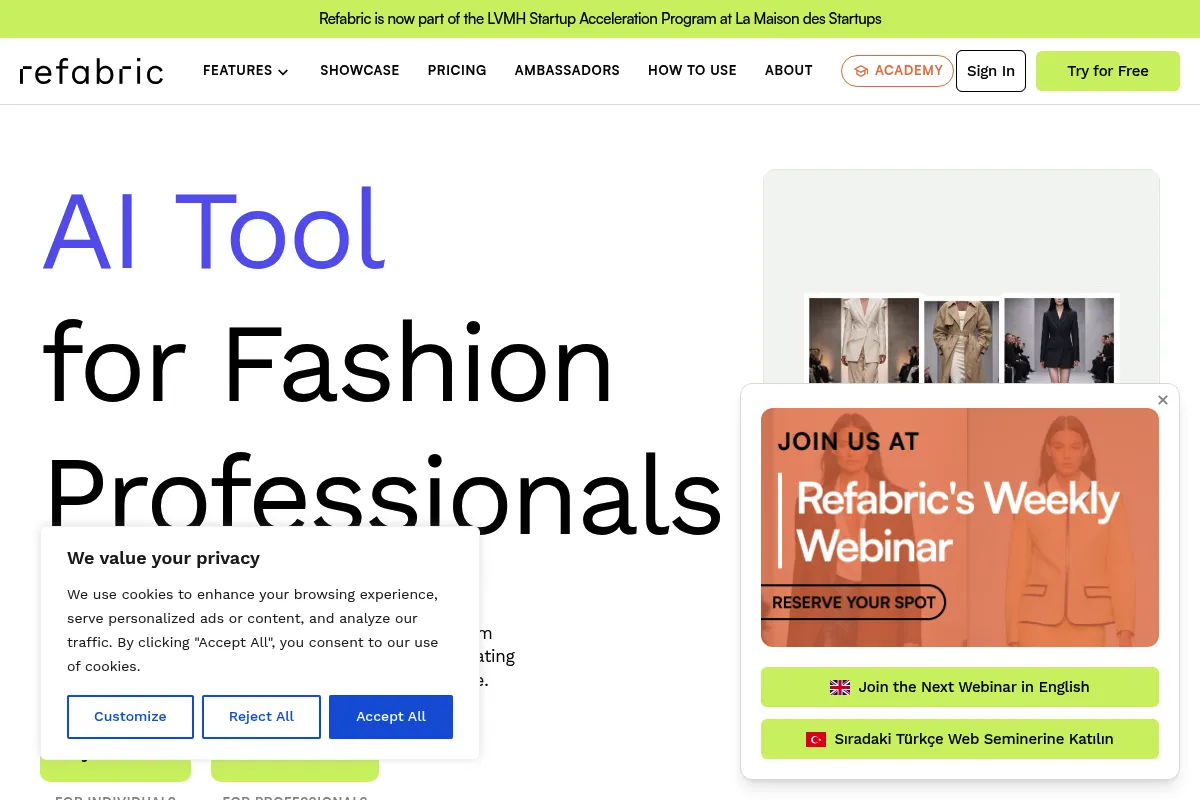
Refabric is a generative design platform built specifically for the fashion industry. It moves beyond general-purpose AI by incorporating fashion-specific constraints, fabric textures, and technical documentation tools to help designers move from concept to visual prototype.
What it actually does
The platform converts text prompts or rough sketches into high-fidelity garment designs and places them on virtual AI models. It also generates repeating fabric patterns and provides an AI-assisted framework for creating technical packs used in manufacturing.
What makes it different
Unlike Midjourney or DALL-E, Refabric includes a 'Brand DNA' feature that allows users to upload previous collections to train the AI on a specific house style. It also attempts to solve the 'technical gap' by generating preliminary tech packs alongside creative visuals.
Ratings across the web
Ratings aggregated from independent review platforms.
Key Features
Brand DNA Training
Allows users to upload 15-20 images of their own designs to ensure the AI generates new items consistent with their existing aesthetic.
Sketch-to-Design
Transforms rough pencil sketches into photorealistic garment renders while maintaining the original silhouette.
AI Models
Generates realistic human models in various poses and ethnicities to showcase designs, reducing the need for physical photoshoots.
Pattern Generator
Creates seamless, tileable fabric prints from text descriptions for use in textile design.
Tech Pack Assistant
Generates a structured document including flat sketches and material lists to kickstart the manufacturing process.
Fabric Integration
Allows users to specify textures like silk, denim, or knit, which the AI renders with realistic light interaction.
Collection Management
Organizes generated designs into seasonal folders for team collaboration.
Pricing
Free
- 10 credits per month
- Basic design tools
- Standard resolution
- Public gallery visibility
Starter
- 100 credits per month
- Private mode
- High-resolution exports
- Basic AI model access
Pro
- 500 credits per month
- Brand DNA training
- Advanced tech pack tools
- Priority processing
Enterprise
- Unlimited or bulk credits
- API access
- Dedicated account manager
- Custom model fine-tuning
Pricing checked 4 months ago
Pricing guidance
- When you need to train the AI on your specific brand style
- When you need to generate more than 20-30 high-res images per month
- When you need to export technical documentation
- Credits typically do not roll over to the next month
- High-resolution upscaling costs additional credits per image
- Brand DNA training requires a significant initial credit investment
Mid-range pricing that is significantly cheaper than a single physical sample but more expensive than general-purpose AI tools like Midjourney.
Pros & Cons
Strengths
-
Significant reduction in sampling costs
By visualizing garments realistically before cutting fabric, brands can iterate on designs without the expense of physical prototypes.
-
Niche-specific prompt engineering
The interface uses fashion terminology (e.g., 'sweetheart neckline', 'raglan sleeve'), making it more intuitive for designers than general AI tools.
-
Consistent brand output
The Brand DNA feature prevents the 'generic AI look' by forcing the model to adhere to the user's specific design language.
-
E-commerce ready imagery
The ability to generate high-quality on-model shots directly from a design saves thousands on photography and model booking.
Weaknesses
-
Tech packs require human auditing
The AI-generated tech packs often miss nuanced construction details or measurements, meaning they cannot be sent to a factory without a professional's review.
Affects: Production managers and technical designers
-
Credit-based pricing can be restrictive
High-resolution exports and Brand DNA training consume credits quickly, which can lead to unpredictable monthly costs during heavy design cycles.
Affects: High-volume design teams
-
Occasional anatomical 'hallucinations'
Like most image AI, it can still struggle with complex hand poses or overlapping garment layers in virtual photoshoots.
Affects: Marketing teams using AI models
Real User Sentiment
Generally positive among designers who view it as a mood-boarding and visualization tool, though technical users remain skeptical of its manufacturing outputs.
Users tend to like
- Speed of turning sketches into realistic photos
- Quality of the AI fashion models
- The 'Brand DNA' consistency
- Intuitive interface for non-technical users
Users commonly complain about
- Tech packs are too basic for complex garments
- Credit consumption is too high for upscaling
- Difficulty in controlling specific small details like button types or zipper teeth
Recurring tradeoffs
- You trade granular control over every stitch for extreme speed in visual ideation.
Happiest users
Independent designers launching their first collections and e-commerce sellers needing fast product imagery.
Often frustrated
Technical designers and production leads who expect the AI to handle the 'boring' parts of manufacturing documentation perfectly.
Use Cases
Mood Boarding
Quickly generating 50+ variations of a jacket concept to narrow down a seasonal direction.
Sketch Realism
Uploading a hand-drawn dress sketch to show a client what it would look like in silk vs. linen.
Virtual Photoshoots
Creating marketing images for a Shopify store before the actual clothes have been manufactured.
Textile Design
Generating unique floral or geometric patterns to send to a digital fabric printer.
Wholesale Pitching
Showing retailers realistic 'on-model' versions of a collection to secure pre-orders.
Frequently Asked Questions
Can Refabric replace a professional pattern maker?
No. While Refabric generates 'tech packs,' they are currently conceptual. They provide flat sketches and material lists, but they do not produce the precise CAD patterns or graded measurements required for professional manufacturing. You still need a pattern maker to translate these visuals into production-ready files.
How does Refabric compare to Midjourney for fashion?
Midjourney is better for abstract 'artistic' fashion inspiration, but it struggles with consistency. Refabric is superior for actual designers because it allows you to upload your own sketches as a base and train the AI on your specific 'Brand DNA' to keep designs consistent across a whole collection.
Is there a free version of Refabric?
Yes, there is a free tier that gives you 10 credits per month. This is enough to generate about 5-10 images, which is useful for testing the quality of the output but not enough for professional work. Most users will need the $29/month Starter plan.
Does Refabric own the designs I generate?
On paid plans, you typically retain the rights to the images you generate for commercial use. However, on the Free plan, your designs may be visible in the public gallery. Always check the latest Terms of Service for specific IP clauses.
Can I use my own models for the virtual photoshoots?
Refabric provides a library of AI-generated models. While you can influence their look through prompts, the platform is primarily designed to use its own generated models rather than 'face-swapping' your specific hired models, though features in this area are evolving.
What are the main limitations of the AI designs?
The AI can sometimes struggle with 'impossible' geometry—seams that lead nowhere or zippers that don't align. It also has difficulty rendering very specific hardware, like a particular brand of luxury buckle or custom-engraved buttons.
Why trust this page?
This evaluation combines product positioning, pricing analysis, traffic and market signals, and public user sentiment into a single decision-support page. Content is generated editorially — not copied from the vendor's website.
Funding & Company
Founded
2023
Stage
Seed
Total Raised
$1.16M
Latest Round
Pre-Seed (Aug 2024)
Notable Investors
Refabric has raised a single pre-seed round of $1.16 million, providing it with initial capital to develop its AI-powered design platform. This early-stage funding, coupled with acceptance into LVMH's accelerator, suggests strong initial validation but indicates the company is still in its nascent stages with a limited financial runway.
Market Signals & Traffic
Estimated visits, global rank, geography, traffic sources, monthly visit trends, and organic search keywords (Similarweb)—on a dedicated page built for depth and search.
- Estimated visits
- 5,096
- Global rank
- #2,488,602
- Snapshot
- Apr 2026
- Traffic trend
- Cooling
Estimated monthly visits
Alternatives to Refabric
View all alternativesBrowzwear
Design, Workflow, E-commerce

3D fashion design and digital apparel development platform
The New Black
Design, E-commerce, Content Creation

Generate unique fashion designs and clothing concepts instantly
yoona.ai
Design, Automation, E-commerce

Design platform for fashion brands and creative teams
Similar Tools
Raspberry AI
Design, E-commerce, Content Creation

Generative design platform for fashion brands and apparel designers.
Fashable
Design, E-commerce, Content Creation

Generative design platform for the fashion and retail industry
Slazzer
Design, E-commerce, Content Creation

Automatically remove image backgrounds in seconds with high precision.
The New Black
Design, E-commerce, Content Creation
Generate unique fashion designs and clothing concepts instantly
Aragon AI
Content Creation, Design, Productivity

Professional headshot generator for LinkedIn and corporate profiles.
AI SuitUp
Design, Social Media

Professional headshot generator for LinkedIn profiles and corporate resumes.