

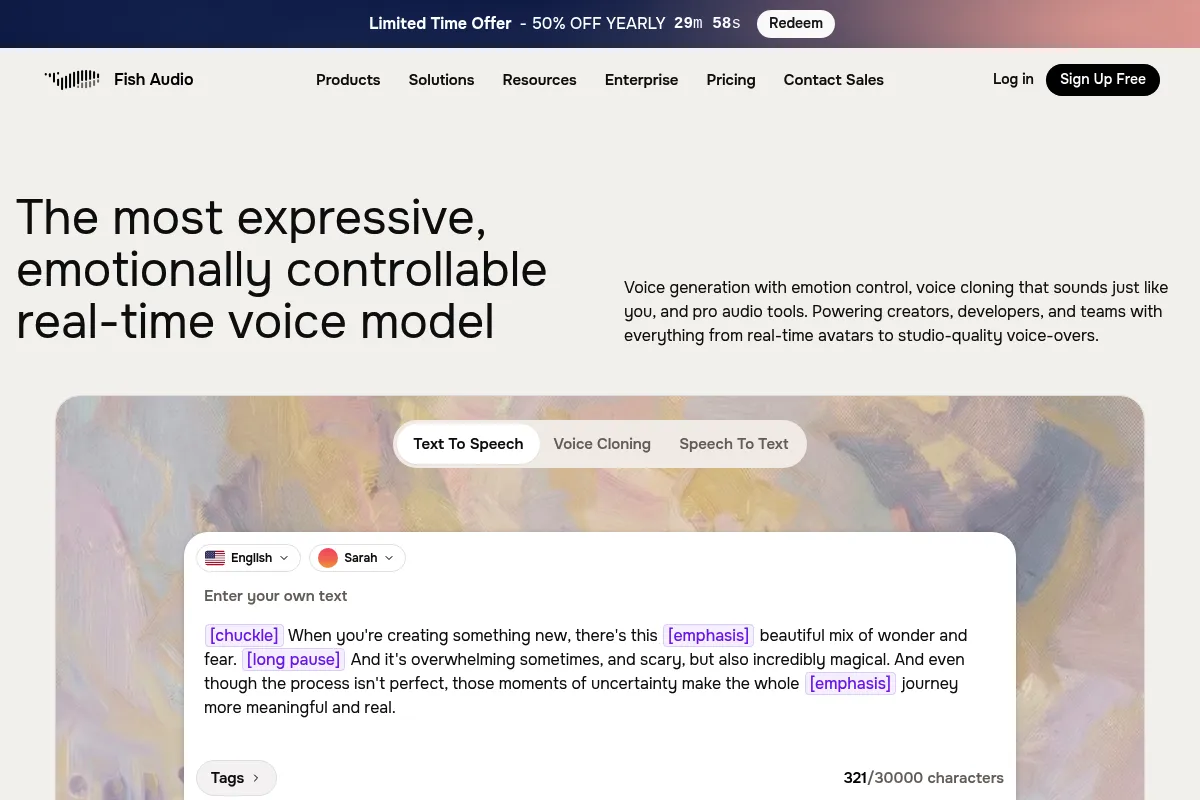
A high-performance speech synthesis engine built on an LLM-based architecture that prioritizes natural prosody and multilingual accuracy over a massive library of stock voices.
Excellent for developers needing low-latency API integration and creators requiring high-fidelity cloning, weaker for users seeking a polished, feature-rich video editing suite.
Analysis based on product data, pricing structure, traffic signals, and public user sentiment.
Who Should Use Fish Audio?
Typical users
Independent developers building voice-enabled applications, YouTube/TikTok creators, and localization teams focusing on Asian and European markets.
Maturity fit
scaling to advanced
Choose this if…
- You need high-quality voice cloning with less than 60 seconds of source audio
- Your priority is natural emotional inflection rather than just clear pronunciation
- You require a developer-friendly API with competitive per-character pricing
- You want the option to self-host using open-source model weights
Skip this if…
- You need a built-in video editor or advanced timeline-based audio syncing
- Your workflow depends on a library of thousands of pre-licensed character voices
- You require enterprise-grade legal indemnification for every voice in a public community gallery
About Fish Audio
Fish Audio is a speech synthesis platform powered by the Fish Speech model, a state-of-the-art LLM-based text-to-speech system. It exists to provide more natural, human-like audio generation than traditional diffusion or concatenative models, specifically targeting developers and high-volume content creators.
Official profiles
What it actually does
The platform converts text into speech using either pre-made voices or custom clones created from user-uploaded samples. It provides a web interface for manual generation and a REST API for automated, real-time audio production in multiple languages.
What makes it different
Unlike most closed-source competitors, Fish Audio releases its model weights (Fish Speech) under open-source licenses, allowing for local execution and transparency. Its architecture treats speech as a language modeling task, which results in superior handling of context-dependent emphasis and pauses compared to standard TTS engines.
Ratings across the web

Ratings aggregated from independent review platforms.
Key Features
Fish Speech LLM
Uses a transformer-based architecture to predict acoustic tokens for more natural phrasing.
Zero-Shot Cloning
Generates a digital voice replica immediately without requiring a lengthy training process.
Multilingual Engine
Maintains consistent voice identity across English, Chinese, Japanese, German, French, and Spanish.
Low Latency API
Optimized for real-time applications like AI agents or interactive voice response systems.
Local Inference Support
Allows developers to run the engine on their own hardware to avoid API costs and privacy concerns.
Voice Gallery
A searchable database of user-contributed voices for immediate use in content creation.
Pricing
Free
- 500 characters per day
- Basic voice cloning
- Access to community voices
- Non-commercial use only
Standard
- 100,000 characters
- Commercial usage rights
- API access
- High-priority generation
Pro
- 600,000 characters
- All Standard features
- Lower cost per character
- Priority support
Ultra
- 3,000,000 characters
- Best character-to-dollar ratio
- Enterprise-grade API limits
- Dedicated account management
Pricing checked 6 months ago
Pricing guidance
- When you need commercial usage rights
- When you need to integrate the API into an application
- When your daily character needs exceed the 500-character free tier
- API rate limits apply based on your current credit balance
- Commercial rights are only granted on paid tiers
- High-fidelity cloning may consume credits at a different rate than standard TTS
Aggressive value positioning, offering high-end features at a fraction of the cost of legacy providers.
Pros & Cons
Strengths
-
Superior Prosody and Rhythm
The LLM-based approach captures human-like nuances, such as breathing and realistic pauses, which reduces the 'robotic' feel common in cheaper TTS tools.
-
Strong Asian Language Performance
Outperforms many Western-centric tools in Chinese and Japanese, making it a top choice for regional localization.
-
Flexible Deployment
The availability of open-source weights provides a safety net for developers who may eventually need to move away from a SaaS model for cost or privacy reasons.
-
Competitive Pricing Structure
The credit-based system often results in a lower cost-per-minute compared to market leaders like ElevenLabs, especially for high-volume users.
Weaknesses
-
Basic Web Interface
The dashboard is functional but lacks advanced audio post-production tools, meaning users often need external software to polish the final output.
Affects: Content creators
-
Inconsistent Community Voice Quality
Since many voices are user-contributed, the quality varies significantly, requiring manual testing to find usable assets.
Affects: Casual users
-
Credit Expiration Policies
Depending on the plan, unused credits may not roll over indefinitely, which can be frustrating for users with fluctuating workloads.
Affects: Freelancers and small teams
Real User Sentiment
Users generally praise the platform for its high-quality cloning and natural-sounding output, particularly in non-English languages.
Users tend to like
- Exceptional voice cloning accuracy
- Natural emotional inflection
- Open-source model availability
- Low API latency
Users commonly complain about
- Occasional audio artifacts in long sentences
- Web UI feels a bit unpolished
- Limited stock voice variety compared to competitors
Recurring tradeoffs
- Users trade a polished 'studio' experience for better raw audio quality and lower costs.
Happiest users
Developers building AI applications and creators who need high-quality clones of their own voices.
Often frustrated
Non-technical users looking for a complete 'all-in-one' video and audio editing suite.
Use Cases
Podcast Localization
Translating and dubbing episodes while maintaining the original host's voice.
AI Customer Agents
Integrating natural-sounding voices into real-time support bots via API.
Audiobook Production
Generating long-form narration with consistent character voices.
Game Development
Creating diverse NPC dialogue without hiring dozens of voice actors.
Social Media Content
Rapidly producing voiceovers for short-form video in multiple languages.
Frequently Asked Questions
How does Fish Audio compare to ElevenLabs?
Fish Audio is generally more cost-effective and offers open-source model weights for self-hosting, which ElevenLabs does not. While ElevenLabs has a more polished web UI and a larger library of pre-made voices, Fish Audio often produces more natural prosody in Asian languages like Chinese and Japanese.
Is there a free plan available?
Yes, Fish Audio offers a free tier that includes 500 characters per day. This is intended for testing and personal use; commercial rights and higher limits require purchasing credits starting at $5.
Can I use the generated audio for commercial purposes?
Commercial use is permitted only for users on paid plans. If you are using the free tier, the audio is restricted to personal or non-commercial projects.
How much audio do I need to clone a voice?
Fish Audio can perform 'zero-shot' cloning with as little as 30 to 60 seconds of high-quality audio. For the best results, providing a clean sample without background noise is critical.
Does Fish Audio provide an API?
Yes, it provides a RESTful API that allows developers to integrate text-to-speech and voice cloning directly into their own applications, supporting real-time streaming and batch processing.
Can I run Fish Audio locally?
Yes, the underlying Fish Speech model weights are available on GitHub. This allows technical users to run the model on their own hardware using NVIDIA GPUs, bypassing the SaaS costs and ensuring data privacy.
Why trust this page?
This evaluation combines product positioning, pricing analysis, traffic and market signals, and public user sentiment into a single decision-support page. Content is generated editorially — not copied from the vendor's website.
Funding & Company
Founded
2024
Stage
Seed
Total Raised
—
Latest Round
Undisclosed (May 2026)
Notable Investors
Fish Audio's parent company, Hanabi AI Inc., has secured at least one early-stage venture capital round, though the total amount raised remains undisclosed. This investment, coupled with the company's reported rapid revenue growth, suggests a strong market fit and provides a degree of stability for continued product development.
Market Signals & Traffic
Estimated visits, global rank, geography, traffic sources, monthly visit trends, and organic search keywords (Similarweb)—on a dedicated page built for depth and search.
- Estimated visits
- 0
- Global rank
- —
- Snapshot
- May 2026
- Traffic trend
- —
Alternatives to Fish Audio
View all alternativesElevenLabs
Content Creation, AI Assistant

AI-powered platform for realistic speech, voice cloning, and audio generation.
Murf AI
Content Creation, Video Creation

AI voice generator for creating realistic text-to-speech voiceovers.
Resemble AI
Content Creation, AI Assistant

AI-powered voice cloning and speech synthesis platform.
Similar Tools
MusicCreator AI
Music Generation, Content Creation

Generate custom music and full songs from text prompts
Wondercraft
Content Creation, Video Creation, Marketing Automation

Create professional podcasts, audiobooks, and videos from text content.
Pyramid Flow
Video Creation, Developer Tools, Content Creation

Generate high-resolution videos from text and image prompts efficiently.
Zep
Developer Tools, Automation & Agents
Long-term memory and data persistence layer for LLM applications.
Tavily
Developer Tools, Data Extraction, Automation & Agents

Search engine for AI agents and RAG workflows
Plandex
Developer Tools, Automation & Agents

Terminal-based coding engine for complex multi-file development tasks