

Fixie
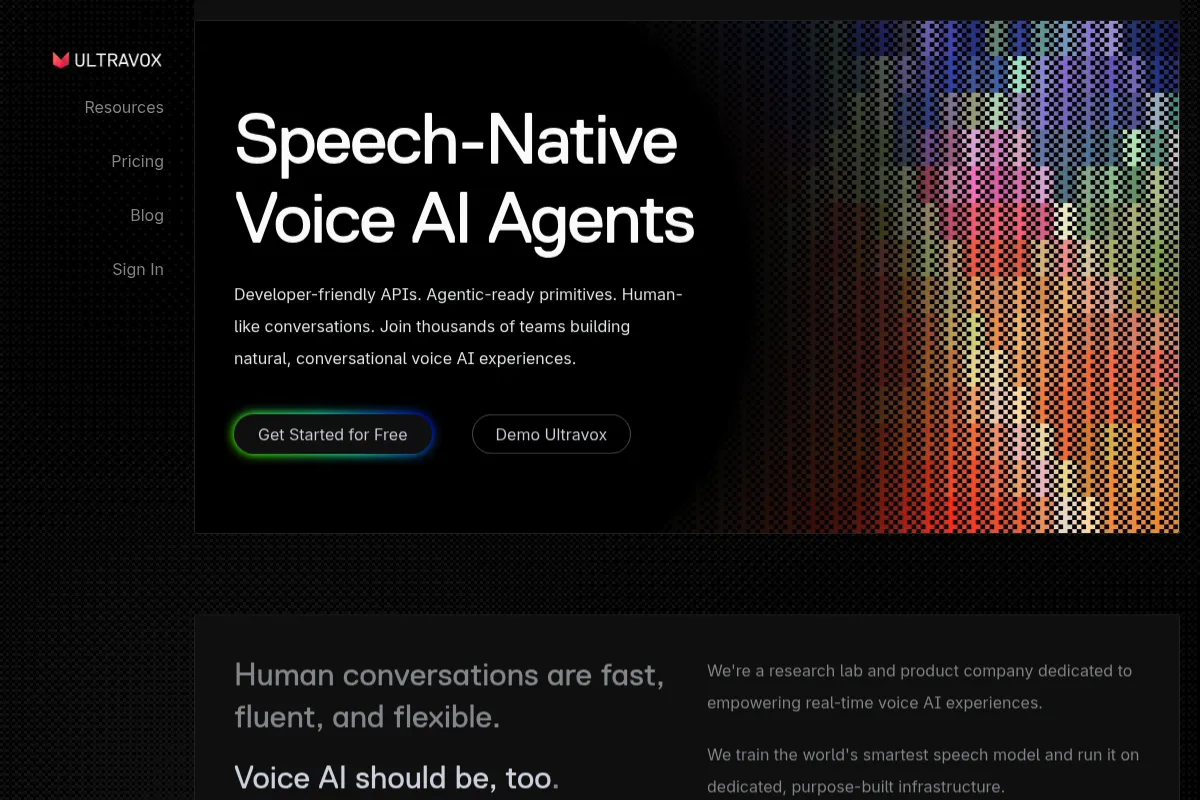
A developer-first platform for building voice agents that bypasses traditional transcription delays by using a native speech-to-speech model.
Excellent for developers requiring sub-500ms latency and model-level control, weaker for teams seeking a no-code, turnkey telephony solution.
Analysis based on product data, pricing structure, traffic signals, and public user sentiment.
Who Should Use Fixie?
Typical users
Software engineers and AI product teams building real-time conversational applications like customer support bots or interactive tutors.
Maturity fit
scaling to advanced
Choose this if…
- Your application requires natural, low-latency conversation without the 'stutter' of traditional STT-LLM-TTS pipelines
- You want to use open-weights models like Ultravox to avoid vendor lock-in
- You need to integrate complex custom tools and APIs into voice workflows via code
Skip this if…
- You are looking for a drag-and-drop builder for non-technical staff
- Your primary need is simple text-to-speech generation rather than interactive agents
- You require out-of-the-box, deep telephony integrations without writing glue code
About Fixie
Fixie provides the infrastructure and models necessary to build voice-native AI agents. It centers on Ultravox, a multimodal LLM that processes audio directly, eliminating the latency inherent in converting speech to text and back again.
Official profiles
What it actually does
The platform allows developers to deploy voice agents that can listen, think, and speak in real-time. It handles the complexities of audio streaming, interruption management, and tool execution through a unified API and SDK.
What makes it different
Unlike competitors that stitch together separate services for transcription, reasoning, and synthesis, Fixie uses a native speech-to-speech architecture. This architectural choice significantly reduces 'time to first byte' and allows the model to understand prosody and emotion better than text-only models.
Key Features
Ultravox Model
A multimodal LLM that understands audio directly for faster response times.
Fixie SDK
Simplifies the management of WebRTC streams and state handling in frontend applications.
Tool Calling
Allows agents to query databases or trigger external API actions mid-conversation.
Open Weights
Ultravox is available as open weights, allowing for self-hosting or fine-tuning.
Knowledge Base Integration
Connects agents to custom data sources for RAG-based voice interactions.
Interruption Logic
Built-in detection to stop agent speech immediately when the user starts talking.
Pricing
Free
- 30 minutes of usage per month
- Access to Ultravox models
- Standard support
- Public community access
Pro
- Usage-based billing ($0.10/min)
- Higher rate limits
- Priority email support
- Custom tool definitions
Enterprise
- Volume discounts
- SLA guarantees
- Dedicated infrastructure options
- Custom model fine-tuning
Pricing checked 4 months ago
Pricing guidance
- When you exceed 30 minutes of testing
- When you need production-level rate limits
- When you require private data connectors
- Usage is billed by the minute, which can scale rapidly with high-traffic applications
- Custom voice cloning may incur additional third-party costs if using external providers
Competitive with other high-end voice AI platforms, positioning itself as a premium developer tool rather than a budget utility.
Pros & Cons
Strengths
-
Industry-leading latency
By removing the transcription step, Fixie achieves response times that feel human, which is critical for user retention in voice apps.
-
Developer-centric flexibility
The SDK-first approach gives engineers full control over the agent's behavior, state, and integration points compared to 'black box' alternatives.
-
Open-source contributions
The release of Ultravox as an open-weights model provides transparency and a path to self-hosting for security-conscious enterprises.
Weaknesses
-
High technical barrier
There is no significant 'no-code' interface; you must be comfortable with Python or TypeScript to build anything functional.
Affects: Product managers and non-technical founders
-
Telephony is not native
While it can be connected to Twilio or Vonage, it lacks the one-click phone number provisioning found in competitors like Vapi.
Affects: Teams building simple inbound/outbound phone bots
-
Niche ecosystem
As a specialized voice platform, it has fewer third-party 'marketplace' integrations than broader AI agent frameworks.
Affects: Teams looking for pre-built connectors to CRM or ERP systems
Real User Sentiment
Generally positive among the developer community, specifically regarding the technical achievement of the Ultravox model.
Users tend to like
- Extremely low latency
- The ability to run Ultravox locally
- Clean, well-documented SDKs
- Responsiveness of the engineering team on Discord
Users commonly complain about
- Lack of a visual workflow builder
- Initial setup can be complex for those unfamiliar with WebRTC
- Limited documentation for complex multi-agent handoffs
Recurring tradeoffs
- You trade ease of setup (compared to Vapi) for deeper architectural control and lower latency.
Happiest users
Full-stack developers building high-performance web apps that require real-time voice interaction.
Often frustrated
Business users or 'AI wrappers' looking for a quick, no-code way to set up a phone line.
Use Cases
Language Learning
Creating tutors that can correct pronunciation in real-time without awkward pauses.
Gaming
Building non-player characters (NPCs) that players can talk to naturally using their voice.
Customer Support
Deploying high-speed voice bots that can handle complex troubleshooting via API tool calling.
Accessibility Tools
Developing real-time voice assistants for users with visual impairments.
Roleplay & Simulation
Creating realistic training environments for sales or emergency response.
Frequently Asked Questions
How does Fixie compare to Vapi or Retell AI?
Vapi and Retell AI are higher-level platforms that focus on ease of use and telephony (Twilio integration). Fixie is lower-level and developer-centric, focusing on the underlying speech-to-speech model (Ultravox). Choose Fixie if you want to write code and need the lowest possible latency; choose Vapi if you want a faster, no-code setup for phone bots.
Is there a free trial for Fixie?
Fixie offers a Free plan that includes 30 minutes of voice processing per month. This is intended for developers to test the API and SDK capabilities before committing to the $20/month Pro plan.
Can I use my own LLM with Fixie?
Fixie is optimized for its own Ultravox model to achieve low latency, but the platform is designed to be flexible. However, using an external LLM via API (like GPT-4) will reintroduce the latency that Fixie's native architecture aims to solve.
Does Fixie support multiple languages?
Yes, the Ultravox model and Fixie platform support multiple languages, though performance and nuance are currently strongest in English. They are actively expanding the linguistic capabilities of the speech-to-speech model.
What are the limitations of the Ultravox model?
While Ultravox is excellent for latency, it may have a smaller 'knowledge base' or lower reasoning capability compared to massive models like GPT-4o. It is best used as a high-speed interface layer that calls out to other tools for complex data retrieval.
Can I self-host Fixie?
You can self-host the Ultravox model because it is open-weights (Apache 2.0). However, the Fixie 'Platform' (the orchestration layer, managed SDKs, and infrastructure) is a hosted service.
Why trust this page?
This evaluation combines product positioning, pricing analysis, traffic and market signals, and public user sentiment into a single decision-support page. Content is generated editorially — not copied from the vendor's website.
Funding & Company
Founded
2022
Stage
Seed
Total Raised
$17M
Latest Round
Seed (Mar 2023)
Notable Investors
Fixie.ai secured a significant $17 million Seed round in March 2023, led by Redpoint and including other notable VC firms. This substantial early-stage investment from established investors indicates strong confidence in the founding team, comprised of veterans from Google and Apple, and their vision for a developer platform for Large Language Models (LLMs). This funding provides a solid financial runway to develop their platform and scale the team.
Market Signals & Traffic
Estimated visits, global rank, geography, traffic sources, monthly visit trends, and organic search keywords (Similarweb)—on a dedicated page built for depth and search.
- Estimated visits
- 0
- Global rank
- #11,927,939
- Snapshot
- Apr 2026
- Traffic trend
- Falling
Estimated monthly visits
Alternatives to Fixie
View all alternativesAmazon CodeWhisperer
Developer Tools

AI-powered coding companion that generates code recommendations.
Retell AI
Communication, Automation & Agents, AI Assistant

Build and deploy human-like conversational voice agents for business.
Similar Tools
Employers
Automation & Agents, AI Assistant, Workflow

Automate candidate sourcing, screening, and scheduling for recruitment teams.
E2B
Developer Tools, Automation & Agents

Secure cloud sandboxes for running code and AI agents
Martian
Developer Tools, Automation, Workflow

Dynamic router that automatically selects the best LLM for every prompt.
Roboflow
Developer Tools, Automation

Platform for building, deploying, and managing computer vision models.
iMini
AI Assistant, Automation & Agents, Productivity

Create and use intelligent agents through a modular interface.
AIScraper
Data Extraction, Automation, Developer Tools

Extract structured data from any website using natural language.