

Glif
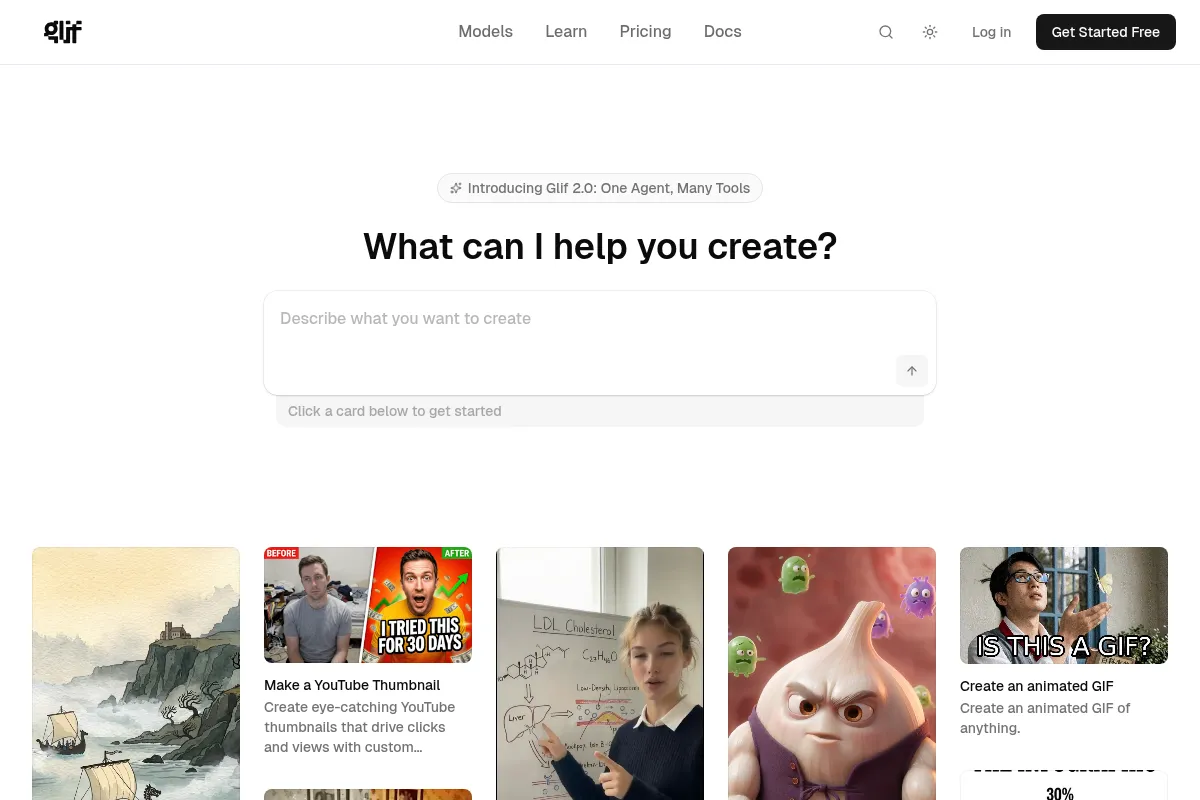
Glif is a no-code platform for building and sharing AI-powered generative tools, best suited for creators and marketers who want to experiment with AI art and content creation without coding.
Best for no-code AI content generation, weaker for complex automation or enterprise workflows.
Analysis based on product data, pricing structure, traffic signals, and public user sentiment.
Who Should Use Glif?
Typical users
Content creators, marketers, designers, and hobbyists looking to generate AI art, memes, videos, and other creative assets without writing code.
Maturity fit
beginner to scaling
Choose this if…
- You want to create AI art, memes, or short videos without coding.
- You need to quickly prototype generative AI tools.
- You want to share or remix AI workflows with a community.
- You are a marketer looking to scale ad creative variations.
Skip this if…
- You require advanced automation logic or complex integrations.
- You need fine-grained control over model training or deployment.
- You are building a large-scale enterprise application.
- You need a tool for deep technical AI research or development.
About Glif
Glif is a no-code platform that allows users to build, remix, and share generative AI tools, referred to as 'glifs.' It aims to democratize AI content creation by providing a visual workflow builder that integrates various AI models for image, video, and text generation. The platform is designed for creators, marketers, and developers who want to experiment with AI without extensive coding knowledge.
What it actually does
Glif enables users to create custom AI applications (glifs) through a drag-and-drop interface. These glifs can generate a wide range of content, including AI art, memes, AI selfies, logos, comics, and short videos. Users can chain multiple AI models and tools together to build complex workflows, which can then be shared in a marketplace.
What makes it different
Glif differentiates itself by offering a no-code, visual workflow builder that integrates a vast array of AI models and tools in one platform. Its emphasis on 'prompt chaining' and the ability to easily remix and share community-created 'glifs' fosters a collaborative environment, setting it apart from single-purpose AI generators.
Key Features
No-Code Visual Builder
Allows users to create AI workflows by dragging and dropping blocks, making complex AI generation accessible without coding.
Prompt Chaining
Enables users to link multiple AI models and processes together to create sophisticated generative tools.
Model Integration
Supports a wide range of AI models for image, video, and text generation, acting as a central hub for various AI capabilities.
Community Marketplace
Users can share, discover, and remix 'glifs' created by others, fostering collaboration and accelerating creative exploration.
AI Agents
Advanced workflows that can intelligently select and chain tools to achieve a user's goal.
Content Generation Variety
Capable of producing diverse outputs like AI art, memes, AI selfies, logos, comics, and short videos.
Pricing
Free Tier
- Daily free credits (e.g., 10 credits)
- Access to core features
- Community marketplace access
Credit Bundles
- 200 credits
- Full commercial rights
- Access to all core features (LLMs, image/video generators, ElevenLabs voice, etc.)
Pricing checked 6 months ago
Pricing guidance
- When daily free credits are insufficient for your projects.
- When you need to run more complex or numerous workflows.
- When you require commercial rights for generated content.
- When you want to explore advanced features or models that consume more credits.
- Daily free credits do not roll over.
- The cost of running a workflow can vary significantly based on the AI models used.
- There might be run time limits for complex workflows.
Glif uses a flexible credit-based system, allowing users to purchase credits as needed rather than committing to a subscription, positioning it as a pay-as-you-go service for AI generation.
Pros & Cons
Strengths
-
Accessibility for non-coders
The no-code visual builder makes it easy for anyone to create and experiment with AI generative tools, lowering the barrier to entry for creative AI applications.
-
Extensive AI model integration
Glif acts as a central hub for numerous AI models, allowing users to combine different capabilities within a single workflow without needing to manage multiple subscriptions or APIs.
-
Community-driven innovation
The ability to share and remix 'glifs' creates a collaborative ecosystem where users can learn from each other and rapidly iterate on creative ideas.
-
Versatile content generation
Supports a wide array of creative outputs, from static images and memes to short videos, making it a flexible tool for various content creation needs.
Weaknesses
-
Credit-based pricing can be complex
The pay-as-you-go credit system can be confusing, as different models consume varying amounts of credits, making it difficult to predict costs for complex workflows.
Affects: Users who are new to credit-based systems or those running frequent, complex workflows.
-
Potential for basic output quality
While versatile, the quality of output for highly specific or complex tasks might not match dedicated, single-purpose AI tools.
Affects: Users with very high-fidelity or specialized generation requirements.
-
Limited advanced automation
The platform is primarily focused on generative tasks and may lack the deep automation logic or enterprise-level integrations required for complex business processes.
Affects: Developers or teams needing sophisticated workflow orchestration or integration with existing enterprise systems.
Real User Sentiment
Users generally find Glif to be an accessible and versatile tool for AI content creation, especially appreciating its no-code interface and the breadth of integrated AI models. However, some find the credit system and output quality for complex tasks to be areas for improvement.
Users tend to like
- No-code visual builder
- Wide range of integrated AI models
- Community sharing and remixing of workflows
- Versatility in content generation (art, memes, video)
- Ease of use for beginners
Users commonly complain about
- Credit system can be confusing and expensive for complex workflows
- Output quality may not always match specialized tools
- Occasional technical glitches or limitations in workflow execution
- Free credits not rolling over can be frustrating
Recurring tradeoffs
- Ease of use vs. depth of control
- Breadth of AI models vs. specialized performance
- Community-driven sharing vs. potential for unrefined workflows
Happiest users
Creators, marketers, and hobbyists who value ease of use and rapid prototyping for AI-generated content.
Often frustrated
Users who require highly specific output quality, complex automation, or predictable pricing for extensive use.
Use Cases
Generating AI art and illustrations for social media or blogs
Creating memes and viral content quickly
Designing custom AI selfies for profile pictures
Prototyping generative AI tools without coding
Automating ad creative variations for marketing campaigns
Building simple AI-powered chatbots for specific tasks
Exploring creative AI possibilities through community-shared workflows
Frequently Asked Questions
What is Glif?
Glif is a no-code platform that allows users to build, remix, and share AI-powered generative tools, called 'glifs.' It uses a visual workflow builder to chain together various AI models for tasks like image generation, video creation, and text manipulation, making AI content creation accessible without coding.
How does Glif pricing work?
Glif operates on a credit-based system. Users receive a small number of free credits daily, which do not roll over. For more extensive use, users can purchase credit bundles in various sizes. The cost of running a workflow depends on the AI models and complexity involved. There are no mandatory subscriptions, offering a pay-as-you-go model.
What are some alternatives to Glif?
Several alternatives exist, depending on your specific needs. For no-code AI app building, platforms like Opal and Dify.AI are options. For more focused AI art generation, tools like Midjourney, Stable Diffusion interfaces (e.g., ComfyUI), and other AI image generators are available. For broader creative automation, tools like Zapier or n8n can integrate with AI models.
What are the limitations of Glif?
While Glif offers broad capabilities, limitations can include the complexity of the credit system for cost prediction, potential output quality that may not match highly specialized tools, and a focus on generative tasks rather than deep enterprise automation. Some users have noted that free credits do not roll over and that complex workflows might have time limits.
Can I use Glif for commercial purposes?
Yes, Glif generally allows for commercial use of generated content, especially when using paid credit bundles. It's always advisable to check the latest terms of service on their website for the most up-to-date information regarding usage rights and licensing.
What kind of AI models does Glif support?
Glif integrates with a wide array of AI models, including LLMs like GPT and Claude, image generation models such as Flux and SDXL, and video models like Kling and Veo. It also supports tools like ElevenLabs for voice generation and ComfyUI for advanced image workflows.
How does Glif compare to tools like ChatGPT or Midjourney?
Glif differentiates itself by acting as a meta-layer that chains together multiple AI models, including LLMs and image/video generators, within a no-code visual interface. While ChatGPT excels at text generation and Midjourney at image art, Glif allows you to combine these capabilities and more, creating custom workflows that go beyond single-purpose tools.
Is Glif suitable for developers?
Yes, Glif can be useful for developers for rapid prototyping of AI applications and workflows due to its visual builder and integration capabilities. However, for highly complex AI development, fine-tuning models, or deep programmatic control, traditional coding frameworks or specialized platforms might be more appropriate.
Why trust this page?
This evaluation combines product positioning, pricing analysis, traffic and market signals, and public user sentiment into a single decision-support page. Content is generated editorially — not copied from the vendor's website.
Funding & Company
Founded
2023
Stage
Seed
Total Raised
—
Latest Round
Seed (Apr 2026)
Notable Investors
Glif secured an undisclosed amount in a Seed funding round on April 23, 2026, led by the prominent venture firm Andreessen Horowitz (a16z). This investment provides the initial capital to pursue its vision of unifying a fragmented generative AI tool market into a single, agent-based creative platform.
Market Signals & Traffic
Estimated visits, global rank, geography, traffic sources, monthly visit trends, and organic search keywords (Similarweb)—on a dedicated page built for depth and search.
- Estimated visits
- 137,093
- Global rank
- #273,088
- Snapshot
- Apr 2026
- Traffic trend
- Falling
Estimated monthly visits
Alternatives to Glif
View all alternatives
Similar Tools
DeepAI
Content Creation, AI Assistant, Productivity

AI platform for generating images, videos, music, and text.
Iterable
Marketing Automation, Email Marketing, Communication

Cross-channel customer communication and journey orchestration platform.
v0
Developer Tools, Website Builder, AI Assistant

AI-powered platform to generate full-stack web apps from prompts.
Listnr
Content Creation, AI Assistant

AI voice generator for realistic text-to-speech and voiceovers.
Amie
Productivity, Communication, Workflow

Unified calendar, task manager, and email client for seamless scheduling.
Keycard
Developer Tools, Automation & Agents, Privacy & Compliance

Identity and access management infrastructure for autonomous agents.