

KoboldAI
A specialized open-source interface for local LLM storytelling that prioritizes uncensored creative freedom over general productivity.
Best for roleplayers and fiction writers running local hardware, weaker for business-oriented document processing.
Analysis based on product data, pricing structure, traffic signals, and public user sentiment.
Who Should Use KoboldAI?
Typical users
Hobbyist fiction writers, tabletop RPG players, and privacy-conscious users with mid-to-high-end consumer GPUs.
Maturity fit
beginner to advanced
Choose this if…
- You want total control over model parameters without corporate censorship
- Your priority is long-form creative writing or interactive roleplay
- You want to run models locally to ensure data privacy
- You need a free alternative to paid services like NovelAI
Skip this if…
- You need a turnkey business tool for data analysis or coding
- You lack a dedicated GPU and aren't willing to pay for cloud compute
- You prefer a polished, modern SaaS UI over a functional, technical interface
About KoboldAI
KoboldAI is an open-source browser-based interface designed to host and interact with Large Language Models (LLMs). It serves as a bridge between raw model files and the user, specifically optimized for prose generation and interactive fiction.
What it actually does
It allows users to load various AI models (like Llama, Mistral, or Pygmalion) to generate text in story, adventure, or chat formats. The software manages the technical aspects of model loading, memory management, and output sampling through a local web server.
What makes it different
Unlike general-purpose LLM interfaces, KoboldAI features a 'World Info' system that functions as a persistent database for characters and lore, ensuring the AI maintains consistency over long narratives. It also supports the 'AI Horde,' a crowdsourced cluster of GPUs that lets users without powerful hardware run large models for free.
Key Features
World Info (Lorebooks)
Stores character and setting details to keep the AI consistent over long stories.
KoboldCPP
A high-performance C++ implementation that allows running models efficiently on both CPU and GPU.
Adventure Mode
Mimics classic text adventure games with 'Do' and 'Say' commands for interactive play.
Sampling Presets
Pre-configured settings for temperature and top-p to change the AI's creativity level.
Memory/Context Management
Allows users to pin specific text to the AI's short-term memory.
Multi-Model Support
Switch between different model architectures without changing the interface.
Uncensored Output
Provides a platform for models that do not have the safety filters found in ChatGPT or Claude.
Pricing
Open Source (Self-Hosted)
- Full access to all features
- Local model execution
- No usage limits
- Community support
AI Horde
- Use other people's GPUs for free
- Kudos system for priority access
- No hardware required locally
Cloud (RunPod / Vast.ai)
- High-end GPU access
- Fast generation for large models
- Pay-as-you-go
Pricing checked 4 months ago
Pricing guidance
- When local VRAM is insufficient for larger models
- When generation speed on CPU is too slow for a fluid experience
- When you want to contribute to the community via AI Horde
- Electricity costs for local hosting
- Google Colab's frequent disconnects on the free tier
- AI Horde wait times if you have low 'Kudos'
Community-driven and free, with costs externalized to hardware or third-party compute providers.
Pros & Cons
Strengths
-
Complete Privacy and Autonomy
Since the software runs locally, no data is sent to external servers, making it the standard for users handling sensitive or private creative work.
-
Robust Lore Management
The World Info system is more advanced than most competitors, allowing for complex conditional triggers that bring specific facts into the AI's context only when needed.
-
Hardware Versatility
Through KoboldCPP, it can utilize system RAM and CPU, making LLMs accessible to users without high-end NVIDIA graphics cards.
Weaknesses
-
Steep Initial Learning Curve
Users must understand model formats, VRAM limits, and context windows to get the best results, which can be daunting for non-technical writers.
Affects: Beginners
-
Dated User Interface
The 'Classic' UI feels like a web tool from the early 2010s and lacks the sleekness of modern AI platforms.
Affects: Users accustomed to premium SaaS products
-
Hardware Bottlenecks
Running high-quality models (70B+ parameters) requires expensive hardware (24GB+ VRAM) or results in extremely slow generation speeds on consumer gear.
Affects: Users on budget laptops or older PCs
Real User Sentiment
Users view KoboldAI as the reliable, 'no-nonsense' workhorse for local LLM interaction, though many eventually move to SillyTavern for a better UI while keeping Kobold as the backend.
Users tend to like
- Unfiltered generation
- The ability to run on older hardware via GGUF
- Active community development
- Deep customization of AI 'logic'
Users commonly complain about
- UI is clunky and unintuitive
- Setup can be error-prone on Windows
- Documentation is scattered across Wikis and Discord
Recurring tradeoffs
- Users trade ease-of-use for total control and zero subscription fees.
Happiest users
Technical hobbyists who enjoy 'tinkering' with settings to achieve the perfect prose.
Often frustrated
Casual users looking for a 'one-click' install and a ChatGPT-like interface.
Use Cases
Fiction Writing
Using the AI as a co-author to brainstorm plot points or expand descriptions.
Solo Roleplaying
Playing through a story where the AI acts as the Game Master.
Uncensored Chat
Engaging in conversations or scenarios that are blocked by commercial AI providers.
Local AI Research
Testing how different models respond to specific prompts without API costs.
Offline AI Access
Running a functional LLM on a laptop without an internet connection.
Frequently Asked Questions
Is KoboldAI completely free?
Yes, the software itself is open-source and free. However, you need a powerful computer to run it well. If your computer is weak, you can use the 'AI Horde' (free community GPUs) or pay for cloud services like RunPod, which typically cost between $0.30 and $0.80 per hour.
What is the difference between KoboldAI and SillyTavern?
KoboldAI is both a backend (the engine that runs the model) and a frontend (the UI). SillyTavern is only a frontend with a much more modern UI. Most advanced users run KoboldAI in the background to do the heavy lifting and use SillyTavern as the actual interface they type into.
Can I run KoboldAI on a Mac?
Yes. By using the KoboldCPP version, Mac users with Apple Silicon (M1, M2, M3 chips) can take advantage of Metal acceleration, which allows models to run very efficiently using the Mac's unified memory.
Does KoboldAI require an internet connection?
If you are running models locally on your own hardware, no internet connection is required after the initial download. This makes it ideal for private work or use in environments without web access.
What are the hardware requirements?
For a decent experience, an NVIDIA GPU with at least 8GB of VRAM is recommended. However, KoboldCPP allows you to run models on your system RAM (CPU), though this is significantly slower. For high-quality 70B models, 24GB to 48GB of VRAM is ideal.
Is KoboldAI safe to download?
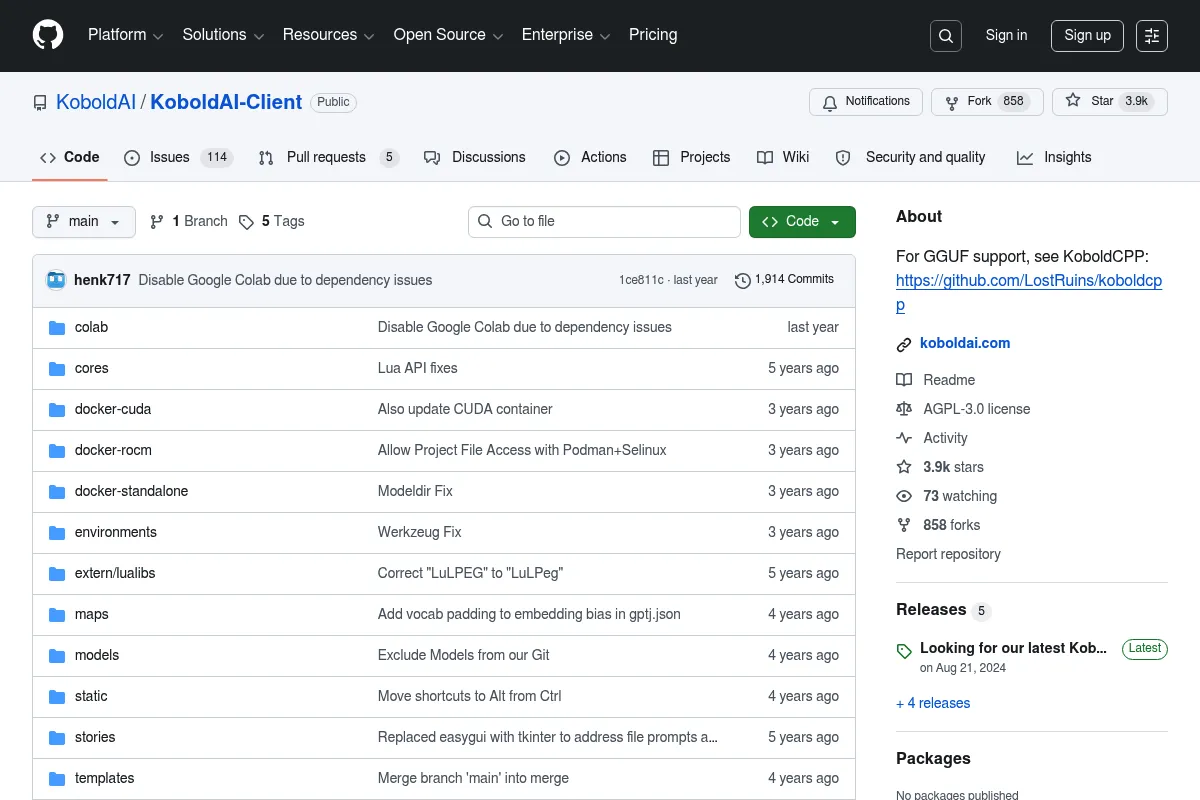
Yes, it is a well-known open-source project. However, you should only download it from the official GitHub repositories (KoboldAI or LostRuins for KoboldCPP) to ensure you aren't getting a compromised version.
Why trust this page?
This evaluation combines product positioning, pricing analysis, traffic and market signals, and public user sentiment into a single decision-support page. Content is generated editorially — not copied from the vendor's website.
Funding & Company
Founded
2021
Stage
Bootstrapped
Total Raised
Bootstrapped
Latest Round
—
KoboldAI is a community-driven, open-source project and has not received any external venture funding. Its stability and longevity are dependent on the engagement and contributions of its volunteer developers and user community, rather than on financial investment.
Market Signals & Traffic
Estimated visits, global rank, geography, traffic sources, monthly visit trends, and organic search keywords (Similarweb)—on a dedicated page built for depth and search.
- Estimated visits
- 4,856
- Global rank
- #3,954,868
- Snapshot
- Apr 2026
- Traffic trend
- Surging
Estimated monthly visits
Alternatives to KoboldAI
View all alternativesGitHub Copilot
Developer Tools, AI Assistant

AI-powered coding assistant that suggests and generates code.
LM Studio
Developer Tools, Privacy & Compliance, AI Assistant

Run large language models locally on your own computer
Backyard AI
AI Assistant, Gaming, Privacy & Compliance

Local platform for private and uncensored character-based chat.
Similar Tools
Msty
AI Assistant, Productivity, Developer Tools

Unified interface for local and cloud-based language models
OpenRouter
Developer Tools

Unified API gateway for accessing and comparing large language models.
Ollama
Developer Tools, Privacy & Compliance

Run large language models locally on your machine.
01.AI
Developer Tools, Research, AI Assistant

Large language models and developer platform for multimodal application building.
Decart
Gaming, Video Creation

Real-time generative world models for interactive video game environments
Comet
Developer Tools, Research, Automation & Agents

MLOps platform for experiment tracking and model evaluation