

Kyutai
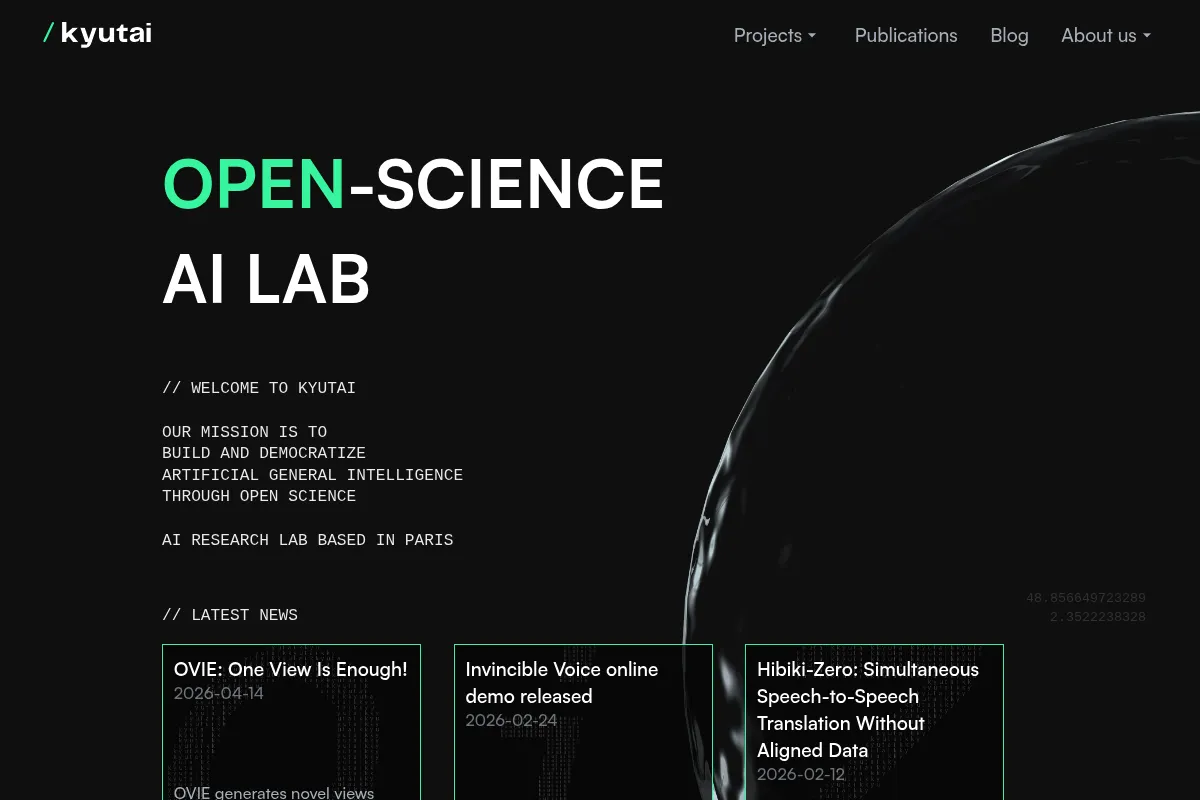
Kyutai is an open-science research lab providing the weights and architecture for low-latency, speech-to-speech AI, making it a primary choice for developers building sovereign voice applications.
Excellent for developers needing local, low-latency voice-to-voice models; not a turnkey solution for non-technical business users.
Analysis based on product data, pricing structure, traffic signals, and public user sentiment.
Who Should Use Kyutai?
Typical users
AI researchers, machine learning engineers, and product teams building custom voice assistants or real-time translation tools.
Maturity fit
advanced
Choose this if…
- You need sub-200ms latency for voice interactions
- Your priority is running models on private infrastructure for data sovereignty
- You want to fine-tune a speech-to-speech model on proprietary data
- You want to avoid the per-minute costs of proprietary voice APIs
Skip this if…
- You need a plug-and-play customer service bot with a web dashboard
- You do not have access to high-end NVIDIA GPU infrastructure
- Your workflow requires a wide range of supported languages beyond English and French
About Kyutai
Kyutai is a Paris-based non-profit AI research laboratory founded by Xavier Niel, Rodolphe Saadé, and Eric Schmidt. It operates on an open-science mandate, releasing model weights and research papers to democratize access to multimodal AI technology.
Official profiles
What it actually does
Kyutai develops and releases multimodal generative models, most notably Moshi. It provides the underlying code, weights, and audio codecs necessary for developers to run real-time, expressive voice-to-voice AI locally or in the cloud.
What makes it different
Unlike closed-source competitors that offer voice via API, Kyutai releases the full weights of its models. Its architecture uses a dual-stream approach that allows the model to listen and speak simultaneously, enabling natural interruptions and sub-200ms latency that rivals human conversation.
Key Features
Moshi Model
A 7B parameter multimodal engine that handles reasoning and speech generation in a single pass.
Mimi Audio Codec
Compresses audio into tokens at high ratios while maintaining the fidelity needed for low-latency processing.
Temporal Alignment
Synchronizes text and audio streams to ensure the model understands timing and rhythm in conversation.
Dual-Stream Inference
Processes user input and model output on parallel tracks to support natural interruptions.
Helium LLM Backbone
A custom-trained language model optimized specifically for multimodal tasks rather than just text.
Open Weights
Allows for full inspection, hosting, and modification without reliance on a third-party vendor's uptime.
PyTorch Integration
Built on standard frameworks to simplify deployment within existing AI engineering stacks.
Pricing
Open Source
- Access to Moshi model weights
- Mimi audio codec code
- Inference scripts
- Technical research papers
- Community-based support
Pricing checked 5 months ago
Pricing guidance
- When you need managed hosting (requires third-party providers)
- When you require custom fine-tuning services from AI consultancies
- When you hit the limits of your internal GPU clusters
- Compute costs for inference are significant
- No guaranteed uptime or SLA
- Requires manual setup and maintenance
Kyutai is a non-profit research lab; its value lies in providing free, high-quality intellectual property rather than a paid service.
Pros & Cons
Strengths
-
True low-latency performance
By eliminating the need for separate speech-to-text and text-to-speech steps, it achieves conversational speeds that feel natural to users.
-
Data sovereignty and privacy
Since the model runs locally, sensitive audio data never leaves the user's infrastructure, which is critical for healthcare or legal applications.
-
No usage-based API fees
Developers avoid the scaling costs associated with proprietary models, paying only for their own compute power.
-
Natural conversational flow
The ability to handle interruptions and overlapping speech makes it significantly more human-like than traditional turn-based voice bots.
Weaknesses
-
High hardware requirements
Running Moshi effectively requires significant VRAM (typically NVIDIA A100/H100 class GPUs), making it expensive to host at scale.
Affects: Small startups and individual developers
-
Research-grade documentation
The tools are released as research artifacts, meaning they lack the polished SDKs and customer support found in commercial products.
Affects: Product teams with limited ML engineering resources
-
Limited language support
Initial releases focus heavily on English and French, making it less viable for global applications requiring broad linguistic coverage.
Affects: International enterprises
Real User Sentiment
The developer community is highly enthusiastic about the latency and open-weight nature of Moshi, though some note the difficulty of local deployment.
Users tend to like
- Exceptional speed and responsiveness
- The ability to run a high-quality voice model locally
- Natural-sounding vocal inflections
- The transparency of the research
Users commonly complain about
- High VRAM usage for local inference
- Occasional 'mumbling' or audio artifacts
- Complexity of the initial setup process
Recurring tradeoffs
- Users trade ease of use (API) for control and privacy (local weights).
Happiest users
ML engineers who want to tinker with the internals of voice models and organizations with strict data privacy requirements.
Often frustrated
Product managers looking for a quick API integration to add a voice interface to a website in an afternoon.
Use Cases
Local Voice Assistants
Building smart home or office assistants that process audio without cloud latency.
Roleplay and Gaming
Creating NPCs that can hold fluid, real-time conversations with players.
Accessibility Tools
Developing low-latency communication aids for individuals with speech or visual impairments.
Sovereign AI Development
Government or enterprise projects that cannot use US-based cloud APIs for sensitive data.
Research and Fine-tuning
Using the weights as a base to train models on specific dialects or industry-specific jargon.
Frequently Asked Questions
Is Kyutai Moshi free to use?
Yes, Kyutai has released the weights for Moshi for free under an open-source license. However, you are responsible for the hardware and compute costs required to run the model, which typically requires high-end NVIDIA GPUs.
How does Moshi compare to OpenAI's GPT-4o voice mode?
Moshi offers similar low-latency, expressive voice-to-voice interaction. The primary difference is that Moshi is open-source and can be hosted locally, whereas GPT-4o is a closed-source API. Moshi currently has more limited language support compared to OpenAI.
What hardware do I need to run Kyutai models?
To run Moshi with acceptable performance, you generally need an NVIDIA GPU with at least 24GB of VRAM (like an RTX 3090/4090) for basic inference, though A100 or H100 GPUs are recommended for production-level stability.
Does Kyutai offer an API?
No, Kyutai is a research lab and does not currently provide a managed API service. You must download the weights and host the model yourself or use a third-party provider like Hugging Face or Replicate.
Can Moshi understand languages other than English?
Moshi was primarily trained on English and French. While it may show some capability in other languages, its performance and reasoning are most reliable in those two languages at this time.
What is the Mimi codec?
Mimi is a custom audio codec developed by Kyutai that compresses audio into a very small number of tokens. This is the 'secret sauce' that allows the model to process and generate high-quality audio with extremely low latency.
Why trust this page?
This evaluation combines product positioning, pricing analysis, traffic and market signals, and public user sentiment into a single decision-support page. Content is generated editorially — not copied from the vendor's website.
Funding & Company
Founded
2023
Stage
Seed
Total Raised
$324M
Latest Round
Grant (Nov 2023)
Notable Investors
Kyutai launched in November 2023 as a non-profit AI research lab with an initial commitment of nearly €300 million (approx. $324M USD) from its co-founders. This significant, single tranche of funding from high-profile billionaires provides a substantial runway for its open-science mission without the pressures of traditional venture capital.
Market Signals & Traffic
Estimated visits, global rank, geography, traffic sources, monthly visit trends, and organic search keywords (Similarweb)—on a dedicated page built for depth and search.
- Estimated visits
- 92,467
- Global rank
- #430,537
- Snapshot
- Apr 2026
- Traffic trend
- Falling
Estimated monthly visits
Alternatives to Kyutai
View all alternativesHugging Face
Developer Tools, Productivity

Open-source platform for machine learning models, datasets, and tools.
Veo
Video Creation, Content Creation, AI Assistant

AI model generating high-quality videos from text or image prompts.
Stable Diffusion
Content Creation, Developer Tools, AI Assistant

Open-source generative AI models for image, video, audio, and code.
Similar Tools
Surge AI
Research, Developer Tools

Data labeling and RLHF platform for training large language models.
Runway ML
Video Creation, Content Creation

AI-powered creative suite for generating and editing video, images, and audio.
HappyRobot
Automation & Agents, Communication, Workflow

Automated communication platform for logistics and supply chain operations
Zilliz
Developer Tools, Search

High-performance vector database for similarity search and RAG applications.
Shotstack
Video Creation, Developer Tools, Automation

Cloud-based video editing API for automated content creation at scale.
Cognition
Developer Tools, Automation & Agents

Autonomous software engineer that plans and executes complex coding tasks.