

Surge AI
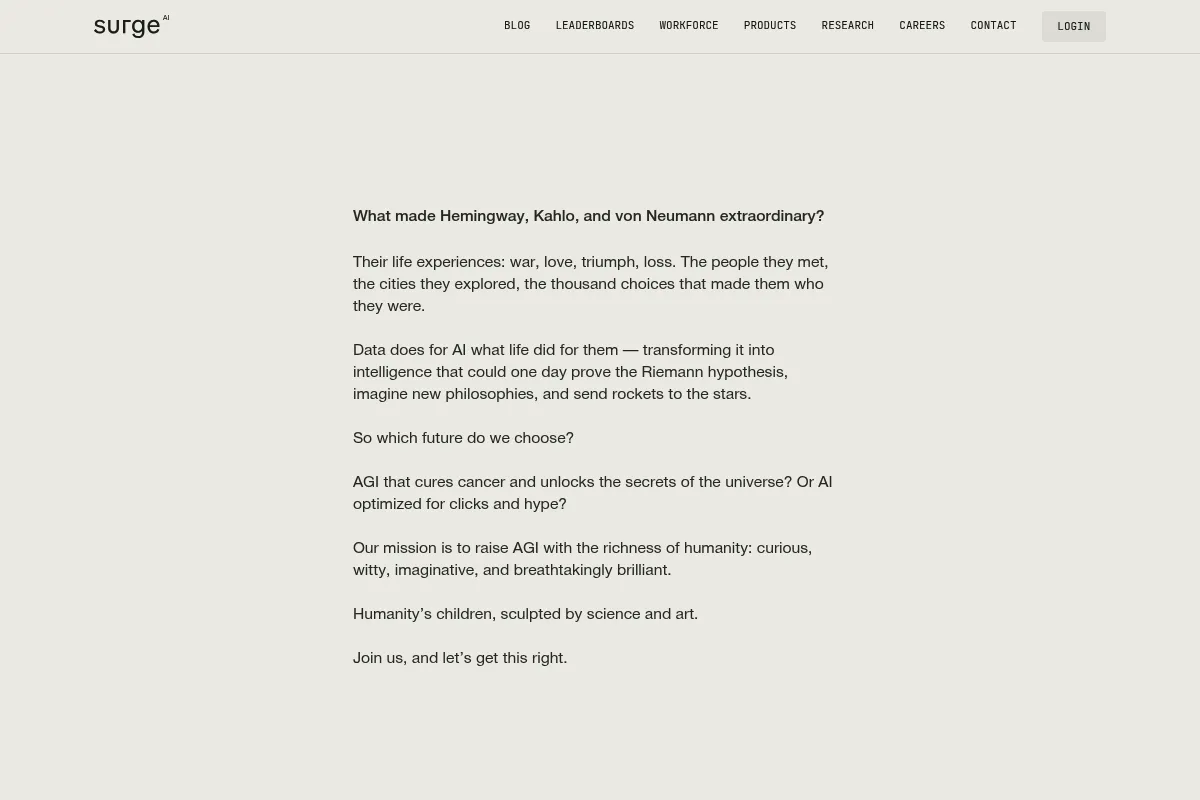
A specialized data labeling platform built specifically for the LLM era, prioritizing high-quality human reasoning and linguistic nuance over the high-volume, low-cost crowd work typical of legacy providers.
Excellent for teams requiring high-fidelity RLHF and red teaming, weaker for budget-sensitive projects needing simple computer vision labeling.
Analysis based on product data, pricing structure, traffic signals, and public user sentiment.
Who Should Use Surge AI?
Typical users
ML engineers, LLM researchers, and product teams at scaling AI startups or enterprise labs building proprietary models.
Maturity fit
scaling to advanced
Choose this if…
- Your model requires complex reasoning or creative writing data that generic crowd workers can't provide
- You need specialized labelers like coders, lawyers, or medical professionals
- Your priority is data quality and safety alignment over the absolute lowest price per label
Skip this if…
- You are a solo developer with a three-figure budget looking for a self-service tool
- Your primary need is basic image bounding boxes or simple data entry
- You require a fully transparent, pay-as-you-go pricing model without a sales cycle
About Surge AI
Surge AI is a human-in-the-loop data labeling platform designed to solve the 'garbage in, garbage out' problem for large language models. It provides the high-quality human feedback necessary for RLHF, instruction tuning, and model evaluation by employing a vetted workforce capable of handling complex linguistic tasks.
Official profiles
What it actually does
The platform connects AI teams with a managed workforce to generate, label, and audit datasets. It facilitates Reinforcement Learning from Human Feedback (RLHF) by having humans rank model outputs, perform red teaming to find safety flaws, and write high-quality demonstrations for instruction following.
What makes it different
Unlike legacy platforms like Amazon Mechanical Turk or early Scale AI which focused on massive scale for simple tasks, Surge AI focuses on 'expert' labeling. They emphasize a workforce with high English proficiency and specialized skills, positioning themselves as a premium boutique alternative for the nuance required by LLMs.
Key Features
Specialized Workforce
Access to labelers with backgrounds in coding, law, and creative writing for domain-specific models.
RLHF Workflows
Built-in templates for ranking model responses to align outputs with human preferences.
Red Teaming
Structured environments for testers to attempt to bypass model safeguards.
Quality Control Engine
Algorithmic and manual checks to ensure labeler consistency and accuracy.
Custom Labeling UI
Interfaces optimized for long-form text analysis rather than just image clicking.
API-First Infrastructure
Programmatic submission of tasks and retrieval of labeled data for CI/CD training loops.
Pricing
Custom / Enterprise
- Access to specialized workforce
- Full RLHF and Red Teaming suites
- Dedicated project management
- API access
- Custom quality control workflows
Pricing checked 5 months ago
Pricing guidance
- Moving from open-source datasets to proprietary fine-tuning
- Requiring safety alignment (Red Teaming) before a public release
- Scaling data volume beyond what an internal team can audit
- Minimum contract sizes often apply
- Turnaround times vary based on worker availability for niche domains
Premium positioning justified by the higher skill level of the workforce and specialized LLM tooling.
Pros & Cons
Strengths
-
Superior data quality for NLP
The workforce is better at understanding nuance, sarcasm, and complex instructions compared to cheaper, unvetted crowd platforms.
-
LLM-native tooling
The platform is built for text-heavy tasks like ranking and reasoning, saving teams from hacking together tools designed for computer vision.
-
Reduced management overhead
As a managed service, they handle the sourcing and vetting of workers, which is a significant time-saver for small ML teams.
Weaknesses
-
Opaque, premium pricing
There is no public pricing; everything is custom and generally more expensive than competitors like Labelbox or Toloka.
Affects: Bootstrapped startups and academic researchers
-
Sales-led onboarding
You cannot simply sign up and start labeling; you must go through a sales and discovery process which slows down initial experimentation.
Affects: Developers wanting immediate access
-
Narrower focus on text
While they handle other data types, their core strength is NLP; teams with heavy 3D point cloud or complex video needs may find better tools elsewhere.
Affects: Autonomous vehicle and robotics teams
Real User Sentiment
Users generally view Surge AI as the gold standard for high-quality English language datasets, though they acknowledge the high cost of entry.
Users tend to like
- High caliber of labelers
- Responsiveness of the account teams
- Nuanced understanding of complex safety guidelines
- Clean, intuitive UI for labelers
Users commonly complain about
- High cost per label
- Lack of self-service options
- Slow sales cycle for smaller projects
Recurring tradeoffs
- You pay significantly more than Mechanical Turk, but you spend significantly less time cleaning the data yourself.
Happiest users
ML researchers at well-funded labs who need to align models for safety and reasoning.
Often frustrated
Early-stage founders trying to build a 'wrapper' app on a shoestring budget.
Use Cases
Instruction Tuning
Generating high-quality prompt-response pairs to teach a model how to follow commands.
RLHF for Chatbots
Ranking multiple model outputs to train a reward model for better conversational flow.
Safety Red Teaming
Hiring specialized 'adversaries' to find ways to make a model generate toxic or restricted content.
Coding Assistant Training
Using professional developers to label and verify code snippets for accuracy.
Search Relevance
Auditing search engine results to improve ranking algorithms with human-judged relevance.
Frequently Asked Questions
How much does Surge AI cost?
Surge AI does not publish a price list. Pricing is custom and based on the complexity of the task, the expertise required from the workforce, and the volume of data. Expect to pay a premium compared to unvetted crowd-working platforms.
How does Surge AI compare to Scale AI?
Scale AI is a massive incumbent with a broader focus, including heavy investment in computer vision for autonomous vehicles. Surge AI is more specialized in NLP and LLMs, often preferred by teams who find Scale's text labeling quality inconsistent or their platform too complex.
Is there a free trial or self-service tier?
No. Surge AI is an enterprise-grade managed service. You must contact their sales team to discuss your project requirements before gaining access to the platform.
What kind of workers does Surge AI use?
They claim to use a vetted workforce primarily based in the US, UK, and Canada, often with specific degrees or professional backgrounds in fields like computer science, law, or linguistics.
Does Surge AI support languages other than English?
Yes, they offer multilingual labeling and content moderation services, though their primary reputation is built on high-quality English language tasks.
Can I integrate Surge AI into my ML pipeline?
Yes, Surge AI provides a REST API that allows you to programmatically create tasks, upload data, and retrieve completed labels, making it suitable for automated training workflows.
Why trust this page?
This evaluation combines product positioning, pricing analysis, traffic and market signals, and public user sentiment into a single decision-support page. Content is generated editorially — not copied from the vendor's website.
Company
Founded
2020
Stage
Late stage
HQ
San Francisco, California
Surge AI has achieved a rare feat in the AI industry by bootstrapping to over $1 billion in annual revenue without any external funding. As of mid-2025, the company is reportedly in talks for its first-ever funding round, seeking up to $1 billion at a valuation potentially exceeding $15 billion. This move signals a strategic shift to accelerate growth and capture market share, rather than a need for operational capital.
Market Signals & Traffic
Estimated visits, global rank, geography, traffic sources, monthly visit trends, and organic search keywords (Similarweb)—on a dedicated page built for depth and search.
- Estimated visits
- 225,031
- Global rank
- #130,895
- Snapshot
- Apr 2026
- Traffic trend
- Cooling
Estimated monthly visits
Alternatives to Surge AI
View all alternativesScale
Developer Tools, Research, Automation

Data infrastructure for training, labeling, and evaluating machine learning models.
Encord
Developer Tools, Workflow, Research

Data development platform for labeling, managing, and evaluating multimodal datasets.
Similar Tools
Kyutai
Research, Developer Tools

Open-science research lab developing multimodal generative models.
Weaviate
Developer Tools, Search

Open-source vector database for building scalable semantic search applications.
Julep
Developer Tools, Automation & Agents, Workflow

Development platform for building stateful agents with long-term memory.
Semantic Scholar
Productivity, Data Extraction, Developer Tools

AI-powered research tool for scientific literature discovery and analysis.
Listen Labs
Research, Productivity, Communication

Extract actionable insights from user interviews and feedback recordings.
CAMEL-AI
Developer Tools, Automation & Agents, Research

Framework for building and orchestrating autonomous multi-agent systems.