

NoimosAI
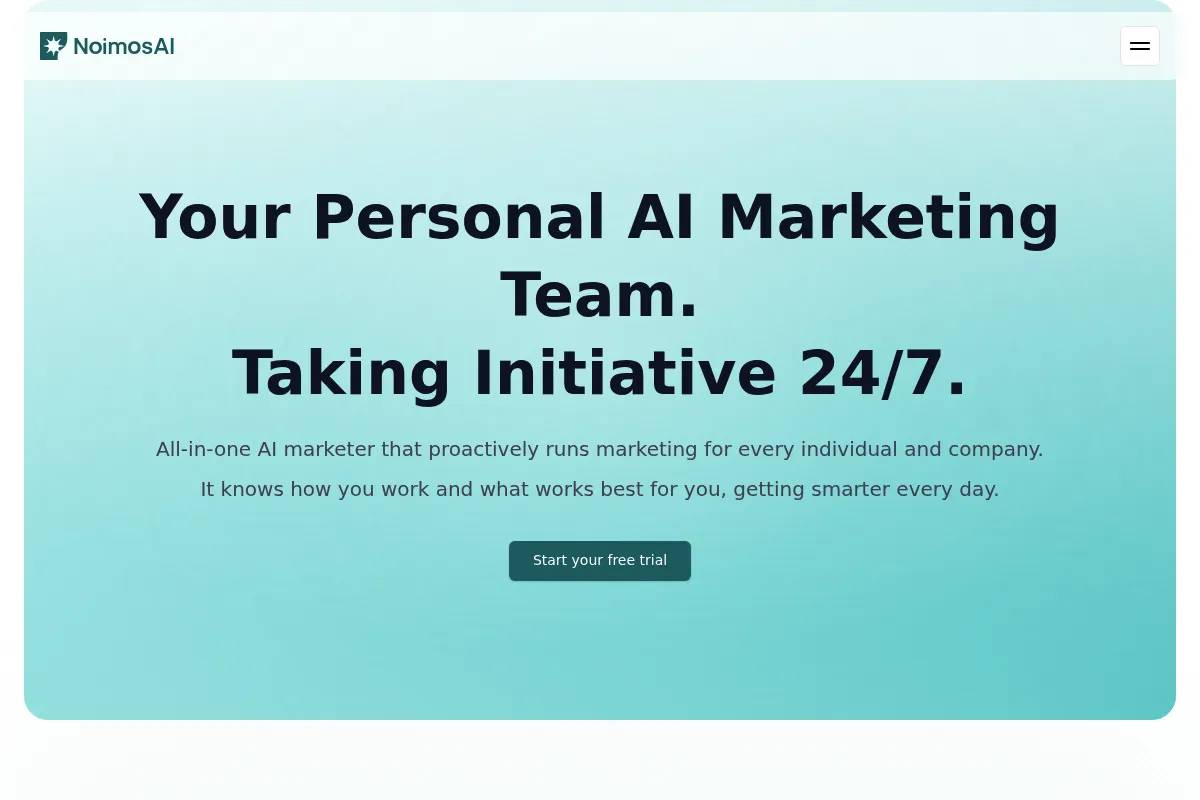
Noimos AI is a workspace for building and deploying custom AI agents that interact with internal company data, serving as a middle layer between LLMs and business workflows.
Excellent for teams needing a centralized hub for custom AI agents, but weaker for those requiring deep, native integrations with legacy enterprise software.
Analysis based on product data, pricing structure, traffic signals, and public user sentiment.
Who Should Use NoimosAI?
Typical users
Operations managers, small to mid-sized product teams, and agency owners who need to automate repetitive knowledge-based tasks.
Maturity fit
beginner to scaling
Choose this if…
- You want to build custom AI agents without writing code
- Your priority is centralizing internal knowledge for AI retrieval
- You need to switch between different LLMs like GPT-4 and Claude in one interface
Skip this if…
- You require complex, multi-step logic that exceeds basic trigger-action workflows
- Your workflow depends on deep integrations with niche industry software not supported by their API
- You prefer a specialized tool for a single task rather than a general-purpose agent builder
About NoimosAI
Noimos AI is an 'AI Operating System' designed to help businesses create and manage autonomous agents. It bridges the gap between raw LLMs and practical business applications by providing a structured environment for data ingestion and agent deployment.
Official profiles
What it actually does
The platform allows users to upload documents to a knowledge base, configure AI agents with specific personas, and deploy them to handle tasks like customer support, content generation, or data analysis. It provides a unified interface to manage these agents and their underlying data sources.
What makes it different
Unlike simple chat interfaces, Noimos focuses on the 'agent' architecture, allowing for persistent memory and specific tool-calling capabilities. It differentiates itself by offering a multi-model approach, letting users choose the specific brain for each task within a single subscription.
Key Features
Agent Personas
Define specific roles and instructions for different business functions
Knowledge Base Sync
Upload PDFs, docs, or links to give agents context on your business
Multi-Model Toggle
Switch between models like GPT-4o or Claude 3.5 Sonnet based on the task
Workflow Automation
Connect agents to specific triggers for automated responses
Team Workspaces
Share agents and knowledge bases across departments with permission controls
Custom Tools
Allow agents to perform actions like searching the web or calling APIs
White-labeling
Options to brand the interface for client-facing use cases
Pricing
Free
- Limited messages per month
- Basic model access
- 1 Knowledge base
- Standard support
Pro
- Increased message limits
- Access to GPT-4 and Claude 3
- Multiple knowledge bases
- Priority support
Business
- High message volume
- Team collaboration tools
- Advanced API access
- Custom branding options
Pricing checked 4 months ago
Pricing guidance
- When you need to use GPT-4 or Claude 3 models
- When you need to share agents with team members
- When your monthly message volume exceeds the trial limits
- File size limits for knowledge base uploads
- Rate limits on API calls for lower tiers
- Seat-based pricing for larger teams
Competitive pricing that aligns with standard AI SaaS models, making it accessible for SMBs.
Pros & Cons
Strengths
-
Model flexibility
Users aren't locked into one provider; you can use the best model for the specific cost or performance needs of a task.
-
Low-barrier knowledge ingestion
The process of turning static documents into a searchable AI brain is straightforward, reducing the technical overhead for non-developers.
-
Centralized agent management
Provides a single dashboard to monitor and update all AI assistants, which is more efficient than managing multiple API keys and custom scripts.
Weaknesses
-
Limited native integrations
While it has API support, it lacks the deep, pre-built library of native integrations found in more mature automation platforms.
Affects: Teams looking for 'plug-and-play' connectivity with CRM or ERP systems.
-
Workflow complexity ceiling
The internal automation builder is less sophisticated than dedicated tools like Make or Zapier for complex branching logic.
Affects: Advanced users building intricate, multi-stage business processes.
-
Emerging platform risk
As a newer player, the documentation and community support are still developing compared to established AI platforms.
Affects: Enterprise users requiring extensive support and long-term stability guarantees.
Real User Sentiment
Generally positive among early adopters who appreciate the clean UI and the ease of setting up RAG (Retrieval-Augmented Generation) systems.
Users tend to like
- Clean and intuitive user interface
- Ease of uploading and indexing documents
- Ability to switch between different LLMs easily
Users commonly complain about
- Occasional bugs in document parsing
- Desire for more direct integrations with third-party apps
- Limited advanced configuration for agent 'temperature' and parameters
Recurring tradeoffs
- Ease of use comes at the cost of deep technical customization found in tools like LangChain.
Happiest users
Small business owners who want to 'AI-ify' their internal docs without hiring a developer.
Often frustrated
Developers who find the platform too restrictive for complex AI engineering tasks.
Use Cases
Customer Support
Train an agent on your help docs to answer common queries
Content Strategy
Create an agent that knows your brand voice and past successful posts
Onboarding
Build a bot for new hires to query internal company handbooks
Sales Enablement
Give sales teams an agent that can quickly reference product specs and pricing
Research Assistant
Upload industry reports and have an agent summarize key findings
Frequently Asked Questions
Does Noimos AI have a free plan?
Yes, Noimos AI offers a free tier that allows users to test the platform with limited messages and basic models. To access advanced models like GPT-4 or to increase usage limits, you will need to upgrade to a paid plan starting at approximately $20/month.
How does Noimos AI compare to Custom GPTs from OpenAI?
Noimos AI offers more flexibility than OpenAI's Custom GPTs by allowing you to use multiple models (like Claude) and providing better tools for managing large knowledge bases and team permissions. It acts more as a standalone business platform rather than just a feature within ChatGPT.
Can I integrate Noimos AI with my existing tools?
Noimos AI provides API access for custom integrations, but it currently lacks the extensive library of native 'one-click' integrations found in platforms like Zapier. You may need to use webhooks or custom code to connect it to specific business software.
Is my data safe with Noimos AI?
Noimos AI states they use industry-standard encryption and do not use your private data to train their base models. However, users should always review their specific privacy policy regarding data storage and third-party LLM providers.
What file types can I upload to the Knowledge Base?
The platform supports common document formats including PDF, DOCX, and TXT, as well as the ability to scrape content from URLs to build your agent's knowledge.
Why trust this page?
This evaluation combines product positioning, pricing analysis, traffic and market signals, and public user sentiment into a single decision-support page. Content is generated editorially — not copied from the vendor's website.
Funding & Company
Founded
—
Stage
Bootstrapped
Total Raised
Bootstrapped
Latest Round
—
NoimosAI appears to be a bootstrapped company, as there is no publicly available information on any venture capital funding, investors, or funding rounds. The company's stability and longevity are therefore dependent on its own revenue generation and operational efficiency.
Market Signals & Traffic
Estimated visits, global rank, geography, traffic sources, monthly visit trends, and organic search keywords (Similarweb)—on a dedicated page built for depth and search.
- Estimated visits
- 0
- Global rank
- —
- Snapshot
- May 2026
- Traffic trend
- —
Alternatives to NoimosAI
View all alternativesJasper
Content Creation, AI Assistant

AI-powered content creation platform for marketing and business teams.
ActiveCampaign
Email Marketing, Marketing Automation, Automation

Marketing automation and CRM platform for personalized customer experiences.
Gumloop
Automation & Agents, Productivity

No-code platform for building AI agents and automating complex workflows.
Similar Tools
Pika Labs
Content Creation, Video Creation

AI-powered platform to generate and edit videos from text and images.
Letta
Developer Tools, Automation & Agents

Build stateful agents with persistent long-term memory and context.
Pictory
Content Creation, Video Creation

AI-powered platform to create engaging videos from text and existing content.
Vybe
Developer Tools, Automation, Productivity

Build secure internal web applications and dashboards using natural language.
Arahi AI
Privacy & Compliance, Workflow
Governance and risk management platform for enterprise deployments.
Relevance AI
Automation & Agents, Developer Tools, Productivity

Build and deploy autonomous agents to automate complex business workflows.