
A specialized platform for building a digital twin that mimics your specific knowledge and communication style—best for high-volume communicators, but requires significant data curation to be effective.
Excellent for thought leaders and professionals scaling their availability, weaker for those seeking a general-purpose productivity assistant without the setup overhead.
Analysis based on product data, pricing structure, traffic signals, and public user sentiment.
Who Should Use Personal AI?
Typical users
Founders, subject matter experts, and creators who need to scale their presence or recall vast amounts of personal documentation.
Maturity fit
scaling
Choose this if…
- You want an AI that sounds like you rather than a generic chatbot
- You have a massive backlog of personal writing, emails, or transcripts to train on
- Data privacy and ownership are non-negotiable for your personal knowledge
Skip this if…
- You just want a better version of ChatGPT for general tasks
- You lack a substantial volume of personal data to feed the model
- You aren't willing to spend time reviewing and correcting AI responses
About Personal AI
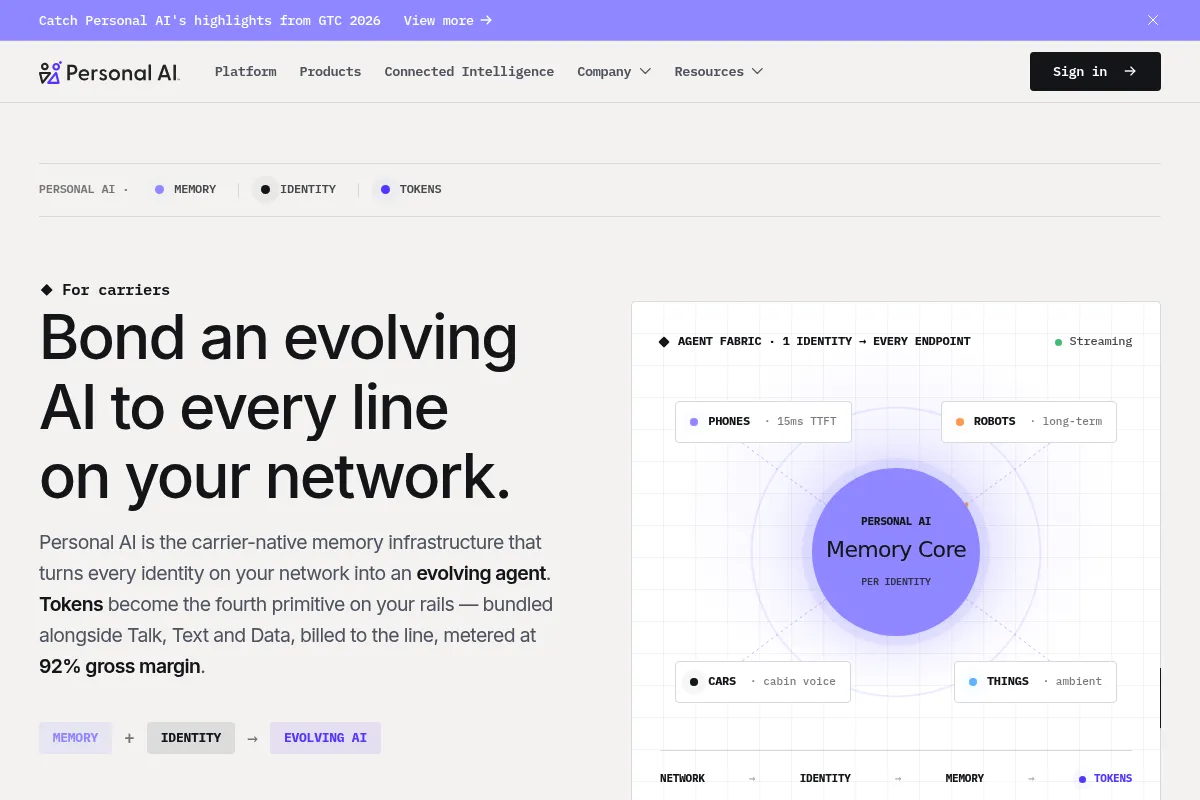
Personal AI is a platform for creating Personal Language Models (PLMs). It focuses on individual data sovereignty, allowing users to train an AI on their own memories, documents, and communication history to act as a digital extension of themselves.
Official profiles
What it actually does
The tool ingests data from Slack, Gmail, and documents to build a searchable, conversational 'twin.' It can draft message replies in your specific voice and serve as a private knowledge base that grows as you interact with it.
What makes it different
Unlike general LLMs trained on the internet, Personal AI uses a proprietary architecture called Oasis designed for small, individual datasets. It includes a 'Personal Score' that quantifies how much of a response is grounded in your specific data versus general knowledge.
Ratings across the web
Ratings aggregated from independent review platforms.
Key Features
Memory Stack
The central repository where all ingested data is organized and weighted for the model.
Personal Score
A transparency metric showing the percentage of a response derived from your personal data.
Autopilot & Copilot
Modes that allow the AI to either draft responses for review or send them automatically.
Training Loupe
A tool for reviewing and correcting AI outputs to improve accuracy over time.
Integrations
Direct connections to Slack, Discord, and SMS to capture and send messages.
Oasis Model
A small-scale model architecture optimized for individual use and data privacy.
Pricing
Basic
- Basic memory stack
- Limited personal messages
- Standard model access
Premium
- Unlimited personal messages
- 100 public messages
- Zapier and API access
- Priority support
Pro
- Unlimited personal messages
- Higher public message limits
- Advanced model controls
- Early access to new features
Pricing checked 4 months ago
Pricing guidance
- When you need to integrate with Slack or Zapier
- When you want to publish a public 'Twin' for others to chat with
- When you exceed the basic memory storage limits
- Public messages are capped even on paid tiers
- API access is gated behind the $40/month tier
Premium positioning that targets professional users and creators rather than casual consumers.
Pros & Cons
Strengths
-
True Data Ownership
Your data is used only to train your specific model and is not fed into a global training pool, which is critical for professionals handling sensitive information.
-
Voice Consistency
By training on your actual messages and documents, the AI captures your specific phrasing and tone better than generic prompt engineering.
-
High-Fidelity Retrieval
The 'Personal Score' helps users trust the output by showing exactly when the AI is guessing versus when it is citing your actual history.
Weaknesses
-
High Setup Friction
The AI is only as good as the data you provide; users must invest significant time in 'stacking' memories before the tool becomes useful.
Affects: New users looking for immediate utility
-
Premium Pricing
At $40/month for the entry-level paid tier, it is significantly more expensive than standard AI assistants.
Affects: Individual users on a budget
-
Mobile App Limitations
User feedback suggests the mobile experience is less polished than the desktop version, with occasional sync and interface bugs.
Affects: On-the-go professionals
Real User Sentiment
Users are generally impressed by the privacy-first approach and the 'Personal Score' feature, though setup fatigue is a common complaint.
Users tend to like
- Data sovereignty and privacy guarantees
- The ability to 'chat' with your own past notes
- Slack and SMS integration for capturing thoughts
Users commonly complain about
- High monthly cost compared to ChatGPT
- Steep learning curve for training the model
- Occasional hallucinations when data is sparse
Recurring tradeoffs
- You trade immediate convenience for long-term accuracy and privacy.
Happiest users
Knowledge workers and researchers who have years of digital notes and want a way to query them conversationally.
Often frustrated
Casual users who expect the AI to be 'smart' out of the box without providing it with a significant training set.
Use Cases
Thought Leaders
Creating a public twin to answer common audience questions based on past content.
Researchers
Querying a massive personal library of PDFs and notes to find specific connections.
Founders
Drafting emails and Slack replies that match their specific communication style.
Students
Building a knowledge base throughout their education that remains private and searchable.
Developers
Using the API to build custom applications on top of their own personal knowledge base.
Frequently Asked Questions
How does Personal AI differ from ChatGPT?
ChatGPT is trained on the public internet to be a generalist. Personal AI is trained on your private data to be a specialist in 'you.' It uses a smaller, private model architecture (Oasis) that prioritizes your specific facts and tone over general web knowledge.
Is my data used to train other people's models?
No. Personal AI emphasizes data ownership. Your Personal Language Model is isolated, and your data is never used to train the models of other users or the company's base models.
What is the 'Personal Score'?
The Personal Score is a percentage shown with every AI response. It indicates how much of that specific answer was pulled directly from your 'Memory Stack' versus how much was filled in by general language patterns.
Does it have a free version?
Yes, there is a Basic plan that is free to use. However, it has significant limits on message volume and lacks the API/Zapier integrations found in the $40/month Premium plan.
Can I use it to automate my Slack or SMS?
Yes, through 'Autopilot' mode. You can set a Personal Score threshold; if the AI is confident enough that the answer is based on your data, it can respond automatically to incoming messages.
How much data do I need to make it useful?
While it starts learning from the first 'memory' you add, most users find it becomes truly effective after stacking several hundred messages or documents. It is a tool that improves linearly with the amount of data you provide.
Why trust this page?
This evaluation combines product positioning, pricing analysis, traffic and market signals, and public user sentiment into a single decision-support page. Content is generated editorially — not copied from the vendor's website.
Funding & Company
Founded
2020
Stage
Series a
Total Raised
$23.8M
Latest Round
Series A (Dec 2025)
Notable Investors
Personal AI has raised a total of $23.8 million over four funding rounds, including a recent $14.1 million Series A in late 2025. This consistent fundraising from a mix of venture capital and crowdfunding demonstrates investor confidence in their personal language model technology.
Market Signals & Traffic
Estimated visits, global rank, geography, traffic sources, monthly visit trends, and organic search keywords (Similarweb)—on a dedicated page built for depth and search.
- Estimated visits
- 59,298
- Global rank
- #584,499
- Snapshot
- Apr 2026
- Traffic trend
- Surging
Estimated monthly visits
Alternatives to Personal AI
View all alternativesMem AI
Productivity, AI Assistant

AI-powered note-taking and knowledge management app.
Notion AI
AI Assistant, Content Creation
AI assistant integrated into Notion for content creation and task automation.
Lindy
AI Assistant, Automation, Productivity
No-code AI agent builder for automating business workflows.
Similar Tools
Bluedot
AI Assistant, Communication, Productivity

Bot-free meeting recorder and note-taker for professional teams.
Amigo AI
AI Assistant, Communication, Productivity

WhatsApp assistant for instant answers, image generation, and voice transcription.
Circleback
AI Assistant, Communication, Productivity

Automated meeting notes, action items, and follow-up emails.
Ai Pin
AI Assistant, Communication, Productivity

Wearable screenless device for voice and gesture-based digital interaction.
Unsloth
Developer Tools, Research

Lightweight framework for faster and memory-efficient LLM fine-tuning.
Julep
Developer Tools, Automation & Agents, Workflow

Development platform for building stateful agents with long-term memory.