

Scenario
A specialized image generation platform for game developers that prioritizes style consistency through custom-trained models and fine-tuned control over generic prompt-to-image outputs.
Excellent for game studios needing consistent art styles across hundreds of assets, weaker for general-purpose artistic exploration compared to Midjourney.
Analysis based on product data, pricing structure, traffic signals, and public user sentiment.
Who Should Use Scenario?
Typical users
Small to mid-sized game studios, indie developers, and concept artists who need to maintain a specific visual DNA across characters, props, and environments.
Maturity fit
scaling
Choose this if…
- You have a specific art style and need to generate 100+ assets that look like they were drawn by the same artist
- Your workflow requires precise control over composition via depth maps or sketches
- You need to integrate asset generation directly into a game engine or custom pipeline via API
Skip this if…
- You only need one-off, high-fidelity marketing illustrations where style consistency across assets doesn't matter
- You lack a base set of 10-30 high-quality images to train a custom model
- You are looking for a free, unlimited tool for casual experimentation
About Scenario
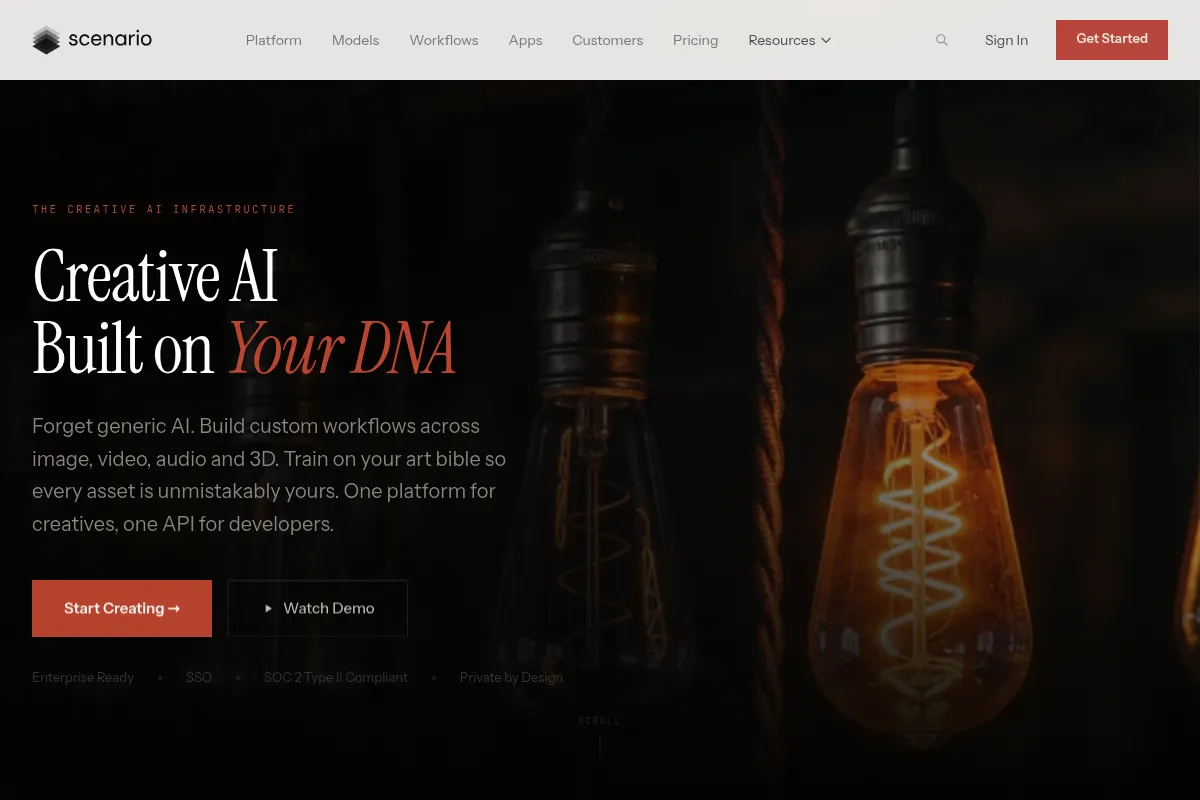
Scenario is an AI-native production platform designed specifically for the gaming industry. It allows teams to train proprietary generative models on their own IP to ensure every generated asset matches their game's unique aesthetic. It bridges the gap between chaotic text-to-image generation and professional asset production.
Official profiles
What it actually does
The platform enables users to upload a set of reference images to train 'Style Models' that generate new content in that exact style. It provides a suite of composition tools like ControlNet-style layers to guide the AI's output based on structure, depth, or outlines. Assets can be managed in a web dashboard or pulled directly into development environments via an API.
What makes it different
Unlike general models like Midjourney that prioritize 'beauty' over 'consistency,' Scenario focuses on 'Style-Alignment.' It allows for the creation of private, fine-tuned models that belong to the user, ensuring that a character generated today matches the environment generated next month. Its Canvas tool also offers more granular spatial control than most web-based AI generators.
Key Features
Style Training
Upload 10-30 images to create a model that replicates your specific art style.
Composition Control
Use sketches, depth maps, or pose references to dictate exactly where elements appear.
Canvas
An infinite workspace to edit, expand, and refine images with pixel-level control.
API & Workflow Automation
Programmatically generate assets for procedural games or internal tools.
Model Management
Organize and version-control different styles for different projects or biomes.
Prompt Templates
Save complex prompt structures to ensure team-wide output consistency.
Asset Upscaling
Increase resolution of generated sprites or textures for production use.
Pricing
Free
- Limited credits for testing
- 1 active training slot
- Access to public models
- Basic generation tools
Starter
- 1,000 credits per month
- 5 training slots
- Private models
- Standard API access
Pro
- 3,500 credits per month
- 15 training slots
- Priority generation
- Advanced API features
Premium
- 12,000 credits per month
- 50 training slots
- Dedicated support
- Highest rate limits
Pricing checked 4 months ago
Pricing guidance
- When you need to train more than 5 distinct styles
- When your monthly generation volume exceeds 1,000 images
- When you need higher API rate limits for production integration
- Credits do not always roll over (check current terms)
- Training a model consumes a significant chunk of credits separate from generation
- Upscaling and advanced features cost more credits per action
Mid-market pricing that scales with production volume, positioned as a professional B2B tool rather than a consumer toy.
Pros & Cons
Strengths
-
Superior style consistency
By training on your own data, you avoid the 'AI look' and maintain a cohesive visual identity across an entire game project.
-
Professional-grade control
The inclusion of depth, edge, and pose controls means artists spend less time 'prompt-rolling' and more time directing the output.
-
Developer-friendly infrastructure
The API and engine plugins make it viable for technical teams to build Scenario into their actual development stack, not just a side tool.
-
Private model ownership
Models trained on your assets are private by default, protecting your IP from being used by other users on the platform.
Weaknesses
-
Steep learning curve for fine-tuning
Getting a custom model to perform perfectly requires understanding data curation and parameter settings, which can frustrate non-technical users.
Affects: Solo artists and non-technical designers
-
Credit-based pricing can be expensive
High-volume generation or frequent model training sessions can burn through monthly credits quickly, leading to unpredictable costs.
Affects: High-output studios and experimental users
-
Requires high-quality training data
If your initial 10-20 images are inconsistent or low-resolution, the resulting model will produce poor results, making it hard to use for brand-new projects.
Affects: Early-stage concepting teams
Real User Sentiment
Users generally view Scenario as a 'serious' tool for production, praising its ability to stay 'on-brand' compared to the randomness of Stable Diffusion or Midjourney.
Users tend to like
- The 'Canvas' feature for manual editing
- Consistency of custom-trained models
- Ease of use compared to setting up local Stable Diffusion
- Responsive developer team
Users commonly complain about
- Credit costs for training can feel high
- Occasional UI bugs in the web interface
- The quality of public models varies significantly
Recurring tradeoffs
- You sacrifice the 'infinite variety' of Midjourney for the 'strict consistency' required for game dev.
Happiest users
Indie game developers who have a clear art style but lack the budget for a large team of concept artists.
Often frustrated
Casual users who expect high-quality results without putting in the effort to curate training data.
Use Cases
Character Design
Generating 50 variations of a hero character that all fit the same hand-drawn aesthetic.
Environment Texturing
Creating consistent tileable textures for different biomes in a 2D platformer.
Icon Sets
Producing hundreds of ability or item icons that share the same lighting and line weight.
Procedural Content
Using the API to generate unique, style-aligned loot items for players in real-time.
Concept Art
Rapidly iterating on world-building ideas using a model trained on the studio's previous games.
Frequently Asked Questions
Is there a free plan for Scenario?
Scenario offers a limited free tier that provides a small number of credits to test the platform's capabilities. However, for professional use, including private model training and higher generation limits, you will need to move to the Starter plan ($29/mo) or higher.
How does Scenario compare to Midjourney?
Midjourney is better for high-fidelity, one-off artistic images with a 'wow' factor. Scenario is superior for game production because it allows you to train custom models on your own art, ensuring that every asset you generate matches your specific project's style perfectly.
Do I own the images I generate on Scenario?
Yes, according to Scenario's terms, users own the outputs they generate. Furthermore, models you train on your own data are private to your account, ensuring your intellectual property isn't used by others.
What kind of images do I need to train a model?
For best results, you need 10 to 30 high-quality images that represent a consistent style. These should be clean, well-defined, and focused on the specific aesthetic or subject matter you want the AI to replicate.
Does Scenario integrate with Unity or Unreal Engine?
Yes, Scenario provides official plugins for both Unity and Unreal Engine, allowing developers to bring AI-generated assets directly into their game scenes and automate parts of the creative pipeline.
What are the limitations of the API?
The API is available on all paid plans, but rate limits and advanced features (like training via API) scale with your subscription tier. The Premium plan ($299/mo) is designed for teams with the highest throughput requirements.
Why trust this page?
This evaluation combines product positioning, pricing analysis, traffic and market signals, and public user sentiment into a single decision-support page. Content is generated editorially — not copied from the vendor's website.
Funding & Company
Founded
2021
Stage
Seed
Total Raised
$6M
Latest Round
Seed (Jan 2023)
Notable Investors
Scenario has raised a single Seed round of $6 million in early 2023, led by gaming-focused VC Play Ventures. This funding provides the company with a solid foundation to develop its core AI-powered asset generation platform for game developers.
Market Signals & Traffic
Estimated visits, global rank, geography, traffic sources, monthly visit trends, and organic search keywords (Similarweb)—on a dedicated page built for depth and search.
- Estimated visits
- 275,053
- Global rank
- #105,599
- Snapshot
- Apr 2026
- Traffic trend
- Steady
Estimated monthly visits
Alternatives to Scenario
View all alternativesLeonardo AI
Content Creation

AI platform for creating and editing visual assets like images and video.
Meshy AI
Content Creation, Developer Tools, Design

AI-powered platform for generating 3D models and textures from text and images.
Recraft
Content Creation, Design, Productivity

AI-powered design tool for creating consistent brand visuals, illustrations, and vector graphics.
Similar Tools
Evatype
Design, Content Creation

Generate custom, high-quality fonts and typography using text descriptions.
Phidata
Developer Tools, Automation & Agents, Workflow

Framework for building multi-modal agents with memory and tools.
Defog
Developer Tools, Search, Automation

Natural language interface for querying structured data and databases
Stable Diffusion
Content Creation, Developer Tools, AI Assistant

Open-source generative AI models for image, video, audio, and code.
Spider
Data Extraction, Developer Tools, Search

High-performance web crawler for data extraction and LLM training.
MuleSoft Anypoint Platform
Automation & Agents, Developer Tools

Connect applications, data, and devices through APIs and automated workflows.